

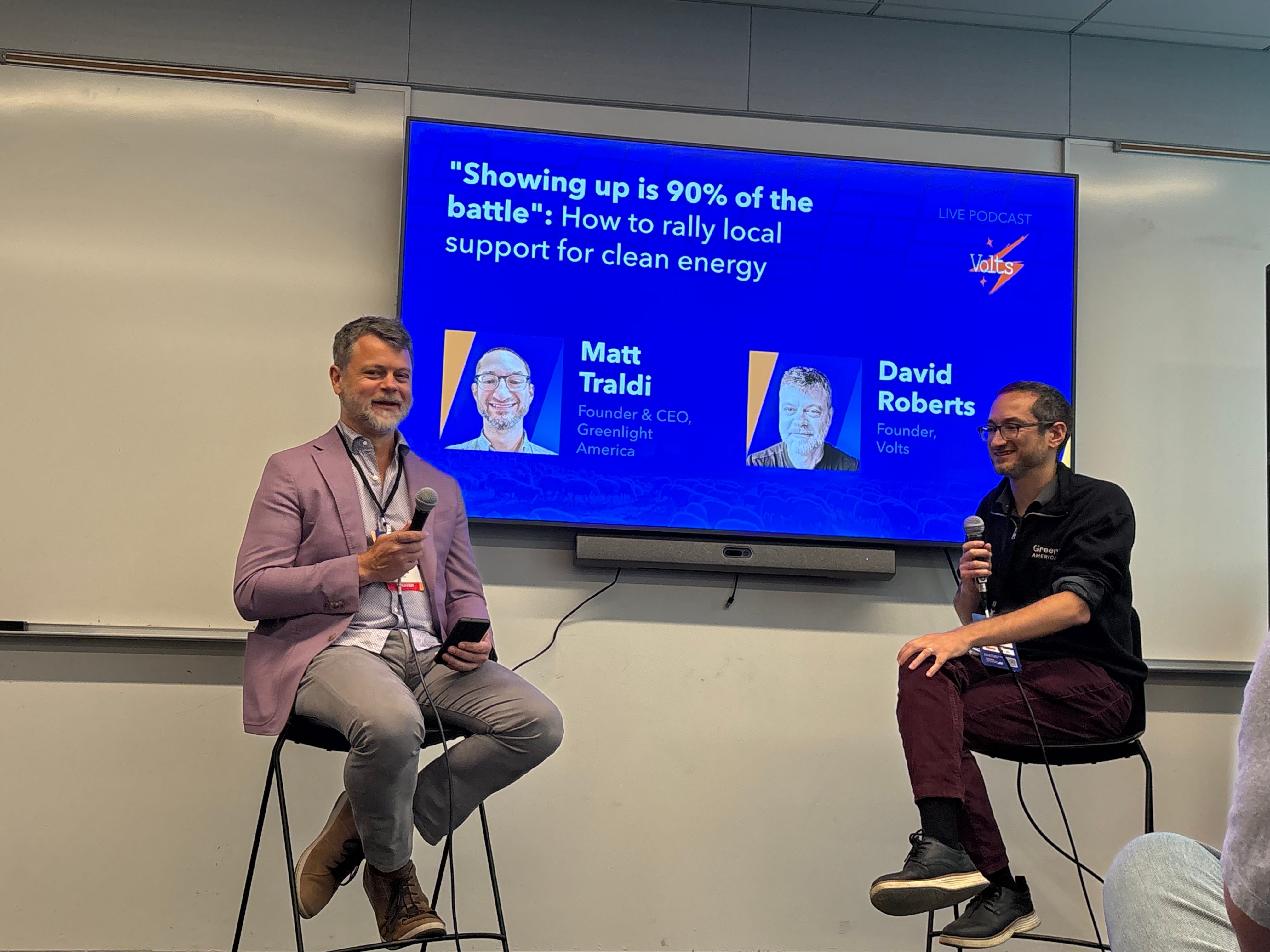
On this episode, recorded live at Climate Week NYC, I talk with Matt Traldi. He’s the founder and CEO of Greenlight America, which finds the local meetings where clean energy’s fate is being decided and recruits supporters to attend. Traldi argues that siting and permitting approvals turn on who shows up, and that local partners, conservative groups included, outperform outside advocates. We discuss how to measure impact, recent wins and losses, blue-state resistance, data center backlash, and Greenlight’s growth.

Back in January 2025, I introduced Volts listeners to a group called Greenlight America, a nonprofit with a refreshingly simple mission: find the local meetings where the fate of clean energy projects is being determined and make sure that supporters show up to those meetings.
CEO Matt Traldi had about 20 staff then. He said the group had helped advance 4.4 gigawatts of clean energy over the previous year. In 2025, that number reached 20.9 gigawatts. In total, since our last conversation, it’s something like 55.7 gigawatts.
Staff went from 20 to 37, on track for north of 100 by the end of this year. In early 2025 they were involved in four local wins in a quarter; last month, they scored eight in a single day. The model has proven incredibly fruitful.
Traldi shared all this good news when I caught up with him at a Canary Media event during NY Climate Week. We talked about how the group finds local partners, what kinds of messages supporters deliver at these meetings, how it measures success, and how he is navigating such precipitous growth. The conversation was fun and heartening; thanks to Canary for convening it. I hope you enjoy.
Chapters
00:00 – Introduction
02:09 – What Greenlight does and why Matt started it
04:43 – How Greenlight finds the decisions that matter
07:27 – Growth, and the tax credit deadline sprint
13:38 – Who shows up to local hearings
19:39 – Winning in conservative communities
22:35 – Bodies in the room, measuring impact, and win rates
27:46 – Losses, wins, and “there is no bag”
32:44 – Blue-state obstacles and organized opposition
36:31 – When data center backlash spills over onto clean energy
42:31 – Which projects Greenlight won’t back
45:38 – Lessons from housing and growing an organization
50:17 – Audience Q&A: disinformation and state permitting reform
54:39 – Audience Q&A: developers and elections
59:30 – Audience Q&A: funding local groups and designing community input
Resources
People & Organizations
David Roberts (Substack - Bluesky)
Volts (Apple Podcasts - Spotify - YouTube - Instagram - LinkedIn)
Matt Traldi (LinkedIn)
Greenlight America (Website)
Other Orgs Mentioned: Faith in Place, Land & Liberty Coalition, Indivisible
Company & Industry News
Books & Articles Discussed
Related Volts Episodes
Transcript
David Roberts: Matt, let’s start here. We talked about two years ago on the pod, but maybe some of the audience here, some people listening at home, aren’t familiar yet with the basic model. So maybe just like give the elevator pitch. What is Greenlight? What does it do?
Matt Traldi: Sounds good. First, thank you. Such a pleasure to be back here with you, David. And thank you everyone for being here, everyone listening. So I’m Matt Traldi. I’ll do a quick personal intro and then, you know, go to Greenlight. My background is in political organizing. I was in the labor movement for around a decade. Then in 2016, I was one of the co-founders of Indivisible, a national grassroots network that sprung up to respond to the first time Trump won the election.
And a few years ago, a couple things happened at once. First, my wife and I decided to become parents. I’d always cared about climate, but that pushed it up my personal priority list. And right around the same time while I was at Indivisible, I got to work a little on passing the Inflation Reduction Act and felt very excited and optimistic about this area of work. Still do, by the way. Still do. Spoiler alert.
And so I started learning as much as I could about what it would take to transition the economy to build a ton of clean energy. And what I kept hearing from folks who were doing this work in the industry and the advocacy space was that in the next decade, the overwhelming majority of emissions reduction would come from the power sector, mainly from building big clean energy projects and taking fossil fuels off the grid.
And I also kept hearing that the big obstacle to doing that was not the technology, which is well established, or the cost. This was the cheapest and fastest energy to build. It was local permitting. Small numbers of opponents would show up. They’d make a lot of noise. Supporters are out there in every community, but they would not usually show up, and clean energy would lose by forfeit as a result.
Now that piqued my interest. I am an organizer. That’s what I’ve spent my time doing. So I decided, along with a few other folks, to start Greenlight America. Greenlight is a very simple organization. We only do the one thing. We track the local moments that are gonna make or break clean energy deployment, approval of permits for projects, and passage of local ordinances for these technologies.
And then we find, engage, and support local supporters, local partner organizations to show up, to advocate effectively, and to win favorable decisions that advance clean energy in their communities. When we last spoke, we’d just come off a great year. We’d had a pilot program. We’d advanced in 2024, our first year, 4.4 gigawatts of clean power. During our pilot program, we’d won 60% of the campaigns that we’d taken on. I am pleased to share that we’ve now advanced 67 gigawatts of clean power across the US, so some things have changed... since that time. The pace has accelerated.
David Roberts: Yes, we’ll get into that. But can you give us a just a little bit more granularity, a little bit more detail about, A, how you find out about these things, because there’s so much going on, and there are so many of these meetings happening and so many places? How do you find out about them and how do you prioritize them? And then two, like, what are we talking about? Are these, like, city council meetings, zoning meetings? What are they, what meetings are these? What do they look like?
Matt Traldi: These are great and important questions, and one of the really fun things about doing this work, I should say, is that this is a burgeoning field, in part because this rapid acceleration of clean energy deployment is pretty new. So we’re at the stage collectively as a field, and I see a lot of friends in the room, other folks doing amazing work in this area. We’re at the stage of building the tools that are gonna be necessary to deploy a massive, massive amount of clean energy over the coming years and decades.
And so one of the key things in any organizing and campaigning is knowing when and where to show up. You can’t organize, you can’t win unless you know when and where the decision is happening. We tackle this through something we call our early warning system, and there are two main sources of information for it. It’s more complicated than this, I’m sure, but the two main ones, the first is we spend a lot of time talking to developers of projects. We have a whole team that’s dedicated to this. We’re not developer-funded, we’re philanthropically funded, but our work is always gonna be much more effective if we’re coordinating really closely with developers and sharing information and, you know, some of them have been willing to share information about their projects, when they’re gonna submit for permits, you know, all of those things.
And the second is a big data operation to find, you know, agendas that get posted to local government websites and media alerts. You know, in a lot of places there are notice requirements for these public hearings.
David Roberts: Yeah, there’s not really a central repository for any of this. This is all extremely local, and some of these are just these people that have, like, pamphlets that... You know what I mean? There’s not... Even the internet is not necessarily the best guide.
Matt Traldi: That’s right. There are more than 3,100 counties in the US, and county is generally, I’ll get to this in a moment, but county is the most common decision-making body. But the joke about doing local and state work is if you know how it works in one state, you know how it works in one state, so that is a little bit true in this area.
But so we have web scrapers that gather this information. We have algorithmic review to determine which of the alerts coming from these things, and we look at thousands and thousands of alerts, which of them are actually relevant for us, which are situations where local voices could tip the scales. And then we also have an amazing research team that takes a look and tries to figure out what’s going on, you know, what are the decisions that are happening, and is this something where local advocates, local supporters, local partner organizations could make all the difference?
David Roberts: Yeah, I wanna get a little bit into all that in a second, but I wanna just briefly ask you about your growth story, which you referred to a little bit. Last time we talked two years ago, you had a staff of about 50, you had about $5 million in funding, couple dozen projects that you had supported, and as you say, 4.4 gigs of energy that you had helped usher through. Where are you now? What’s happened in the last two years?
Matt Traldi: A lot has happened in the last two years. So we’re gathering next week as a staff team, actually. Our team is amazing. None of the work that we do would be possible without our team. We’ve been very, very lucky at the incredibly talented people that have come to work at Greenlight, and we have now almost 100. We’re getting close to 90 folks on the team around the country. Our team is fully remote, and our biggest department is our campaigns team, which are folks who are, you know, based in the states and regions where they’re working with partners, running campaigns, you know, all of those things.
And we’ve raised almost $20 million this year. We’re looking to raise even more next year, and that all comes from our crazy aspiration. I mentioned earlier the challenge of losing by forfeit, so our aspiration is that we’ll be aware of, we’ll be able to see, and we’ll be able to influence, and then we’ll be able to win every single local decision for clean energy in the United States.
David Roberts: In all 3,100, uh-
Matt Traldi: That’s right...
David Roberts: counties?
Matt Traldi: Well, again, some states, it’s not the county, but it, this is that some of it’s municipality. That’s even worse. I don’t even wanna think about the number of municipalities.
David Roberts: Talk a little bit about there’s been a lot of policy developments in this space since we talked two years ago.
Matt Traldi: To put it in a manner of speaking.
David Roberts: Not all wonderful. So the OBBBA, hate that term, killed a lot of credits, sunsetted some, et cetera. It’s a very confusing mass welter of different things that happened to different credits. But I think sort of the upshot of this is that in terms of these local projects, there’s currently kind of a flurry, a sprint happening, trying to get projects built under some deadline or other. So flesh out for us exactly what’s going on with the credits and what is the sprint you’re seeing.
Matt Traldi: Yeah, absolutely. Some deadline or other is exactly right. I’ll try to paint a little more of a picture, but it is-
David Roberts: I can’t be wrong if I just say some deadline or another, right?
Matt Traldi: That’s right. That’s right. So first, taking a step back, the reconciliation bill last year, you know, that shall not be named, it did phase out tax credits for wind and solar specifically. It left in place tax credits for many other technologies that are critical for the clean energy transition, you know, again, something we can come back to.
But it did so in this really interesting way where developers needed to start construction on their projects by this July. But starting construction under IRS rules is something that, you know, many developers do off-site. They buy equipment, they start working on it. You know, that’s one of the common practices in the industry. And so particularly from some of the larger developers we work with, we hear that they’ve started construction on virtually all of their projects that are already in advanced planning.
So they met that deadline, but there’s more. There’s more deadlines. So then in order to get the tax credit, the project also needs to go into service within the four years after it starts construction. Most developers, most of the projects that we’ve heard about started construction in 2025. That means that they have to go into service by the end of 2029.
And you do at some point need to build on the ground to go into service. That’s necessary. In general, the conventional wisdom is developers need 12 to 18 months at a minimum on the ground to put steel in the ground, to actually build on site, and to get connected to the grid in order to go into service.
So working backwards, that means they’ll have to be through the permitting phase and be able to start building on the ground by early to mid-2028. And so we’re seeing an absolute explosion of the number of projects moving forward. Last year, you know, we had quarters where we were very proud and we had four wins in the quarter. We had a day earlier this month where we had eight local wins in one day.
David Roberts: So the upshot of this is that there’s just gonna be a lot of these meetings happening-
Matt Traldi: A lot...
David Roberts: soon in the coming year or two.
Matt Traldi: That is exactly right. Yeah, I read some statistics, I think it was Wood Mackenzie put this out, that something like 216 to 240 gigawatts of solar, then another maybe 20-some gigawatts of wind has been safe harbored. That’s the term folks will sometimes use for this. They’ve started construction. They’re eligible for the tax credit as long as they get across the finish line.
And the kind of obvious thing to say about that is that’s more than a few years of the pace that we had been building at before. You know, a good year might be, might’ve been 50 gigawatts. Now, of course, it’s not actually the pace we need to build at. That’s a whole other thing and something that I’m hoping we’ll get into today.
David Roberts: And are you worried, as I know some people in the industry are, that post-sprint, post-deadline, there’s gonna be a big drop-off. The incentives are gonna drop off. People will have pushed all their projects into, you know, into this window and then won’t have a lot left. Are you worried about kind of building up and then in 2028 sort of being over, overbuilt?
Matt Traldi: I’m not worried about being overbuilt, far from that. So I think this is a really important question, and I love Yogi Berra quotes, and one of my favorites is like, you know, “Things are hard to predict, particularly in the future,” right? So I would say take with a grain of salt. But we ask everyone we talk to in industry this question.
And in general, what we’ve heard has been pretty reassuring, in large part because there’s increasing power demand right now. In general, what we’ve heard is there might be a dip, but it’s probably gonna be a pretty modest one, and it’s probably gonna be pretty temporary. So the largest number we’ve heard on that front for folks who’ve been willing to put a number on is maybe 20 to 30% of a decline, and that maybe that’s in a year or two where folks have pulled forward some of their projects and there’s that temporary lull. We are not yet- I mentioned earlier our crazy aspiration to work on every single of these local decisions in the country.
We are not yet either at Greenlight or as a collective field anywhere close to working on 100% of these local decisions. So we still have a lot of room to grow, and we as a field need to grow in order to meet this demand for these decisions and for engaging local communities in them.
David Roberts: Let’s get into a little of the nuts and bolts of how it works, starting with who are these people that you are persuading to come to meetings? So a lot of, you know, a lot of these projects sort of are out in the sticks. They’re out rural. They’re out in small towns. They’re not necessarily like- They’re not big, developed activist organizations necessarily in these small towns. So who are the people?
Matt Traldi: Yeah. It’s different in every community. First, I should say one of the core beliefs that we have that kind of motivates everything about how we do our work, we believe that almost anyone can be an effective advocate in their own community. And that almost no one who’s from outside the community is as effective an advocate as anyone who lives in the community, right? And so everything that we do is kind of working backwards from the idea of getting folks who live in the community, members of local organizations that themselves have credibility in that community, getting them to engage, right?
David Roberts: So like the substance of your work is reaching out to them, trying to persuade them to organize around these meetings.
Matt Traldi: Yeah. And in general, the persuade word is tricky in the sense that, you know, usually folks are not aware that these are happening at all, right? So in some ways it’s almost more like alerting people to the fact that this decision’s happening. And, you know, I’ll say this, like I care a lot about the climate, as I mentioned earlier, and in general I am very politically motivated and care about social issues and, you know, I’m always interested in ways that I can make a difference.
And so usually when we’re reaching out to folks we’re saying, “There is this massive opportunity in your backyard to make a difference on something that you care about, and you probably didn’t know it was happening.” And the impact of these decisions is really outsized. A stat that we talk about sometimes is that a mid-size utility scale solar project is roughly the equivalent of planting 4 million trees in terms of emissions. And, you know, often at a county council meeting if you have five people, five local volunteers show up and speak, that makes the difference.
So that’s like you spend an afternoon, you plant 800,000 trees. You know? It’s just, there’s just very few things that give you that opportunity for immediate impact in your own community, right? So that’s the first thing is just like alerting folks. Now in some cases there are local partner organizations who are already working on these decisions, they already know, and we’re really more then trying to support them.
And then the second thing is in most of the country, there are exceptions to this, but in most of the country this is a very whack-a-mole situation. At any given time there are maybe hundreds of communities that are making these decisions, but that’s out of the 3,100-plus counties. You know, most places are not. And once they make a decision it’s then onto the next local issue, you know, whatever that might be. Whereas this is all we do. We only work on local permitting for clean energy.
And so we just try to be helpful, right? We try to share best practices, you know, things that work, things that, you know, other local volunteers have used to be effective. And, you know, a piece of that is that energy can be a technical subject. You know, you do an admirable job of walking that line of the nerdery of it all and, you know, making it engaging.
And complexity, technical complexity is the enemy of good organizing because it discourages people from getting engaged. It makes them think that someone else with better information should be getting engaged instead. And so, you know, we really take it seriously to demystify the technology, the process, you know, making it as easy as possible for people to engage ’cause people should be able to engage in their own community.
David Roberts: Yeah, I was wondering like what is your sort of balance of just giving people information versus giving people arguments and talking points and sort of visuals, you know what I mean? Like, how much of your work is, like, spreading good messaging? Or do you just tell them this is happening and trust that they’ll, you know, know what to say when they show up?
Matt Traldi: Yeah. So it’s a little bit of both. You know, we definitely try to synthesize the lessons that we’ve learned from campaigns in different places and to share them, you know, with volunteers. I know there are a lot of organizers in the room, and I think folks who’ve worked with volunteers know that, you know, the volunteers don’t work for you.
So you can’t… The more you try to tightly control what people do, the more elusive that goal will be. But in general, something that we found that’s very reassuring is that people wanna win. They wanna be effective. They wanna... You know, if they decide to spend their... You know, some of these hearings are at these ridiculous times because nobody ever goes to them.
So it’s like Tuesday at 9:30, you know. You’re spending your Tuesday morning at the library, you know, waiting for your turn to stand up to say something and maybe have your neighbors yell at you. You know, like, If people are gonna invest this time and energy, they wanna win. They wanna be effective, and so usually we find that people are really interested in what’s worked other places. There’s a balance, though, of best practices from these campaigns, and every community is different. You don’t know the winning message, quote, unquote. I’ve been asked that question before: What’s the winning message?
And it’s like you don’t know the winning message unless you know what the community wants. There are themes, though. I would say that one is in general, local decision-makers aren’t deciding whether climate change is real. They’re not deciding whether clean energy is good. They’re deciding, “Should we build this project here?” And that’s about whether it will benefit the community.
So what are the economic benefits? These are often big taxpayers. They fund public services, you know, that sort of thing. And then the other is property rights. You know, a lot of places, people are really- they care about folks having the freedom to do what they want with their land. I would say particularly in some of the rural communities where we work, you know, this is a place where if you wanna build a 150-foot statue of yourself, that’s your God-given right. If you wanna put a wind turbine in the same place, you know, you need a commission. You need several rounds of hearings and people telling you why it’s a bad idea.
So those are two things. Those are two themes. But again, it’s really important. Knowing the right way to advocate for a project is about knowing the community. And usually people know their own communities.
David Roberts: Yeah, like one of my questions was a lot of these rural communities are conservative-
Matt Traldi: Mm-hmm.
David Roberts: Republican, and I would imagine that one of the things you need to do or are trying to do is avoid triggering people thinking in terms of national partisan politics. So like specifically in like Republican communities, how do you dance around that? How do you walk that line and avoid saying the wrong word or just people getting the sense that like, “Oh, here come the libs,” and then you’re, you know, you’re off to the races?
Matt Traldi: Yeah, this is a really important question, and there are a few different parts of an answer, I would say. The first thing, I probably should have said this earlier, it’s so core to how Greenlight operates. We’re never showing up as Greenlight. You know, I’m based in DC. It’s not gonna be helpful if I go to a hearing or, you know, our staff team goes to a hearing. Our first priority when we decide, you know, we think there’s an important decision happening somewhere, is to find local partners. We’ve worked with almost 300 local partner organizations around the country, and it’s a super wide range. We’ve worked with Faith in Place in Illinois, which is a faith-based organization, and some other places.
Land & Liberty Coalition, a conservative organization. We’ve worked with labor unions, we’ve worked with Poder Latinx. You know, tons of partners kind of across the spectrum, that it’s really who are the organizations that are influential in that community, and that’s about the makeup of the community. So having like a big tent approach, you know, is really important to us.
Another thing really is about helping folks understand what motivates the decision-makers. Because in some of these places, if they were deciding is climate change real, I don’t know if we’d like the way the decision would go. But thankfully, that’s not what they’re deciding, and that’s for both crass reasons, you know, they wanna be popular, they wanna get reelected, but it’s also for high-minded reasons. Like, these are often unpaid jobs, you know, county councilor, right? Like, you decide to do this because you wanna serve the community, you wanna help your neighbors, you know, you wanna make responsible decisions.
And so I think it’s really important for folks to approach it with that mindset. One thing I will say that is actually really inspiring about this work is that most of the decisions are in conservative areas. Many of the decisions are made by conservative decision-makers. And, you know, our national politics is so toxic and so partisan and everything is kind of like you have to first figure out, you know, what side of the-
David Roberts: What what team you’re on.
Matt Traldi: That’s right. That’s right. And, you know, I- this is not to... I’ve spent a lot of time in national politics. This is not to critique all the reasons behind that, so much as to say that it’s, it is actually really inspiring in such a divisive period that actually usually people in local communities decide, “This is good for my community, so I’m gonna support it,” or, “My neighbors don’t want it, so I’m gonna oppose it,” and not like some national political leader on the right said something on TV about windmills, and therefore I’m gonna, you know, oppose it without thinking about it.
David Roberts: That’s interesting. And this is like, this is probably unquantifiable, maybe unanswerable, but I’m curious, like, in terms of what works, how much of the efficacy comes from saying the right thing versus just, like, the presence of bodies in the room? You know what I mean? Like, I’m sure in some of these small county council meetings, five people show up, and that’s, like, the biggest county council meeting they’ve ever had. You know what I mean? How much of it is just bodies versus choosing exactly the right thing to say?
Matt Traldi: Yeah. So I’m of two minds on this because I do think that thinking about the audience is always really important, and thinking about the decision-makers is really important. And I also think it’s very important to the success of this broader field that Greenlight’s a part of, that we have an array of organizations representing different constituencies advocating for clean energy, right? That I just think that’s essential. And, you know, just to contrast us, I think I mentioned last time I was on, I’m a student of the opposition.
That’s- I think it’s a smart thing to be in any area, right? And, you know, the opposition often is in the form of, like, they found the craziest person in the neighborhood. They start a Facebook group, and they are saying, you know, a lot of... That’s not always true. A lot of the time people have very reasonable concerns.
But whereas our side is like, well, if you’re not, you know, a priest who’s also a farmer who’s also got... kids in the local school and is registered to vote … ruggedly …
David Roberts: Ruggedly handsome again. Wearing boots.
Matt Traldi: Yeah, then we don’t want you, right? Like, and that’s just I think that we can make the work a lot more complicated, tie ourselves in knots. And that’s why it is really a core belief of ours that anyone could be an effective advocate in their own community, and that is, you know, to the center of the way we approach our work.
David Roberts: How do you measure impact? Like, if you turn up three bodies in a room and the decision goes your way, do you just count that as you having won it? You know what I mean? Like, how do you know what made the difference? How do you quantify?
Matt Traldi: This is a great question, a really important one, and there are kind of two different types of answers, right? So first, in general, when we talk about the big numbers that, you know, the 67 gigawatts, our work has averted more than 1 billion tons of emissions over the lifetime of the projects that we’ve worked on. The gigawatt number is 3.5 times what it would take to power New York City, so you know, these are very exciting numbers. That’s for every campaign we work on that we advance, right? We’re not, when looking at that, saying like, “Oh, well, did we really make the difference?” ’Cause with advocacy, you never really know.
David Roberts: Yeah you don’t know the counterfactual, really.
Matt Traldi: Yeah. But we do spend a lot of time thinking about this question of what is the counterfactual, like, what do we think the results would be otherwise? And have some, you know, partial thoughts on this front. So the first is that we look for anecdata. So we’re always on the lookout for situations where, you know, we won by one vote and we flipped somebody, right?
David Roberts: Yeah. I mean, like, do you reach out after the decision’s made and like say like, “What-” “What did it?” “Why’d you do that?”
Matt Traldi: Yeah. In my personal advocacy experience, they never tell you if you’re the... You know, at least not if you reach out like that. Sometimes decision-makers do say when they’re announcing their vote, they say, “You know, I’ve heard from people in the room, and this is the reason why I’m voting this way.” And sometimes it’s because you actually changed their mind, and sometimes it’s that decision-makers need political cover, right? You know, having been to a lot of these hearings, this gets back to your point about five people showing up. The feeling in the room is so influential to what seems politically possible. If the first five people speak up in favor of something, it feels like it’s sailing through.
If the first five people say negative things about it, it feels like it would be political suicide to go forward, and that’s true regardless of what decision-makers might have felt going into the conversation. You know, that’s just... It’s a feeling in the room, right? And it’s really important to influence the feeling in the room. So those are some kinds of situations. We also look at, you know, situations where there was a lot of opposition organizing and we out-mobilized the opposition.
There were more supporters there than opponents, and they were more effective in whatever way. But the other thing that we’re doing that I’m really interested in is that we can use the same tools we use for the early warning system to look historically to try to gather information on past decisions on clean energy. And so we can use that to start to approach the but-for question.
But for Greenlight’s effort, you know, what would’ve happened? And the early results are very encouraging. I would say that, you know, the first several states we looked at, Greenlight’s win rate was significantly above, you know, those baselines, right?
David Roberts: Mm.
Matt Traldi: And in general, we pay a lot of attention to our win rate. I mentioned, you know, during our pilot program, our win rate was 60%. We think that’s a bit higher than the industry average, but maybe not that much. You know, maybe it’s like a coin flip in general. And so just showing up even before we kind of knew what we were doing made a little bit of difference. Last year our win rate was 75%. This year so far it’s 79%. And so it’s really that trajectory over time also that shows, okay, we’re learning some stuff here. We’re figuring out how to do this effectively.
David Roberts: Presumably you, I mean, you lose some too.
Matt Traldi: Absolutely.
David Roberts: Obviously. Are there particular losses that haunt you or that you think a lot about or that really, that you really thought you had and they didn’t go your way? Like, what happens when you lose?
Matt Traldi: Yeah. So I hate to lose. That’s kind of in my nature, but it is inevitable in this work, right? Like, that’s just gonna happen. There are a couple different ways that I think about this. So first, in some ways the ones that hurt the most are just really big projects or ordinances in places that have a lot in the pipeline because at the end of the day, the scoreboard for us is gigawatts and tons of weighted. It’s not just us. It’s not that we only care about that for Greenlight. It’s like that’s the North Star that we’re working toward, and so, you know, the more something moves the needle on that, the more painful it’s gonna be if it doesn’t go our way. So that’s one way of thinking about it.
David Roberts: You’re talking about ordinances where they’re not just blocking a project, they’re sort of like laying down a ban on future projects, which is happening a lot.
Matt Traldi: Yeah. It’s happening in tons of places. The majority of places that we’ve seen ordinances go forward, they are restrictive, right? So that’s, you know, damaging for the clean energy transition. And it ranges from full-out bans to bans on everything but name, you know, something that’s so unreasonable.
David Roberts: Setbacks and whatnot.
Matt Traldi: Yeah, exactly. But so that’s one way we think about the losses. I will say something we learned early in Greenlight is that, you know, often there would be these situations where maybe there wasn’t a lot of opposition organizing yet, and, you know, folks didn’t wanna spook the community, you know, didn’t wanna trigger the opposition. Maybe the developer was worried about that as well, and, you know, where we therefore were hesitant to do a ton of mobilization to get a lot of people out.
And there were a few that were losses where the developer thought it was in the bag, and then at the last minute some opposition sprung up. And so we have this internal catchphrase, “There is no bag.” There’s no such thing as being in the bag. It’s not in the bag until you’ve won the vote. Even then you have to, you know, be careful.
But at least once you’ve won the vote, you know, that’s the binary decision, right? And so, you know, we’ve really spent a lot of time in response to that on... We talk about this sometimes as right sizing, but that we’re totally happy to engage local supporters and local partners and have folks show up at a meeting, and if the project is sailing through, maybe they don’t say anything. You know? Sometimes if opponents are not gonna say anything, you don’t wanna rock the boat, right?
But that it’s better to have people there ’cause otherwise, if there are a bunch of opponents who show up, you’re screwed, right? Those are some of the kind of more painful lessons. The last thing I would just say is every state’s different, so we’re constantly looking at where are we on track? You know, we’re happy with how things are going in the state. Maybe we’re not winning every project, but we have a good track record. You know, we’re seeing the results we want. Or are there places where we’re facing a lot of headwinds, you know, because there’s a lot of opposition organizing, and so we have to figure out how to adjust what we do.
And that’s why, you know, we have this goal of winning every effort we take on. It’s an unachievable goal, right? But the way you approach it is looking at everywhere that you’re having losses and trying to figure out how you have fewer of them over time.
David Roberts: Yeah, conversely, is there a victory that you, you know, sort of like are particularly proud of, or that when people ask you what you do, you tell the story of, or that you use as kind of, you know, your pamphlet or whatever, like?
Matt Traldi: Yeah, there are a couple that I’d highlight. So first, in Coles County, Illinois, that was one we worked with Faith in Place on, big solar project there that was a huge success. Yakima County Solar Ordinance, that’s in Washington State, tough turf. Two hearings, we had more than 10 volunteers, you know, engage in the hearings, 100-plus petitions, got a workable solar ordinance. It actually… Usually when you have surprises at the end, they’re not good surprises, but this is one where it actually got more permissive right at the end, you know, the based in part on the advocacy, and that covers solar and agrivoltaics. We also had a project, Morgan County, Colorado.
Colorado in general is an amazing... There’s a lot of good organizing happening there. 600-megawatt solar project. It was a very rapid response campaign. One thing we really pride ourselves on is rapid response. We would love to have several month-long campaigns every time we engage. That’s not always possible, and so we really pride ourselves on the ability to jump in quickly and at least have a little bit of influence.
And this was a situation where because of the short turnaround, we mainly got letters of support, but we got some really fun ones. We got one from the owner of an RV park locally who spoke to the impact that the development would have on local businesses, which was awesome, and the president of the local community college wrote a letter of support as well.
And those were just kind of critical voices, which is another thing we talked about earlier. Having those critical voices can really make all the difference. So those are a few that I’d highlight, but one of the really fun things about this work is that it’s usually my favorite is whatever the last one we had was because I’m really excited about it, you know?
David Roberts: Is there a state or a county where you’ve lost every time where you just can’t crack the nut? Is there like one place where you’re like, “Man, I can’t win there”? Where’s the worst territory?
Matt Traldi: Well, so there’s nowhere that I would say we haven’t been able to crack at all. But I do think there’s something that I wanted to mention I’m remembering when you were asking about conservative communities earlier, which is I’m a progressive. I’m a lifelong progressive. That’s how I identify. Been involved in progressive politics a long time. And we really need to get our house in order a little bit as a progressive movement about building stuff, you know? Some of the toughest places are blue places.
David Roberts: Oh, hilarious. God.
Matt Traldi: So there is a ton of… Here we are in New York State. On the one hand, we’ve had some big wins here. We just, the Propel transmission line just got approved, I think it was last week, a massive victory for the clean energy transition. But there are a ton of places with bans on battery storage in New York State, and that makes it very hard to make the clean energy transition work here. We had a really knock-down, drag-out fight in Santa Fe County. Again, these blue places, you know, the-
So I do think that that’s something those of the listeners here who identify as progressives, if we’re gonna transition the economy, which we have to be a movement that builds. There’s no other path. And in order to do that, you know, every once in a while there’s a kind of report that’s like, “Oh, you know, we could power the country with- if we only put things on these areas that have low downsides.”
David Roberts: Solar panels on parking, on parking lots.
Matt Traldi: There you go. There you go.
David Roberts: Kill me.
Matt Traldi: And, look, all of it is good. Like, we should do solar panels on parking lots too, you know? I’m not saying we shouldn’t do that, but there is a little bit of a fantasy there. These projects take up space. They use land. Most of the time land is useful for something else to someone, right? And so building all of the clean energy we need requires accepting that there are gonna be trade-offs for these things. It doesn’t mean every single project site is a good project site, I’m not saying that.
But we have to get comfortable with the fact that we’re gonna need to build a ton of this, and everywhere we build it, there’s gonna be something else that is the counterfactual for what could have happened there, what was happening there before the solar farm or what have you went in.
David Roberts: Yeah. Amen. Is there, um... I mean, presumably the more successful you get, the more likely it is that the Eye of Sauron is going to discover you. Is there an anti-green light? Like, is there now, like, people who are watching what you’re doing, and chasing you around, and trying to do the opposite of what you’re doing?
Matt Traldi: It’s certainly possible. You know, maybe if I say the wrong thing here, then we’ll see, you know, some opposition groups using the same tactic that I mentioned, you know, going forward. But I will say right now we’re actually in the opposite situation, which is that the opposition was ahead.The opposition was ahead. Usually, there were opponents showing up at these decisions, and we’re catching up.
And so I think it’s also important to... You know, if we’re kind of too constrained about how we talk about this work and the importance of it and these decisions, that could end up just contributing to the furthering of the current situation where opposition is showing up and supporters are not. But yeah, this is absolutely something that I think about and, you know, I think there are many folks who, you know, will show up who just have kind of regular concerns about a project, aesthetic concerns, you know, maybe something in their community.
Then there are also really powerful fossil fuel-funded groups that, you know, they write a paper about some made-up problem that is gonna happen based on a solar farm or some other technology, and then you see it cropping up.
David Roberts: Leaching. It’s leaching into the soil, Matt.
Matt Traldi: That’s right. That’s right. Yeah. And then you just see it cropping up and, you know, that’s one of the ways that, you know, opponents organize is spreading that sort of thing.
David Roberts: Let’s talk about these new things… I have heard about during Climate Week, they’re called data centers. I don’t know if you’ve heard of them. What?
Matt Traldi: No.
David Roberts: Um-
Matt Traldi: No, I have not.
David Roberts: So pardon me a small spiel, which I’ve been making to everyone I meet at Climate Week, and I’m gonna take the opportunity to make it again. I worry and see happening, people are very angry about data centers. They associate them with AI, with oligarchs. At this point, they kinda seem to associate them with all the angst of modern life. Like, they associate them with their kids getting, you know, addicted to porn. They associate them with, you know, you’re like name your social ill, people are like, “Oh, the data centers again.” Are you seeing, um... My great worry is that this fury is gonna spill over the bounds, and people are going to start associating electrification writ large with data centers and start hating the whole lump of everything and fighting the whole lump of everything, and that solar and transmission and batteries are gonna get tainted and associated with AI and fought for the same reasons. Like, is this happening, and how do you feel about it?
Matt Traldi: This is such an important question. You know, I know that everyone probably is really refreshed to hear us talk about data centers since it probably hasn’t come up all week. Finally, some data center conversation. So first, I should just say Greenlight doesn’t work on data centers. We don’t work for data centers, we don’t work against data centers. We don’t work against any-
David Roberts: Yeah, just to clarify, is it wind, solar, and batteries? Is that-
Matt Traldi: Wind, solar, and battery, but we’re technology neutral. Any clean energy technology-
David Roberts: Geothermal? Have you looked into it?
Matt Traldi: We have not yet, but we’re very intere- If there are any geothermal developers with projects coming up listening to this podcast, please reach out to me. I am at matt@greenlightamerica.org. But in general, our work follows what’s in kind of mass deployment because that’s where the kind of permitting work we do is needed. And so solar, storage, and wind is the bulk of it, and we’re also doing some work on transmission, which I’m really excited about. Happy to talk about that. You know, say what you want about data centers, they are not clean energy, so they are not something that we work on, right?
But we are really tracking this spillover effect. You know, in particular, there are a couple ways it plays out in our experience. The first is that opponents of clean energy will sometimes use the grassroots opposition to data centers and, you know, trump up some kind of connection between the two. I
David Roberts: Is think Steve Bannon... is o- I’m not kidding, is out doing this on purpose.
Matt Traldi: Yep. That’s, like, a very dangerous... You know, whenever there’s a lot of grassroots energy about something, that can be dangerous. But then the other thing which in some ways is even more, you know, damaging for Greenlight’s work, it’s our belief about what influences these decisions, that they’re about who shows up. They’re not a 50% plus one vote in the community. They’re not a popularity contest.
There are these hearings, there are these moments where community members showing up can have an outsized impact. And because of that, we try to really not over-focus on what the opposition is doing, and instead focus on supporters, how we find supporters, how we help them engage effectively. These, there are always gonna be opponents, and, you know, it’s like, if you’ve ever done political door-knocking, you know, if you figure out someone’s a four, you don’t stay at that door very long. If you figure out they’re opposed to you, you know, that’s probably not the right place for you to use your time and energy.
So we really focus on supporters and on supporting them. And so in some ways, the more damaging thing for our work is that many potential clean energy supporters, natural allies, if you will, are either flipping to opposition or staying on the sidelines because of a perceived connection between clean energy and data centers. And on the one hand, it’s not a totally unreasonable connection to draw because, you know, load growth from data centers and other things is certainly part of what’s driving energy development and all of those things.
But we do also think it’s based on some misunderstandings in a lot of cases. For example, we’ll hear that there’s a rumor a data center is coming in, and if a solar project gets built, then that will encourage the data center, and if it doesn’t, that will mean the data center doesn’t come in.
David Roberts: Yes, precisely.
Matt Traldi: Yeah, and like, you know, I’m not an expert on the tech companies. I don’t think they’re gonna not build the data center wherever they can just because the solar project didn’t come in, right? So we’re really trying to just alert as many people as possible to this problem of confusion between data centers and clean energy and the spillover of grassroots opposition to data centers into clean energy, and just encourage folks to... You know, we’re creating tools and resources for this to try to help stop the problem as much as they can.
David Roberts: So you are helping people with arguments and resources and education about-
Matt Traldi: Yep, that’s the plan. Yeah...
David Roberts: About this. And is this, like, something you’re mostly nervous about happening, or have you- You’re seeing this?
Matt Traldi: We’re seeing it, yeah. We see it on campaigns. Every community’s different, so in some places they’re like, “We already approved a data center, and we wanna build clean energy ’cause otherwise we’re not gonna have enough energy,” you know? So it’s, there’s no one size fits all, but we are seeing this dynamic on campaigns. And one of the critical things about this challenge, I would say, a lot of Greenlight’s work is binary. You know, there’s a decision at the local county council, and it’s either a win or a loss, right?
And in some ways, that’s actually really satisfying, right? It makes it easier to tell how you’re doing and all of these things. This problem is not a binary situation. No matter how effectively Greenlight and all of our partners work on this challenge, we will not completely eliminate it. We will not get to a state where there’s absolutely zero confusion between clean energy and data centers.
On the other hand, everything that any one of us does just to na- Like, this is a problem. This spillover is happening. It would be better if it didn’t happen, and there are significant differences. These two things are not related. Everything that we do on that front is better than not doing it, so we think of it as something to chip away at and manage and to think about on each of our campaigns, rather than something that it’s either happening or it’s not.
David Roberts: Are there projects, wind, solar, transmission batteries that you will not support. Are there projects that if certain allies or groups are opposed to them, you won’t get involved? Like, how do you make those kind of decisions?
Matt Traldi: Yeah, a very important question. I’m gonna say yes and on this one. I’ll start with the “and.” As I mentioned earlier, we need to build a ton of this stuff. Like, I think folks have not fully grappled with how much of clean energy and transmission and all the related infrastructure we need.
David Roberts: Yeah, and one… Briefly to make a point about that, ’cause I was having this discussion with someone yesterday. Even if you’re some kind of de-growther... even if you don’t think our economy should grow any bigger than it is now, even if all you want to do is replace extant fossil fuel infrastructure with new clean energy infrastructure, you gotta build the hell out of things for years and years to come. There is no not building option.
Matt Traldi: 100%. At one point, we did a calculation of what rate of building these things it would take to meet emissions reduction goals, and it was 600 projects per year, so almost two per day of these large-scale clean energy projects. So our orientation is we need to get to yes on the overwhelming majority of this stuff because that’s just necessary for the clean energy transition and for the climate and for the world, right, and for all of the people in it.
And so that’s kind of our starting place. Now, that said, we look at projects, we think about them. We have... Internally, we call them red flags and green flags. You know, we have these things that we look at. So for example, you know, conservation might be a good example. Every project has trade-offs when it comes to conservation because it’s using land that could otherwise be used for something else.
But at the same time, you know, if a project were gonna destroy the only habitat for a species in its entirety, then that would be too much for y- That would be a red flag, right? And so you have to have a bit of a sense of perspective. A role that we’re really proud of playing on some of our campaigns is that at times we think that winning the grid of the future is gonna depend on close collaboration between the companies who are building clean energy and transmission and the local volunteers and nonprofit organizations that care about climate and care about the environment.
And that hasn’t always been, like, an easy everyone is pointed in the same direction collaboration, but we think it can be, so we spend a lot of time on that. And some of the projects that I would say I’m proudest of, we’ve been able to introduce broker conversation, so to speak, between folks with a reasonable-sounding concern about the project and the developer, and usually they found they weren’t so different. They weren’t in such different places. We worked on a solar project on reclaimed mine land, which sounds awesome, right? It is awesome. It turns out... This is obvious once I learned it, but at the time it was surprising to me.
It turns out building anything on reclaimed mine land has watershed concerns. Mm. And we were able to introduce the developer to the watershed association, and they had a good conversation. I think it turned what could have been opposition and, you know, a pretty toxic situation for the project into an asset for getting to approval.
David Roberts: Interesting. How many housing people have come to you and begged you to extend your model to housing in addition to me?
Matt Traldi: I wouldn’t say... Well, you’re the first to exactly that way, so let’s talk about it later. So I wouldn’t say exactly that way, but what I would say is we’re actually learning a ton. One of my taglines, I did a longer, you know, elevator speech when you asked for the elevator speech earlier, but, you know, the shortest elevator speech is YIMBY for clean energy, right?
And YIMBY comes from the housing space, right? Yeah. So we’ve learned a lot from the folks doing that work, and we’ve also been really happy to share when we’ve got something to do. We’re often working in different geographies, not always, but, you know, a lot of the biggest need for housing is in urban and suburban areas, so there hasn’t been, like, a kind of direct collaboration on... There’s one ordinance that does both clean energy and housing or something, but we do learn a lot from them.
And I think in general, you know, I mentioned earlier having a progressive movement that builds. I think that’s a really good example that we need to build a lot of stuff to have the world and the society that we want. We need to decide what is good stuff to build, and then we need to align around it and, you know, make the machinery work to put it in the ground.
David Roberts: Amen. I wanna take some questions from people, but just sort of by way of wrapping up, I’m just sort of curious, like, just internally speaking, a lot of groups founder in the transition from we’re sort of like a small band of brothers to we’re an organization with levels and departments and management and HR and whatever else. You are growing very quickly. How do you think about how to manage that, just how to navigate that transition to size, to scale?
Matt Traldi: I love this question and would love to... I would do a whole pod just on... ’Cause I think we need more non-profits and social enterprises, and in general, there’s less of a culture in this space of, like, we’re always starting new stuff that’s, like, purpose-built for the problem we’re solving. I think maybe it’s because in the for-profit space, there’s the allure of maybe you’re gonna have the unicorn and, you know, become a billionaire or whatever, so maybe that’s an incentive.
But there’s just less of it in our space. I’ve been now part of starting a few organizations and am very proud of all of them. I think the first thing is getting the right people on the team. Like, that is absolutely the core of it. If you have the right people on your team, everything is easy. If you have the wrong people on your team, everything is hard.
So hiring the right people, making sure they understand what they’re signing up for, right? Like, what it is that we do. Greenlight is blessed, I would say, with the simplicity of our mission because I think often complexity is part of where there can be confusion and misalignment internally. No one could possibly think permitting clean energy is the only important thing to do in the world. There’s lots of, even just within the climate space, there’s lots of other important stuff to do.
And so everyone who joins the team knows this is not going to be everything important to do in the world, but I’m gonna go deep on this one really important thing. And I think we’ve been able to offer folks a huge opportunity to have impact on something that they care about. Again, we’re very lucky with our team. We’ve attracted amazing people.
I think the second thing is just really investing in the time you spend together as a team, the culture of the team, and we have a lot of fun together, but we also throw down. You know, it’s a very dynamic, it’s campaigning environment, you know, and that’s really important. And so having those ties that bind. You know, I think the personal thing I’ll say here is I’m not sure if you were kinda doing like a point system checklist for like what’s a good life choice, you know? That starting a nonprofit would kind of come up with the most points, right?
And I have the bug for it because it’s so magical to see something go from being an idea to, you know, being a team to being this, again, organization, right? And like the thing that I love the most at Greenlight is that I’ll like hear about campaign wins that we had or new projects people are doing and like I had no role in starting them. You know, sometimes I’m like, “Oh, that’s amazing. I didn’t know you were even in that place,” you know?
And so that’s, I think, the magic of it. Of course, there are like, challenges to an organization growing as there are about everything, but you have to really love that ride and the magic that comes with it as well.
David Roberts: All right, well, I think I’m supposed to be wrapping up, but I’d love to take a few questions. So how this is gonna work, we’re recording this for a podcast. You don’t have mics. So you tell me your question. I’m gonna repeat it into the mic so that it gets recorded, and then — don’t make me say it — no “comments more than a question,” please. Brief questions straight for the board.
Yeah, go on.
David Roberts: The substance of the question is, can you deploy social media to help against what is often social media-rooted campaigns against projects?
Matt Traldi: This is a really important question. First, thanks for the work you’re doing. It sounds awesome. I would say yes and no. So on the one hand, I do think that one of the challenges in this area is disinformation, and a lot of disinformation spreads through social media. And so I do think that there’s work to do to prepare volunteers and also the folks you’re working with directly to use best practices for stopping the spread of disinformation.
And some of those are... You know, in general, you don’t wanna, like, repeat and then myth bust the disinformation. That just spreads it further. People just remember there’s a controversy. So instead, you want to start with a shared value. This is called the truth sandwich. It’s a George Lakoff thing. Start with a shared value, then name why there might be people spreading disinformation about this thing without saying what the disinformation is, without repeating that talking point, and then redirect to the point that’s actually, you know, more apt, like more something that folks should consider in deciding about the project.
And so those are things that you can do on social media, and it can be- Because there’s negative stuff spreading, it can be an effective area to engage there. And people within the community are the people who matter to local decision-makers. They’re the constituents. They’re the ones who those local decision-makers are there to serve. And, you know, maybe this is me getting older, but showing up in real life, it always is way more impactful than anything that you can do socially.
David Roberts: Than memes?...
Matt Traldi: Yeah. Yeah. And I’m not saying don’t do the memes. I’m just saying that that’s an important thing. I guess last thing I would say, those are areas where there are some good groups on the ground. And so even if you’re not able yourself to kind of go into the community with your team and funding and, you know, mobilize folks and, you know, really do that work, you might find a partner, you know, in one of those places who’s really interested also in getting involved, and that could be the difference. So anyway, thank you for the work you’re doing and the question.
David Roberts: Oh, that’s a nice simple question. Top recommendations for state-level permitting reform.
Matt Traldi: This is a tricky one ’cause I do think this is one that’s like every state is different, right? So there are a bunch of states that have state rules that work, and I would say if it ain’t broke, don’t fix it. In general, a couple things I would think about. The first is we are very motivated by speed at Greenlight, and some of that is just our organizational orientation, but I think some of that is the nature of the challenge that we’re trying to tackle, that climate change is urgent and, you know, delays in a project can result in cancellation, can result in, you know, equipment getting more expensive and, you know, things like that that kinda make the project unviable.
So I think one thing is to really think about speed. I think another piece to think about is to balance in general the processes that kind of tend to work the best in our experience. Illinois is a, it has a state law that works pretty well, I would say. We, you know, we’ve engaged in a lot of places there.
And it doesn’t actually take the decision away from local communities, but there are rules of the road, like developers go in and know what kind of criteria they need to meet and, you know, what they can expect and everything like that. So I would say something to think about in any kind of state legislation on permitting is balancing like there is a need for local input, local engagement with if there’s not certainty about the way the process works or what’s able to be considered, then opponents will absolutely use whatever uncertainty there is to derail stuff. It doesn’t matter, you know, the tiniest little bit of daylight.
So those are some general principles, but again, I would say every state is different, and Greenlight, we’re not working on state legislation. My understanding from, you know, adjacent to that field is that the opportunities are gonna be really different in different places based on who’s in power in the state, which party, and also based on the history of engagement in the state, what the kind of standards and expectations are around permitting in that state, then that’ll influence what’s possible.
David Roberts: This is a great question. You’ve been watching these now, these fights for a couple of years. Are developers getting any better about community engagement, about communication, about the way they approach these things, or are you finding that you have to clean up their messes to some extent?
Matt Traldi: Well, every developer is different. This is a really important question. Every developer is different, and so there are certainly ones who are better at this than others, right? Like, it just depends on the organization and the personnel at the organization and so forth. But, you know, when Greenlight was starting, a bunch of folks who’d been around the industry for a while told me, “Cool idea, and also developers are gonna be really hesitant about getting your help on their projects, sharing information with you, et cetera, because they’ve been burned by working with nonprofits before.” And in general, we got a really welcoming reception, warm reception. Usually, developers wanna kind of work with us a little bit to see how it works before they, you know, then are like, “Okay, let’s work on 50 projects together.” But that’s normal and human, right?
That’s not a surprise. And, you know, I think that’s that a lot of folks in the industry have seen this problem play out in their own projects. It’s very expensive and disruptive for a developer when they lose a project. They don’t want that to happen, and they’re really interested in how to solve the problem and very motivated to solve it, and that includes both working with organizations like Greenlight and also the stuff that they can do internally. Something I’m really interested in, which is not directly related to Greenlight’s work on local permitting, is that there’s a broader conversation happening in the industry right now, and some guests of the pod have spoken to this, you know, over the past few months about, you know, how much being good at advocacy and political communications and that sort of engagement is gonna be core toward establishing the clean energy industry as a leading player, right, and, you know, protecting its interests over the long haul.
And there are lots of different ways people are thinking about that problem and, you know, probably as many developers that as you talk to, you get slightly different answers. But it is something that folks are really interested in talking about. I think I’ll just end by saying, you know, we have had a really great experience partnering with industry. You can always find examples of things that are tricky, and there’s conflict and, you know, all of that. But in general, it is necessary for us to be effective at our work, and we’ve been very gratified at how it’s gone.
David Roberts: This is a great question. Is it worth time and organizing money to try to get better, more favorably inclined people elected to these decision-making roles?
Matt Traldi: Super important question. And here I’m gonna distinguish, I’m gonna do a Greenlight answer first and then kind of zoom out a little bit. So Greenlight is not working on elections. That’s not something that we’re doing. And that’s for a couple of reasons, but one of them is that we know of other folks who are working on it, and I, you know, I’m happy to, you know, connect and share what information I have on that front.
But I’ll go back here to one of the really fun things about this space. There are lots of different ways of looking at this moment. You can look at this moment and say, “We’re in this window because of the IRA that’s gonna close, you know, on clean energy deployment,” or, “The data center conversation’s gonna take over everything.” You know, you can look at it that way. The way I look at this current moment is that we’re at the beginning of a multi-decade massive wave of clean energy deployment, and that what is gonna be happening in terms of deployment in just a few years is gonna leave everything happening right now in the dust.
It’s gonna be just dramatically out of proportion to what’s happening right now, and I’m very excited about that possibility. And if you have that orientation to the moment that we’re in, then a really cool thing is we’re now in the stage of we’ve gotta build all of the stuff that’s gonna make that happen. And so again, zooming out from Greenlight’s work, I would say that a really normal, healthy process is to think about what are the different types of decision-makers that really influence these sets of decisions, these next steps, and what are the levers of engagement, and that could include electoral engagement. I come out of the democracy space before and, you know, 10 years ago, there was not a lot of attention paid.
I guess I’m, I should actually say more than 10 years ago because 2016 was 10 years ago. That’s a depressing thought. 15 years ago, there was not a lot of attention paid to local election officials, and then everyone realized that’s actually a really important thing to pay attention to. And all of the ways that you would pay attention to it, investing in those races, thinking about advocacy, thinking about, you know, having candidates who would run, you know, all of those things kind of came out of that, and there are lots of different... There’s an, a whole ecosystem of efforts that is thinking about that challenge.
And so I would say this is an interesting one as well, where Greenlight is- We’re very proud of what we do, and also we’re just one organization in this growing ecosystem of efforts.
David Roberts: Yeah, and there’s also growing attention paid to PUC races and PUC appointments, which I think is all to the good.
Great question. Why, if you’re dispensing funding dollars, why not fund the local organizations themselves rather than a national centralized organization?
Matt Traldi: This is a great question. Couple different answers. First, it’s not an either/or. People should absolutely fund local organizations, I’m here to say. And, you know, Greenlight in particular, when we ask a local organization to work with us on a campaign, we do offer some modest funding if it makes the difference for whether they can engage. But we’re not primarily a funder. We’re not gonna fund any organization’s whole budget.
And our work is enabled by the presence of these organizations, and it’s a lot harder in places where there haven’t been local organizations funded. So we would not only like to see the local funding continue, we would like to see way more of it and way more investment in the rural communities and conservative communities where maybe the pro-clean energy side, so to speak, pro-clean energy funders have not built infrastructure, have not invested those dollars.
So not an either/or. I do think that the nature of this challenge is very whack-a-mole. I mentioned this earlier, that, you know, at any given time, there’s gonna be decisions being made in hundreds of communities across the US, but that’s hundreds out of several thousand, right? More if you’re at the municipality level. And for a local or membership-based organization, that means it’s very hard to build a long-term program around clean energy engagement. My background is in membership organizations, and you really have to have asks that engage all of your members at the same time and that are ongoing.
That’s how you build a program, because otherwise people drift off and do other things, right? So the reason we built Greenlight as this solely issue-focused and we’re going from place to place thing is the idea that you can’t do a membership organization structure that is gonna survive from one campaign to the next in each of these different places. Frankly, you know, coming out of Indivisible, the first thing that occurred to me when I was thinking about this challenge was should we build, you know, local groups everywhere, right? You know, the same as we did for Indivisible.
But it just doesn’t really make sense for the nature of this problem in the same way. The thing about Indivisible that’s magical is everyone has a member of Congress. Except me, I live in DC, so I only kind of have a member of Congress. But almost everybody has a member of Congress. Almost everybody can ask their member of Congress roughly the same thing at the same time, right?
And that’s just not true for clean energy. So that’s why I think this partnership between national organizations that are really focused on this issue, this is all we do, like Greenlight, but there are also others, and local organizations and membership organizations building a constituency, building local power, et cetera, is, like, really at the heart of how we solve this problem.
David Roberts: This is a great question. Like, what is the... You know, if you were God for a day, how do you design processes that fairly gather representative community feedback... without unduly empowering, say, a few busybodies who have time to go to all the meetings? Do you have thoughts, having now bumped into a million and one of these feedback mechanisms and these meetings and these types of things? Do you have thoughts about how they ought to work?
Matt Traldi: I have lots of different thoughts, and they’re kind of conflicting with one another, so I’ll try to organize them. The first thing that I would just say, because I think this is... In some ways, maybe this is an unpopular opinion that I have, but I think it’s important to say. I’m a veteran of, like, progressive politics starting in student organizing when I was in college. We love process. Progressives love process. We love procedural justice. We love, like, lengthy input things, et cetera.
And the important thing to know, and again, I can think of examples of this in my student organizing time, is that process is a tool for people who wanna create delay. Whether or not it’s intended that way, that’s one of the main functions that process ends up having. So it’s really important to always think about speed, predictability, and not creating those opportunities for opponents to gum up the works. Because otherwise, that’s, like, all the process will be used for functionally. So that’s, like, thing number one.
David Roberts: I’m from Seattle, and I just wanna... give, just give a little hooray to this line of thinking. Boy, do we love our process.
Matt Traldi: If the... And you know, I think that on the flip side, I would say that actually a challenge we run into, we at Greenlight would love for all of our campaigns to be at least a few months long. We don’t necessarily want years long because we’re mainly working with grassroots volunteers. And I don’t know about y’all, but I don’t wanna volunteer on anything for a few years, so it’s, that’s a hard timescale to motivate people.
But months would be nice. Sometimes it’s weeks. We’ve even had some that are days. That’s not my favorite, and it’s harder to do as much good work. And so thinking about things like public notice, having meetings at times that people can actually attend. Some communities have good methods for providing input that aren’t showing up in person. Of course, showing up in person is always gonna be better.
But I do think in general that’s a good practice to have, like, a docket that people can submit letters to and things like that. Because then decision-makers, you know, even if you have, like, a couple of loud opposition voices in the room, decision-makers are able to say, “Well, I’m looking at a bunch of comments here, and actually a lot of people want this to go forward.” So those are a couple of things I would say. Speed and not creating process that is itself a weapon against the thing moving forward, and then more notice and more different ways of engaging so that you just have more ability to participate.
David Roberts: Thank you. Thank you, Matt.
Matt Traldi: Thank you, everyone. Thank you, David.


