


David’s Notes
1. 🇩🇰 As promised in last month’s note, I flew straight from Climate Week NYC — where I found the sideline conversations quite doomy — to Denmark, where I was immersed in thoughtful, cooperative, successful green infrastructure. It was a balm.
I was on an “Industrial Symbiosis” tour — you can read about it and see the itinerary here.
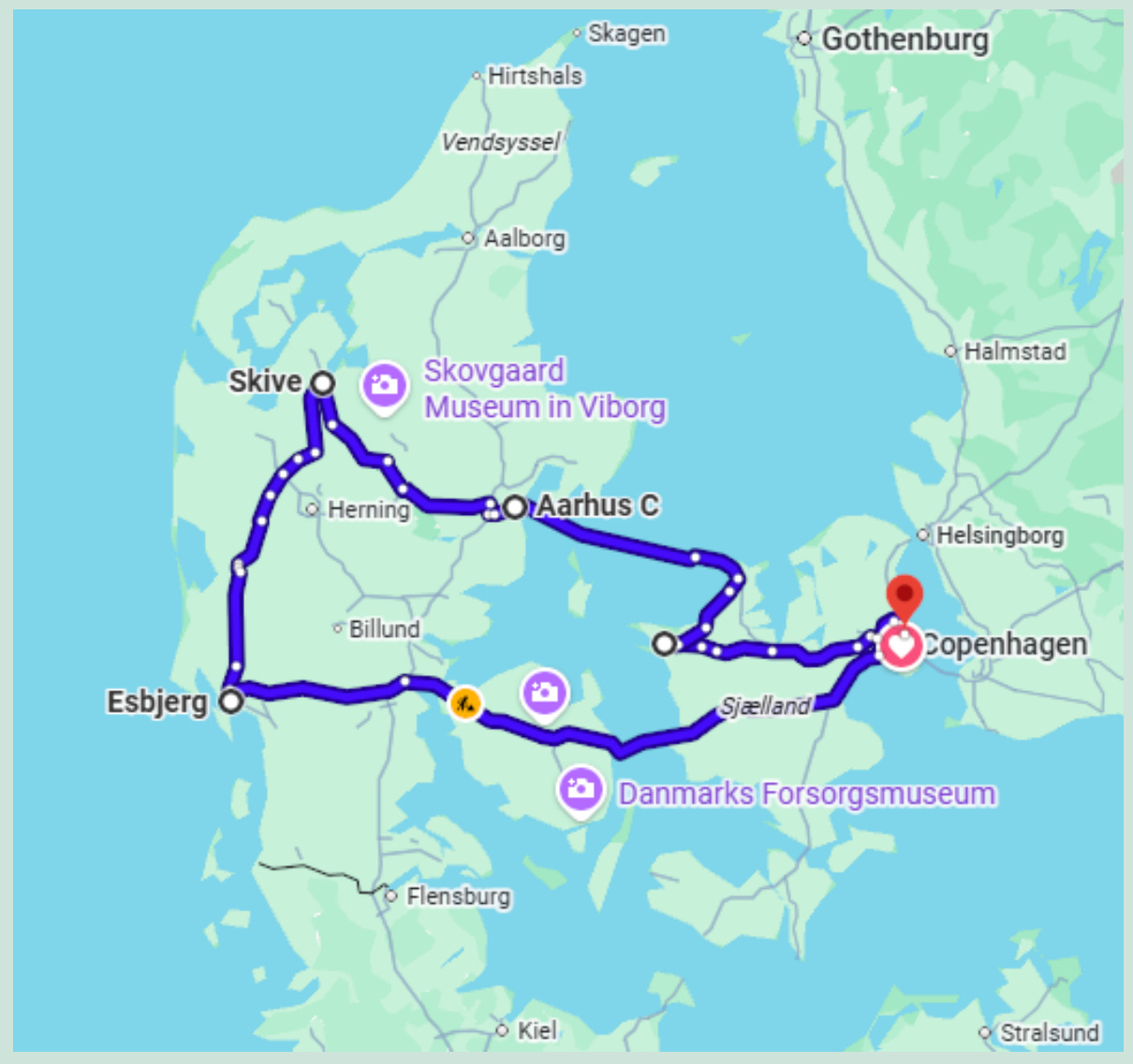
There were many highlights:
Copenhagen itself, of course, which is just as dreamy as everyone says — probably my favorite city I’ve ever visited. During every free second I rented one of the many ebikes from one of the many bikeshare services and just rode, rode, rode. I probably put in 200 miles, all of it on safe, grade-separated bike infrastructure, which is ubiquitous. I could go on about this forever but I’ll just say that, although the city is big, every particular spot in it is somehow … cozy. Human-scale. This includes large-scale, dense housing, which is never fronted by busy roads, always tucked away so it feels quiet and intimate. I didn’t take enough pictures (I never remember), but here are a few:


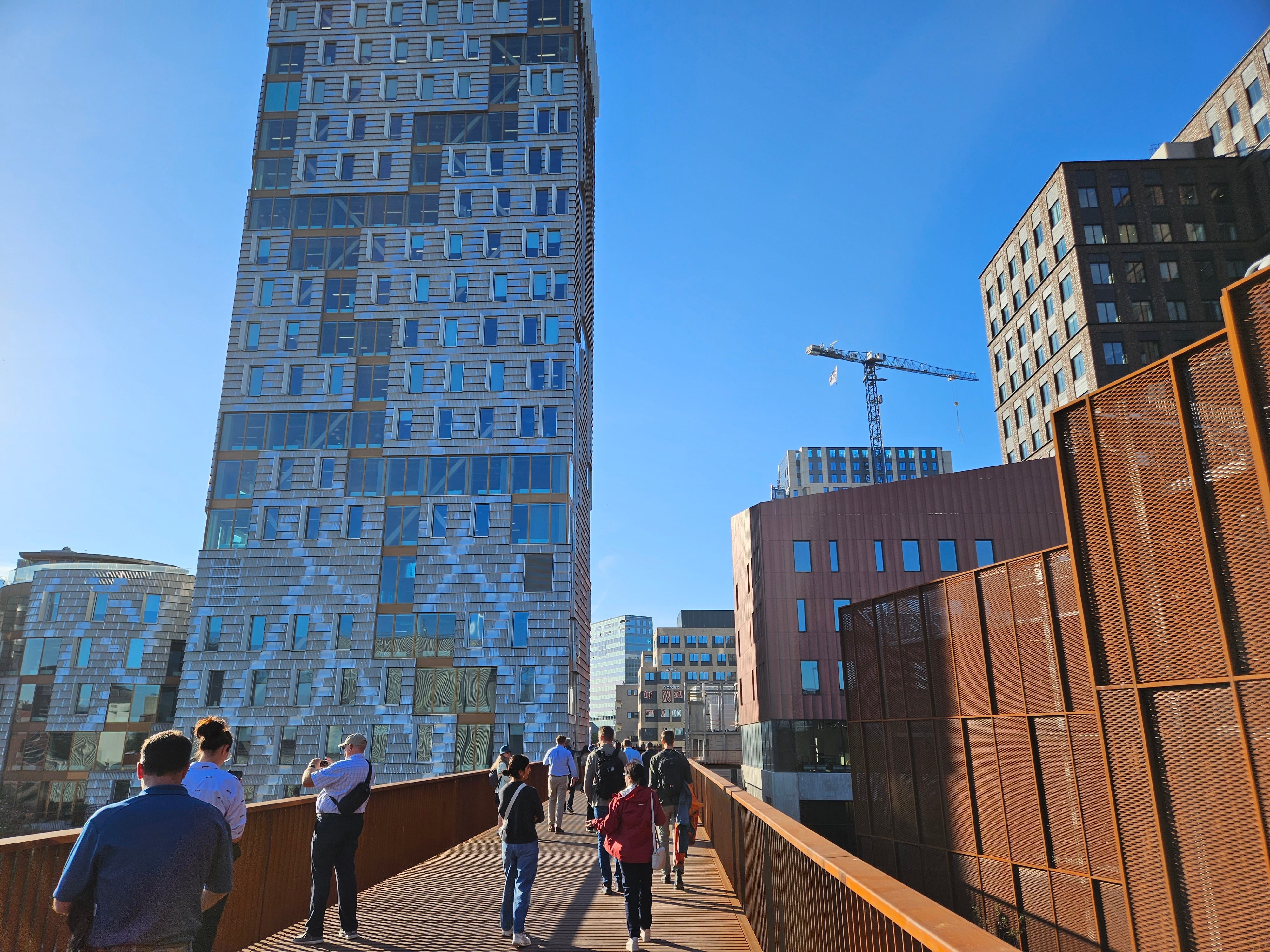
Aarhus, the second largest city in Denmark, is a hidden gem. We visited the port (we visited so many ports …), but my favorite part was our visit to Sydhavnen, the new arts district. They’re developing this raw, post-industrial area between the port and the rest of the city into a district devoted to “creative industries” — artist studios, sound studios, music venues, etc. It is extremely cool. One of the best bits was the recently opened “coal bridge,” adapted from an old rail line that use to carry coal. Modeled on NYC’s Highline, it will connect residential areas to the arts district. Just awesome.
In Skive we got to hang out and talk with the CEO of GreenLab, a semi-off-grid industrial park in the middle of extremely rural land. The park generates most of its own power (~90 percent, as I recall) with wind and solar and uses it to power industrial facilities on the site. There’s a facility that processes agricultural waste into biochar; one that processes plastic waste into chemical feedstocks; one that processes marine byproducts into animal feed; one that electrolyzes hydrogen; and so on. Industrial symbiosis! The extra power goes into batteries and heat batteries, so industries receive steady power and heat around the clock. They’re planning something like a dozen of these parks across the country. I may do a whole pod on it at some point.
The port of Esbjerg (which I heard said aloud probably 100 times and still can not pronounce) — one of Denmark’s newest cities — was cool mainly because it’s become a hub for the offshore wind industry, so we got to see all the giant towers, nacelles, and blades waiting to be loaded on ships. Y’all, that stuff is so big.
We learned about ports, district heating systems, biomass, carbon capture, on and on, but if I had to pull out a central theme, it is this: a society high in social trust can achieve wonders. The drive toward carbon neutrality is supported across the political spectrum. Municipalities own their own electric utilities and district heating systems, so they can make long-term plans and investments, secure in the knowledge that policy won’t lurch in different directions every few years. They conceive of themselves as involved in a common project, as an Us, and it enables an incredible degree of planning and forethought.
The contrast to the US — a notably low-trust society, getting lower all the time, where we can’t get our shit together to do anything for more than a few years at a time — was glaringly evident.
2. 🥊 This great story in Washington Monthly, by Kainoa Lowman, examines a subject near and dear to my heart: why is the US clean energy industry such a wimp, politically speaking? Why won’t it fight for itself? The story quotes me, which is fun, but it also contains some amazing quotes from figures in the industry basically telling on themselves. Say Tim Pawlenty, the milquetoast Republican running the solar trade association: “we’re in the business of making friends, not making enemies.” (Barf.) Basically it’s the industry saying, “everyone loves us, so Republicans are sure to stop kicking us in the face soon,” as Republicans continue to kick them in the face. (More on this in a pod coming soon.)
3. 💩 This great commentary in Nature Energy, by Will McDowall & Michael Fell, examines another subject close to my heart: the risk of enshittification in distributed clean-electricity technology. We’re all going to be getting smart devices in our homes, which are networked to one another and to the grid. It would be extremely bad if those devices get bricked when companies go out of business, or if they impose escalating subscription fees we can’t afford, or if they lock us in and service degrades — basically, if they treat us the way social media platforms treat us. I did a pod on this with Cory Doctorow if you want to hear more.
4. 🔌 The New York Times has a great piece on Jonas Birgersson, the Swedish entrepreneur who is trying to remodel the electricity grid to make it more like the internet. I did a podcast with Birgersson in January, one of my all-time favorites. To my knowledge, basically no one in the US was aware of or engaged with his project before that pod. Then, later the same year, the NYT discovers it! What a coincidence! (Volts is not cited in the story.)
5. 🗼⚡ If you’re a Volts listener you’re probably already convinced of America’s desperate need for more high-voltage interregional electricity transmission. If you’re not, though, read this great new report from the Center for Public Enterprise.
6. 🗳️ Here is a comprehensive guide to the most important elections in the upcoming midterms. Pay attention, and vote, all the way down the ballot!
Nate’s Notes
1. 🔌 Balcony solar, an update. David has been tracking plug-in saga over the years. Last time we checked in (thread #28), Virginia’s bill was waiting on the governor. It was signed in April. And on Sept 30, California Governor Newsom signed SB 868, the state’s plug-in solar bill, which takes effect Jan 1, 2027 (pv magazine).
A bit of thread history: the balcony solar episode itself started as a reader question. Jason Titus asked for it back in thread #11. Thanks, Jason. If there’s an episode you want to hear, leave it under EPISODE IDEAS & GUESTS. I read every one.
2. ✅ Comment of the month. Last month James asked whether paying his utility extra for green power actually adds clean energy, or if it’s squishier than that. Christopher wondered the same about a $200 community solar panel. John C answered both, starting with what that extra money buys: renewable energy certificates (RECs), credits proving a megawatt-hour of renewable power was made somewhere. His bottom line:
Do either of these things help make the grid cleaner? Yes, in a sense… if no one bought REC’s and no one bought the power from a solar project, that solar project would not get built. But plain old RECs are pretty cheap these days.
The full exchange covers community solar too, plus Mark on community choice aggregators. Want the deep version? David’s episode on the debate over RECs gets into it in detail. Know how your own utility’s program works? Tell us in the comments.
3. 🗳️ Coming up. After the 2024 election, Caroline Spears of Climate Cabinet came on Volts to walk through how state and local climate races turned out (listen here). She’s coming back after Nov 3. Which races or ballot measures are you watching for climate and energy? Leave them under ASK DAVID, and I’ll pass it along before they record.

Monthly Thread: How It Works
This is the monthly place to share. Reply under the pinned headers in the comments:
ASK DAVID (keep it light): the questions David likes answering. The top few go into his next bonus episode, or get a one-line answer here.
EPISODE IDEAS & GUESTS: who or what should be on the pod. When one becomes an episode, this thread says who asked.
ASK THE COMMUNITY: the hard technical and how-do-I questions. Readers here answer a lot of these before David can. Keep doing that.
OPPORTUNITIES: jobs, events, meetups, and calls for collaborators. Post only what’s real and current, one post per org, and reply to people who reach out.
EVERYTHING ELSE: including replies to the notes and this month’s question.
Reply directly under a header so people can find you. A few rules of the road: bare links get removed, so tell us in a sentence or two why yours matters to this crowd. Spam and anything inappropriate get removed too. Be nice, and have fun out there.
Rather email? Write to nate@volts.wtf. Send a question for David you’d rather not post, or something you made with a Volts episode (a class, a deck, a chart, a build). With your OK, it may show up here. And if money is the reason you’re thinking about canceling, write to me before you do.
I find that whatever information I can glean from these posts to be so valuable, but I wish they could be interpreted more in layman’s terms, as I find the information difficult to comprehend. Perhaps it’s just me and my aging brain, but I just give up.
But I so appreciate what you do, and that you offer everyone the chance to be a part of it.
--- ASK THE COMMUNITY ---