


Hello Volts listeners!
Sam here. I work behind the scenes at Volts and co-write these community threads with David. As you can see from David’s recent 5th birthday post, he is extremely grateful for the Volts community, but he is also allergic to patting himself on the back for creating what I and many listeners believe is one of the best climate podcasts in the world.
So today, David has begrudgingly agreed to let me pull together a post to celebrate five years of Volts, with David chiming in here and there (his comments will have an orange quote bar on the left). We hope you enjoy.
The first Volts podcast
‘Twas the night before Christmas, in 2020, and David was busy sending out the first Volts podcast, which he called a “Voltscast”:

It’s objectively ill-advised to send out content on a holiday, let alone a podcast debut for a new and unproven business venture, but that’s David for you. The first-ever pod guest was Matt Yglesias, whose Slow Boring eventually turned into an all-time successful Substack.
In retrospect, David’s note in the episode description is dripping with irony: “I’ll be honest: I don’t really want to launch an Actual Podcast and get tied to a particular format and schedule. I’m terrible at satisficing and I know if I did it I would obsess over it and it would eat up all my time, and I’d rather spend my time writing. I’d like to do it on a less formal basis, though, at least if y’all are into it, so let me know.”
@ David, any memories from that first podcast?
Thanks for doing this, Sam! Of course, my main memory is that the first podcast was a total lark. I had no idea that mere months later my wrists and forearms would start to give out and writing would become more and more difficult, which meant I turned to podcasting more often. And guess what: exactly the dynamic I described in that comment took hold! I obsess over it and it now takes all my time.
The most popular Volts pods of all time
There are 383 Actual Podcasts in the Volts archive, most of which are pretty great! We’ve already aggregated our favorites in the Volts Jump-Start guide, but I thought it’d be interesting to comb through the data to share the most popular Volts episodes of all time.
🏆 The most popular episode of all time in terms of downloads/views goes to … this July 2025 conversation with Kostantsa Rangelova and Dave Jones of Ember.

This isn’t surprising — the Volts audience can’t get enough of solar. Every solar episode does well. So why is this particular episode the GOAT?
The not-interesting answer is that it’s a newer solar episode, so it was sent to tens of thousands more subscribers than anything from three years ago. But more importantly, it felt like a significant milestone for the community, a much-needed celebration after an objectively bad six months for US renewable policy.
🏆 The second most popular episode of all time in terms of downloads/views goes to ... this November 2024 conversation with Dan Savage.

David was miserable after the 2024 elections. Honestly, I was a little worried he was going to shut down the podcast. Fortunately, David harnessed his emotions to host a cathartic conversation about the legacy of Dan Savage’s fantastic article “The Urban Archipelago”. Misery loves company, so this conversation resonated with suffering Volts listeners. Some 25 f-bombs were bleeped in this episode, a new Volts record.
🏆 The episode that brought in the most subscribers goes to … this September 2022 episode on learning curves with the heavily bearded Doyne Farmer.

If there were a Volts drinking game, the phrase “learning curve” would certainly be in it. (Should we make a Volts drinking game?) This episode focused on the constant underestimation of learning curves for clean energy, which still holds true today — David and Kingsmill Bond just harped on it a few weeks ago.
@ David, what are some of your favorite episodes?
Obviously, episodes are like children and I love all my children equally! A few that, for one reason or another, stand out in my memory: industrial decarbonization with Rebecca Dell, the fateful episode with Connecticut regulator Marissa Gillett, my first box-of-rocks industrial-heat pod with Rondo, the zero-carbon-cement pod with Sublime, and the pods with Climate Cabinet and PowerLines, which boosted two nonprofit groups I think are doing great work.
The guests
🏆 The guest with the most appearances: Jesse Jenkins, head of the Princeton ZERO Lab, with six.
Jesse was on Volts so many times he thought to himself, “why keep doing this for free?” Now he co-hosts the wonderful Shift Key.
Saul Griffith, Caroline Spears, Jigar Shah, Rep. Sean Casten of Illinois, and probably others I’m forgetting are trailing with three guest spots. Intrepid editor Lisa Hymas has appeared several times as our esteemed mailbag host.
As David emphasizes frequently, Volts is not investing advice. Nevertheless, plenty of investors listen, because Volts has hosted a who's who of startups.
🦄 Unicorns on which Volts was legit early:
They haven’t all been up and to the right, though. Battery recycler Aqua Metals’s share price has gone from $114 to $6. Scooter battery-swapping company Gogoro’s CEO and chairman Horace Luke stepped down due to fraud allegations (now cleared), and Atom Power CEO Ryan Kennedy stepped down but then rejoined.
Sadly, we don’t have the resources to comprehensively follow up on all past guests. If you have interesting info on any of them, put it in the comments!
@ David, is there a guest you want on the pod but haven’t been able to get?
I’ve had incredible luck with guests, not only in their quality but in their willingness to come on the pod. The only one I want on the pod that I’ve never been able to get — my white whale — is JB Straubel, the former CTO of Tesla and current CEO of Redwood Materials. JB, come on the pod!
The Volts community
The first members of the Volts community
I did some internet sleuthing to demystify the true identities of our earliest subscribers. The first ever Volts subscriber currently works at a bitcoin-centric data-center developer, which I couldn’t draw up any better. Volts’ first paid subscription came a week into the experiment, from a fellow Vox reporter who may have taken pity on David for leaving the cushy confines of corporate journalism for whatever you’d call Substack.
The community / commenters
It’s hard to believe that a newsletter comments section was innovative, but it was circa 2020. This functionality allowed communities to form around great content, no matter how niche, much like miniature ecosystems that emerge in bromeliads tucked high within rainforest canopies.
The Volts community is an exceptional ecosystem. It includes solar technicians, engineers, teachers, tech founders, chief scientists, CEOs, White House staffers (well, probably former White House staffers), one guy who is obsessed with Aptera — the list goes on. Thousands of you have shared your subject-matter expertise in the comments section and behind the scenes. We are forever grateful because the added context makes Volts that much better.
🗣️ A big shoutout to the top 10 commenters (by quantity), you’ve been integral to building Volts: John S, Suz C, Peter W, Steve B, Jerry W, Fred P, Auros, Bob W, Geoff S.
@ David, what’s a funny thing that a subscriber has said to you or asked you for?
Like anyone who has written or talked about energy on the internet, I occasionally get an email from a guy who has, in his garage, designed a device that will provide unlimited energy, at trivial cost. He can show you the patent! But — you won’t believe this — the fossil fuel companies are conspiring to suppress this good news. He needs my help to bust it wide open. Unfortunately, they are rarely paying subscribers, so the news remains unbroken.
The oversharers
Bless their hearts, these subscribers do the lord’s work by sharing Volts episodes far and wide to friends, family, and strangers. Our No. 1 oversharer is a floodplain specialist who recently installed a heat pump and induction stove (or so they told me over email), and our No. 2 oversharer is a longtime consultant working in energy markets and transmission.
Over the past five years, Twitter is the predominant way that people have shared and discovered Volts (outside of direct search via Google and Substack), which makes sense given that David was a long-time power user of the platform. He has since absconded to Bluesky, which now takes the top spot. Notably, Hacker News is our second biggest referrer these days. We’re barely registering traffic via ChatGPT; thanks for nothing, robots.
@ David, did Bluesky successfully fill the Twitter-sized hole in your heart?
I’ve come to accept that nothing will ever replace the Good Twitter of the mid-2010s. X these days is a nazi dumpster fire that is poisoning the brains of a good portion of the journalistic class. And Bluesky … just imagine a social experiment in which you lock several thousand hardcore ideological liberals into a room together. It’s like that, but even worse. Still, a man’s gotta post!
Community location
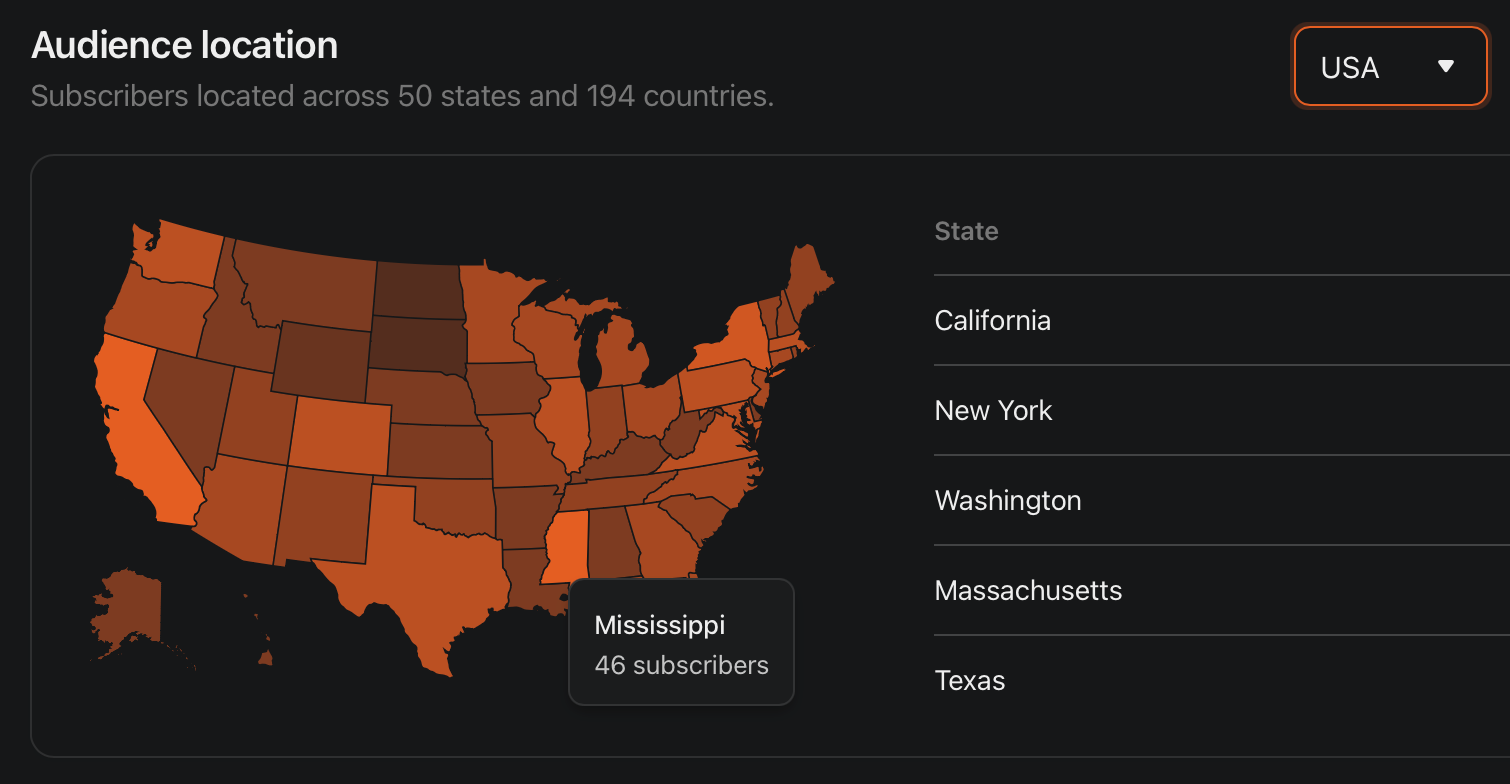
Where are you folks from? The map below shows the top five states in terms of Volts listenership. States with large progressive bases love the podcast. On the other end of the spectrum, fewer people in Mississippi subscribe to Volts (46) than there are Walmart supercenters in the state (65).
From a global perspective, Volts listenership is overwhelmingly English-speaking, with the US, Canada, and the UK leading the pack.
@ David, any guesses which non English-speaking country ranks inside the top 5?
Iceland? China?
The answer is the largest country by population, India, with 3 percent of all subscribers. Is it time to lean in, do a Hindi translation?
Unsubscribers
If I’m having a bad day, I like to go to the Volts unsubscribe feedback page to remind myself that David and every podcaster have it worse. I don’t think he reads the unsubscribe mesages, but if he did, he’d be utterly confused. He’s too liberal and he’s too critical of liberals. He’s too wonky and he only asks softball questions. A recent favorite: “I thought your interview was a perfect teasing out of why your smug insufferability is not just annoying, but unhelpful at this point.” Do tell us how you really feel 😂.
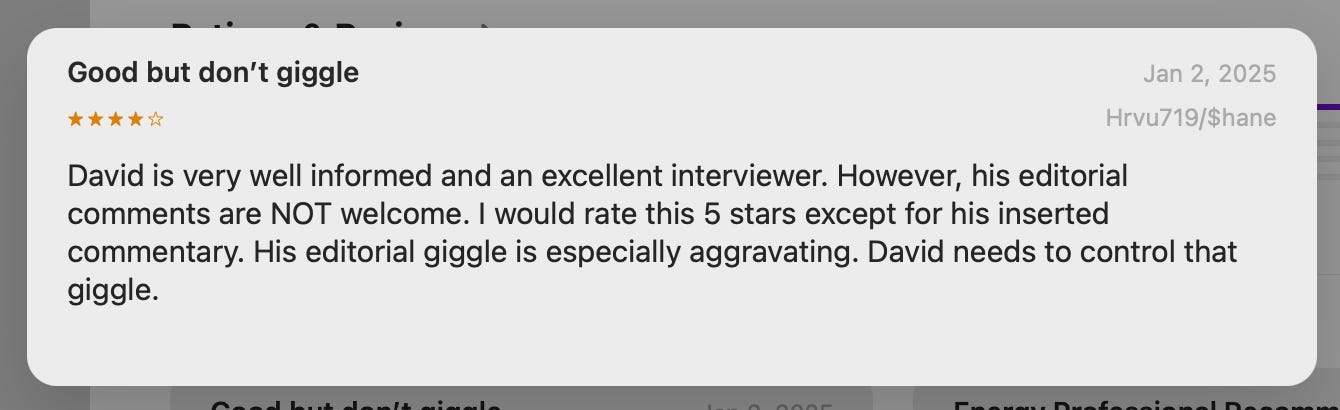
Lately, there’s been an uptick of unsubscribes mentioning tight budgets and lost jobs. If this is the case, please message us and we’ll fix you up with a comped year. We understand that not everyone can afford to pay, and as David says in his in-episode donation request that everyone complains about, a positive podcast review on your preferred podcasting platform goes a long ways. Like this gem for example:
That being said, there are many kind notes too. Here’s a sample of what Substackers who’ve recently subscribed are saying:
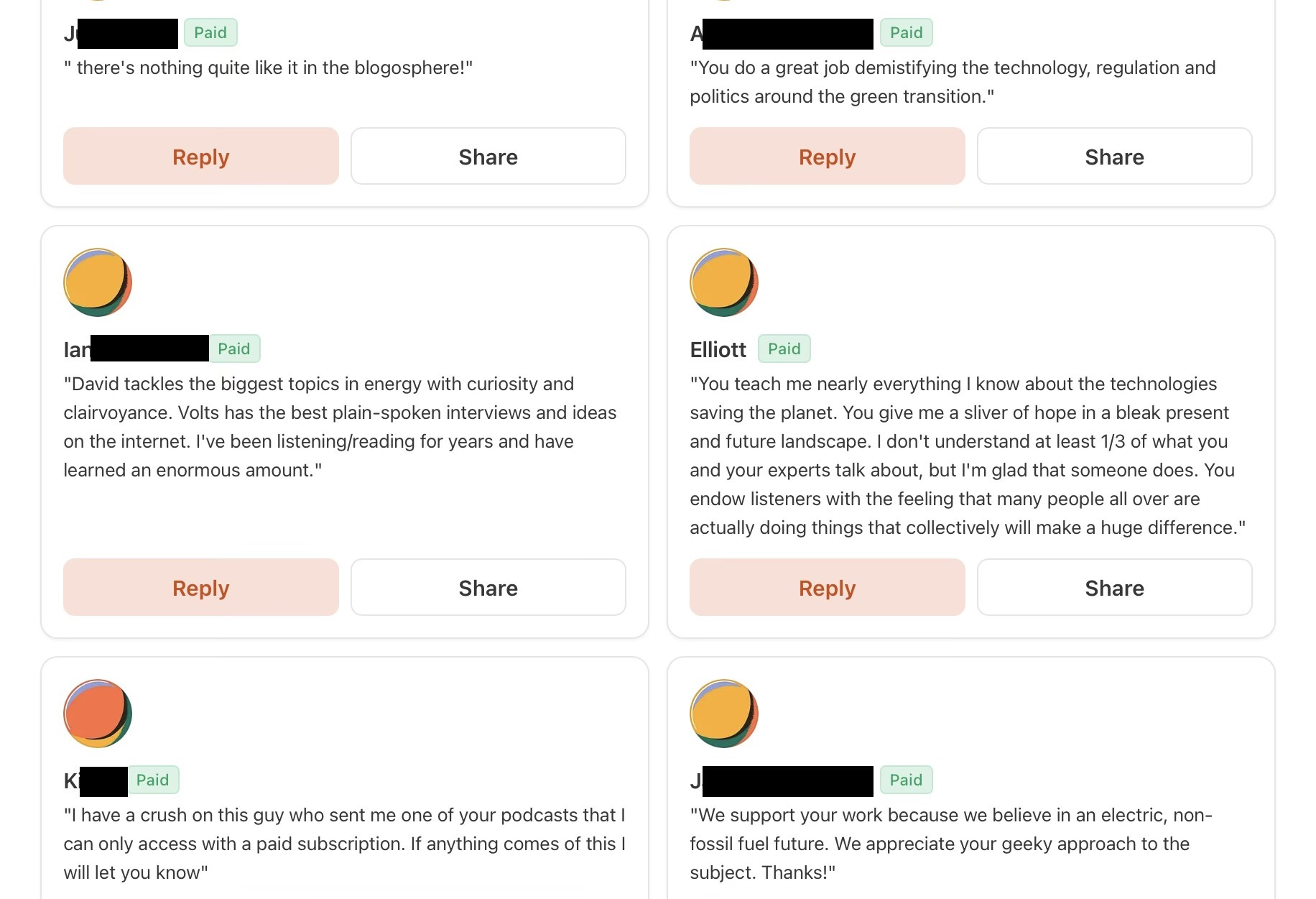
@K — your crush has good taste, please let us know if things worked out!
The impact
Volts has one goal: get good ideas into the hands of people who are in a position to do something with them. This may seem unremarkable, but I think this theory of change is actually quite distinct from others in the space. Climate-tech pods are typically from VC- or finance-adjacent organizations that are looking to forge relationships with founders or talk up solutions/companies in their portfolios. General climate pods are doing 101-level education for lay audiences. Advocacy pods are focused on grassroots movement building.
Volts conversations are conducted with the hard-won presumption that a handful of decisionmakers are listening, eager to learn, and ready to act. Certain episodes may only be directly actionable for 0.1 percent of listeners, but these particular listeners are incredibly motivated and well-situated. The best part of being a fly on the wall here is seeing the comments and emails from subscribers and guests remarking that they were inspired by Volts to write a bill or found a company.
Even so, I don’t want to overlook the smaller, everyday impacts that Volts has on ordinary listeners like me who rely on it to help shape and prioritize our worldviews. I’m mid-career in corporate sustainability, and I listen to Volts as a form of continuing education. I’ve made all manner of decisions informed by the knowledge gained via Volts, and there are 88,000+ listeners who’ve done the same. Pardon the navel-gazing, but I find this supremely cool.
@ David, how do you think about Volts’ impact?
It’s obviously cool hearing about state laws that get written and passed based on Volts pods, or nonprofits that raise money, or companies that raise money or win awards, but the stuff that really gratifies me is the smaller stuff — people who shift careers, or choose academic majors, or upgrade their houses, or just get taken with a new idea. This stuff matters to me more than any award or recognition or audience numbers or anything — just being useful.
What’s next
More episodes, more electrification, more Volts. Thanks for listening, happy anniversary. 🥂

Monthly Thread — How It Works
This is your monthly opportunity to share! Use the comments section in this community thread to:
CLIMATE JOBS & OPPORTUNITIES: Share climate jobs/opportunities
SHARE WORK, ASK FOR HELP, FIND COLLABORATORS: Share your climate-related work, ask for help, or find collaborators
CLIMATE EVENTS & MEETUPS: Share climate-related events and meetups
EVERYTHING ELSE: Discuss David’s Notes or anything else climate-related
QUESTIONS: Ask a question to the community or for an upcoming bonus episode (anyone can ask a question but bonus episodes are a paid-sub-only perk). Don’t be afraid to answer one another’s questions!

🚨 To keep organized, please only “REPLY” directly under one of Sam’s headline comments. Anything inappropriate, spammy, etc may be deleted. Be nice! Check out our Community Guidelines.
--- CLIMATE JOBS & OPPORTUNITIES ---
--- SHARE WORK, ASK FOR HELP, FIND COLLABORATORS ---