


If the world takes its climate targets seriously, the coming decades will see fossil fuel systems shrinking as clean energy systems grow. In this episode, I talk with associate professor Emily Grubert about the issues that may arise during this “mid-transition” period. She has fascinating new study on the physical and financial cliffs that fossil fuel systems may go over as they decline and reach their “minimum viable scale” — and argues that public ownership of these dying industries might be the only way to gracefully phase them out.

(PDF transcript)
(Active transcript)
Text transcript:
David Roberts
Hi. Greetings, everyone. This is Volts for March 4, 2026: “The Fate of Fossil Fuel Systems in the mid-transition.” I’m your host, David Roberts.
It’s easy to imagine a fully clean, fully electrified future in which copious solar energy is stored in abundant batteries, backed up by wind and geothermal and advanced nuclear power, and energy-related greenhouse gas emissions have effectively been eliminated. If we manage not to kill ourselves or dumb ourselves back to the Stone Age, which is a disturbingly large if, I even think we’ll get there someday — maybe 2060, 2080, the year 3000, who knows, but someday.
But what happens between now and then? In the energy forecasting models, the fossil fuel systems gradually decline as the clean systems gradually grow to replace them — one line goes smoothly down as the other goes smoothly up. But as we know from … everything that’s ever happened, lines do not move smoothly in real life. What’s going to happen to those fossil fuel systems as they shrink? Are they going phase out in a way that is economically rational or equitable? Are they going to hand off to the systems that replace them in a way that preserves reliability and safety?
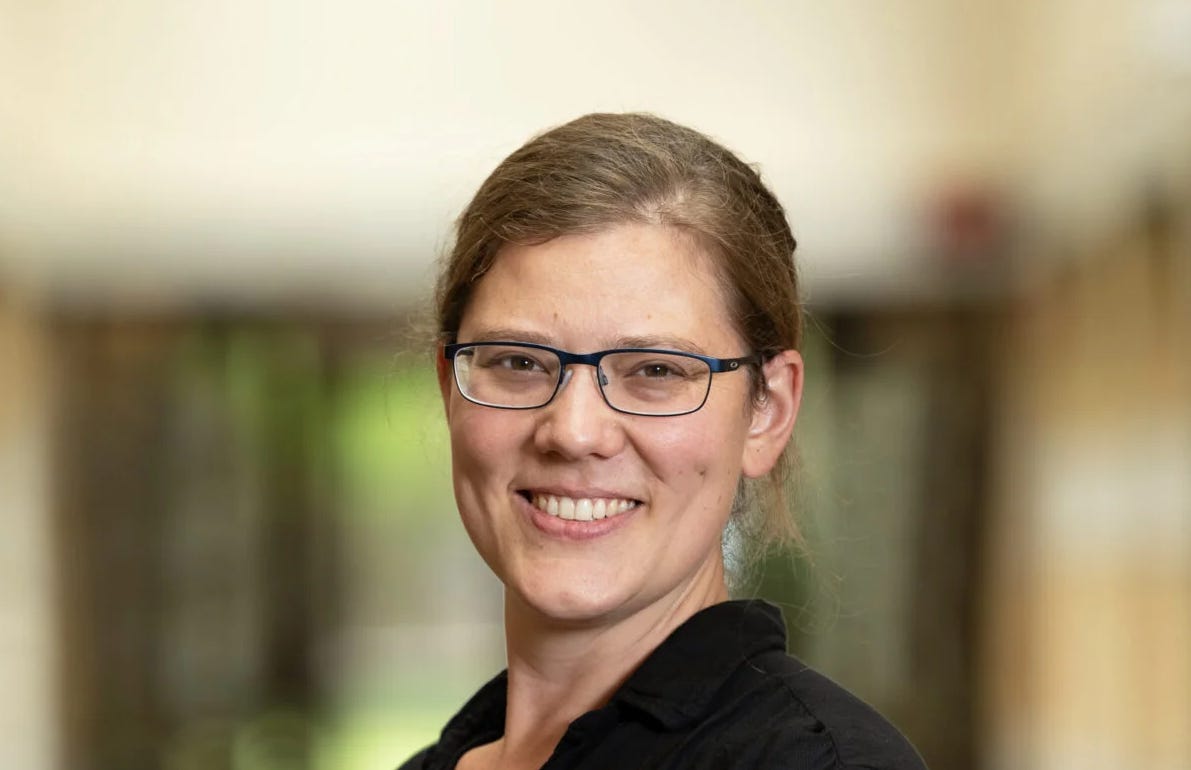
These are the questions that haunt what Emily Grubert calls the “mid-transition,” that murky, troubled period during which one world is dying and another is being born. Grubert — an associate professor of sustainable energy policy in the Keough School of Global Affairs at the University of Notre Dame — has been thinking about the mid-transition, how to study and plan for it, for several years now. With co-author Sara Hastings-Simon, she published an influential paper introducing these medium-term challenges in 2022.
Now, with co-author Josh Lappen, she has released a new study in the journal Science that examines in more detail just how small fossil fuel systems can get before they fail entirely — their “minimum viable scale” — and what that might mean for the design of the transition.
The mid-transition is one of the most interesting and generative ideas I’ve encountered in the last decade, and one of the most interesting research programs going on right now, and I’ve been meaning to talk to Emily about it for years, so I’m glad to finally have the opportunity. We’re going to get into what the mid-transition means and how we might approach it in a less stupid and uncoordinated way than is our typical practice.
With no further ado, Emily Grubert, welcome to Volts at last. Thank you for coming.
Emily Grubert
Thanks so much for having me.
David Roberts
This is way overdue. I should just say, Emily, I listen to a lot of podcasts and they mostly blur together. But I remember after you wrote this 2022 paper, you went on Chris Nelder’s podcast, the Energy Transition Show — shout out to the Energy Transition Show — to explain this and walk through this with Chris. That individual podcast episode has stuck in my head ever since. I still think about it to this day. It is one of the few individual podcasts I’ve listened to that changed the way I think.
Emily Grubert
That’s amazing.
David Roberts
I’m very excited. I wanted to get you on then, but at that time I was feeling abashed about ripping Chris’s guests off one after the other. I was trying to stop doing that. But I think enough statute of limitations is up now.
Emily Grubert
We continue to write papers, the academic thing.
David Roberts
Yeah, you continue to write papers. Excuses to have you on. Let’s just start with — I gestured at the mid-transition in the intro, but maybe just start with what you mean by this, about what is notable about the mid-transition, why is this worthy of study? And maybe talk about — did this just come to you as a concept or is this something you bricolaged together over time? I’m curious about the origin of this with you and Sara Hastings-Simon.
Emily Grubert
I love telling this story. It’s something I’ve been thinking about for a long time. Maybe the all-the-way-back comment here is I was raised in an oil family. My dad’s a petroleum engineer, and I was always around the industry and really excited about going into the field. In college and then in grad school, I helped out with this class taught by Jane Woodward at Stanford that I think some of your listeners are familiar with, just called “ Energy Resources.” I think now it’s called “ Understand Energy,” but it’s a great class that has a ton of field trips.
Where this is going is that I had the pleasure to help teach that class for many years after I’d initially taken it. I went on the same field trip many times, and we went to Moss Landing — this giant natural gas-fired power plant a couple hours outside of Stanford — in my case, over the course of 10 years or so.
By the last couple of trips that I was on, they had announced that the plant was going to be closing at some point, and it was extraordinarily clear, even to me as a not-super-expert, that they were not investing in the plant as much as they had been before. I think the last trip that I was on, our guide, who had been our guide for many years, was visibly shaken and was saying, “Hey, I’m sorry I’m off today, but a bunch of my friends got laid off this morning.” Going around the plant, you could see there was corrosion. They weren’t keeping up with painting. There were things that I was worried about the students stepping on. This comes from a very physical infrastructure place for me and a very observational one.
David Roberts
I think it’s easy for energy geeks, wonks, modelers, pundits like me to talk about infrastructure in a way that is very abstract. One of the very useful correctives of this work is just to remind us that this is lots of big, complicated machinery. There is large physical stuff involved, and you have to think about what to do with it.
You talk about the characteristic feature of the mid-transition, and I’d like to hear you talk through this a little bit, is just that you have this situation where one system is growing and one is shrinking. What’s interesting to think about this — and I say this purely as a compliment — this is one of those ideas that once you hear it, you say, “oh, well, duh!”
Emily Grubert
That’s what we’re going for!
David Roberts
Yeah, it’s why has no one been thinking about this? Of course this is something to think about. It’s easy to think about if you’re building a clean system — I don’t know, electricity, pick a system — if you’re just starting from a clean sheet of paper, that’s one thing, but you’re not. That’s what this work brings into relief: you’re not starting with a clean sheet of paper. Talk about that, about the complications of two systems passing each other.
Emily Grubert
Yeah. I think that some of the ways that I talk about this may lead into the minimum viable scale thing as the obvious next step, which we hope is also one of these things. This has been the response so far, where half the people are “This is a ridiculous idea,” and the other half of people are “Yes, I can see that happening around me already.”
The minimum viable scale thing that I think is the most interesting is essentially you end up in this place for a while, where the fact that you have one system growing from small and one system shrinking from big means that you have two systems that aren’t big enough to do everything for a while. They need to be working together, but they’re also dynamic.
You end up in this situation where you have a much higher effort period, where both systems need to be operable, both systems need to be adapting to the other, and both systems are constrained by the other. You end up with these strange maladaptations at times that are temporary if you assume that this proceeds. One of the things that keeps me up at night is that we could get stuck in this.
David Roberts
One of the things I wanted to say is the term mid-transition itself embeds quite a bit of optimism.
Emily Grubert
Oh yeah. It’s optimism, and it’s also just putting a normative line in the sand that we have to commit to succeeding in order to succeed. There are a lot of ways to fail. There are fewer ways to succeed. What’s important about that, and to your point about the fact that the fossil system is an agglomeration of stuff, is we have so much information about it. One of the most hopeful things about this work for me is that we know a lot about the system that exists.
When we talk about clean energy systems, there’s a lot of hypothesizing about what it’s going to look like. With the fossil system, you know what it is, you know where it is, you know who works there. That gives you a lot of runway to say, “how is it going to break?” And what do we do about that?
David Roberts
Yeah, but you have the inverse problem, which is that the clean system — there is a lot of uncertainty and fuzziness, but everybody is highly incentivized to talk about it and think about it.
Emily Grubert
Yeah.
David Roberts
Here, on the other side, we have tons of information. We know all we need to know. But nobody wants to talk about it going away.
Emily Grubert
No, I think a lot of people know this story, but when Sara and I set out to write that mid-transition paper, we had pitched it as a review — we were going to review everything that everybody was working on talking about this stuff. We started getting in and we said, “Oh, there’s not a whole bunch on that.” But yeah, it’s a huge area.
David Roberts
This is the core intuition of all this work, which is that the job of building brand new systems is huge. It is something that this podcast is about. It is something we have all been thinking about, a big and complicated deal that requires some care. But that is also equally true of the flip side, which is shrinking and shutting down and eliminating systems — also big and complicated and fraught with risk and requires care. That is the core here.
As you say, there’s nothing — as I was reading your work, I was trying to think, have I ever read anything, in my 20 years of covering this stuff, have I ever read anything that thinks in detail, at scale, about how to shut down fossil fuel infrastructure? I couldn’t think of anything at all.
Emily Grubert
Yeah, there’s some. It’s hidden. It doesn’t necessarily present itself that way. But yeah, it’s a huge issue. The other thing that comes up for me a lot is that the build-out is a huge problem, the retirement is a huge problem. But also when we think about what environmental engineering looked like before climate change and what a lot of the conversation about environmental justice looks like and what environmental policy looks like, all of the harms that we’ve been dealing with beyond climate change are in a large way related to these systems, some of which are 100 years old.
The project of closing them goes beyond just, “How do you manage the systems out slowly?” It’s also uncovering the fact that we have this huge legacy of stuff to deal with that we really do need to plan for.
David Roberts
Yes, it’s like the abandoned coal ash pond.
Emily Grubert
Oh, yeah. Yep.
David Roberts
But at global scale. The global version of the abandoned — we’re going to have abandoned ash ponds all over the world from all of these fossil fuel systems. I think about how we are handling it so far. It’s not great.
Emily Grubert
It’s not great.
David Roberts
It’s not great how we’re doing it so far. Talk a little about how the experience of coal is a preview.
Emily Grubert
Yeah, it absolutely is. I think we raised this a lot in the various work that we have been doing on this. I collaborate a lot with Mijin Cha at the University of California, Santa Cruz, obviously with Josh Lappen, who is working with me at Notre Dame right now. We talk a lot about what the lessons of coal mean for the rest of the system.
One thing I point out to people is how much bigger the oil and gas systems are in the United States than the coal system. Also, how much harder they are to replace from a critical services perspective. There’s a huge amount of exciting stuff about how far we’ve come as a society in being able to provide services without fossil fuels. But fundamentally, coal makes electricity. There are some edge cases there — there’s steel, there’s some water filtration — but mostly this is electricity. We’ve known how to make electricity out of other stuff for a while.
The other two are more people, more sites, more services, and harder to replace. If we don’t learn carefully from the fact that what we’ve been doing hasn’t worked, as evidenced by coal, we could end up in a really bad place really quickly.
David Roberts
Before we leave this introductory section, one thing that has helped the idea of the mid-transition click with me is hearing some examples. We can get further into one or two of them later on. But maybe just to start, let’s run through three or four examples of, “here’s a big system that’s in the midst of being replaced by another big system, and here are some of the problems, some of the tricks to that,” just so people can get a sense of the kind of problem you’re talking about.
Emily Grubert
Absolutely. I think my favorite one, and the one that I think clicks for a lot of people, is what happens with gas stations.
David Roberts
Yes, this is the intuitive one.
Emily Grubert
This is the super intuitive one. When you hear EV drivers complaining about the fact that they can’t find a charger, that happens on the way back down too. You get to a system where there aren’t as many gas stations as you’re expecting, and they maybe go out of business in slightly unpredictable ways, or not unpredictable ways, but in ways that aren’t really matched to the optimal placement of where you would want gas stations to support the remaining need. That stuff comes up a lot.
In the power sector, one of the examples that I like to point to is the notion of having to curtail resources. When people talk about the duck curve or having natural gas peakers start-stop to accommodate solar in the middle of the day, or having to shut off solar because there is too much of a baseloader available, these are the kinds of maladaptations that reveal that we can’t run the traditional system the way that we’ve historically run it, but also the new things that are coming online are entering into institutional structures that weren’t designed for them. It’s leading to these strange outcomes that would not probably be the case on either stable side — either a fossil system or a not-fossil system, you wouldn’t really see those problems.
One that we get into a lot with the minimum viable scale stuff is on the petroleum refining side, which is that we expect product demand to go down unevenly. We may expect to see gasoline demand dropping off faster because it’s easier to replace those kinds of services with buses and dense transit options, but also with EVs or something like that. It’s much harder to conceive of seeing jet fuel demand or petrochemical demand going down quite as fast. But the way that refineries are actually designed has these products in pretty specific ratios that are difficult to change. Stuff like that comes up a lot.
David Roberts
There’s a whole family of petroleum products that are cheap because they are drafting on gasoline. Because the gasoline industry is so mega, they are byproducts of that gasoline industry. If gasoline, if the pillar that’s holding that up goes away, among other things, you would expect all these derivative petroleum products to get much more expensive.
Emily Grubert
Yeah, and the example that I love to point out to people because they don’t think it’s all that well known is during COVID. Hawaii has a pretty unusual situation with its energy setup in that they do burn a decent amount of oil for power. During COVID, jet fuel demand dropped. Gasoline demand dropped to some extent as well. The utility in Hawaii had to do a pretty massive wealth transfer from ratepayers to the refinery to prevent it from departing because it wasn’t producing its high-value products. Saying, “You need to keep making the stuff that we burn in the power plant, therefore we’re going to pay you to stay online.” It was a massive story in my world, but very few people know about this.
David Roberts
A lot of those little edge cases, like the little edge bits of petroleum product that you need here and there, those are premised on those products being cheap.
Emily Grubert
Yeah, exactly. Not to go super Landman on this, where I think the line that you hear from the oil industry a lot of the time is, “Certainly, therefore we can’t move away from gasoline because look at all these other things. Your toothbrush is made of oil.” Sure, but my toothbrush doesn’t need oil to be $55 a barrel. The value of some of these products for medical things or children’s playground equipment or what have you — you don’t need the level of cheapness that we have historically seen.
David Roberts
Yeah, and that’s just oil. We’re going through big system after big system. Each one of these is its own nest of issues and problems. To go back to the gas stations, because this is a great intuition pump. Say an individual gas station, the demand at that gas station drops 40, 50% because people are shifting to EVs. That gas station closes.
But that means that 50% of demand that it was still satisfying is still there and still geographically distributed the same way. Which means that 50% of cars that were using that gas station will now have to drive, whatever, twice as far to the one that hasn’t closed. The question is, if we just allow this process to happen haphazardly based on economics, we’re probably going to end up with a result that is highly inequitable, that produces lots of local mini crises, et cetera. I think this gets to the need — which we’ll come back to again later — for planning. This is one where people can see if you just let it happen, all sorts of crazy stuff is going to happen as a result.
Emily Grubert
It can even be a little worse than that intuition. If you go straight Hotelling theory of all of these things where you tend to see gas stations co-located — the four gas stations on a corner situation.
David Roberts
They all close.
Emily Grubert
Yeah, exactly. A lot of the time people look at that and they’re like, “Oh, if one closes, the other three will stay.” That’s probably not what happens. Especially because many of these stations get a lot of their revenue from being convenience stores and whatever. The chance that making an individual decision based on the writing on the wall is going to result in each individual gas station proprietor making the same decision around the same time is nonzero. You wouldn’t necessarily expect one at a time to close, which is also wild.
David Roberts
This gives people a sense of what we’re talking about. In electricity, we’re making this transition. The clean system that we’re building can’t do it all yet, so it’s got to operate in a way that is symbiotic with the existing fossil fuel system. Same for the fossil fuel system. It’s shrunk too much to do everything now, but it’s still doing a lot. You have this weird symbiosis. It occurs to me, there’s a sort of awkwardness about the symbiosis. Just these two systems having to exist side by side. Even if everyone was involved in good faith and had the same values and the same goals and aspirations, even in a perfect system, there would be awkwardness and bumps and gaps and missed opportunities.
But in reality, what tends to happen is that these two systems that are existing side by side are quasi-hostile to one another. They don’t really like one another. They don’t want to work together. They don’t want to have to depend on the other ones. That’s another layer of friction. Almost like politically they’re at odds, you could say.
Emily Grubert
Exactly. One of the things that we think about a lot, from a communications perspective and a big-P politics perspective, is the notion that this is something where a couple of missteps could set you back pretty hard. It’s not that you get a new chance every time you try to close something. If you screw it up once, you probably don’t get to try again for a while. That’s also why I tend to be encouraging of the idea that we should overdo it the first few times to prove that we can.
It’s a tricky situation in a lot of ways because a lot of people that read my work come at it with, “Oh, Emily said that this can take us 50 years, so there’s no need to try anything.” I don’t think that’s true. I think that a lot of our work really points to the idea that we need to try to get through this as quickly as possible.
David Roberts
Let me come back to that in a minute because I want to flesh that point out a little bit because I think that will be on a lot of people’s minds. Let’s just talk about this point, which is something you raise frequently, which is that during this transition period with these two systems awkwardly side by side, you are going to get problems. You note — and this is something I don’t think we’ve drawn out yet, but is hovering over all of this — all of these transitions are going to be taking place during a time when climate change is getting worse.
Emily Grubert
Yes.
David Roberts
Climate change damages are getting worse and disruptions are getting worse. You’re going to have the awkward handoff from one system to another, which brings its own problems, coupled with the increased stresses of climate change, which are going to also cause problems. All those problems — you raise this worry — “it’s going to be very easy for ordinary people to look at these problems and attribute them to the attempt to build the new system.”
Emily Grubert
Yeah.
David Roberts
You say that’s a danger. I say that’s a 100% inevitability that that’s going to happen. How could we avoid that?
Emily Grubert
We’ve already seen it.
David Roberts
I know. Does that not daunt you?
Emily Grubert
Oh, yeah, of course it daunts me. I have this conversation with people a lot, too. This is really hard. What I’m saying we should try to do is really hard. There’s not a guarantee that it’s going to work, but a lot of the stuff that is being proposed under other circumstances, I would argue, can’t work. I would rather try something that’s super hard and maybe would work than something that’s pretty hard and can’t work. In this particular case, we have already seen this tendency.
The one that always sticks out in my mind, because I’ve got a lot of family in Texas, but during Winter Storm Uri, all that initial conversation was, “Look what the wind turbines did.”
David Roberts
That’s 100%, they were ready to go. They were ready to go with that story. They did not hesitate.
Emily Grubert
Exactly. At the same time, people are dying. It’s pretty ghoulish in a lot of ways. When we think about how do you change that, it is really leaning into the planning element. If this is happening and then every time something new happens, you’re like, “We could have seen that coming,” no one’s listening to you. If you’re saying, “This is what we’re going to do for the next 10 years, these are the things we think are going to happen, and we’re going to pre-explain what we’re going to do about them because we can see them coming,” that’s a really different scenario that we haven’t really tried yet.
David Roberts
This is something that I did want to talk about because I think I’m probably slightly more cynical and less hopeful than you on this.
Emily Grubert
I’m rage-driven. I don’t know that I’m not cynical. I’m just rage-driven.
David Roberts
What you are describing is, I guess I would say, for a society that wants to go through a transition like this in a way that is smooth and reasonably coherent, what that requires is a very high degree of social trust.
Emily Grubert
Yes.
David Roberts
Do you have people who, if their leaders come to them and say, “Hey, we’re going to go through some bumps and maybe the occasional blackout and some awkward whatevers, but trust us, it’s for a better thing that we’re building”? I have trouble imagining that working these days. Look around. Who trusts anybody anymore? Obviously this is not something you can answer, but would you agree that your recommended solution, the only real way to do this well, is through social trust.
It’s going to require a lot of that.
Emily Grubert
Oh yeah, no, I absolutely think so. Again, I’m not saying that this is going to be an easy thing or even the most probable thing to work, but if you do care about having a better, less climate-affected future that also gets people out of a lot of massive environmental justice holes they have been in for generations, then you have to try sometimes.
With the trust thing, this is the theme of a lot of my work with Meijin Cha, on thinking about what it would look like to do governance demonstrations the way that we have traditionally sponsored technology demonstrations. We know and think in a lot of different examples that trying to put public money toward proving a technology can work is a common move.
We’re arguing, what if you did that to show people? “We’re going to take an example and show you how we would manage this for decline, and then we will do another one and then another one and we’ll show you what that looks like until we do build some of that trust back.” But that requires people wanting to do this, which is also not a foregone conclusion.
David Roberts
Are you aware — are we aware — is there a historical case where a government was explicit and public about the fact that an industry was going to decline and disappear and open about the fact that it was going to manage that process? Has that ever happened?
Emily Grubert
Oh yeah, for sure. Not at the scale where we’re talking about moving 80% of the modern industrial economy to something different. But this is one every time I’m with Josh on something like this. He’s a historian and loves this question. I think we can point to a number of examples.
One that comes up a lot — and it’s funny, people that have gone through them are “Are you sure that’s a good example?” But this is hard in any circumstance. BRAC — Base Realignment and Closure — is an example where you have essentially end-to-end governmental control of what’s going to happen to a particular base in an area. That’s one that we point to sometimes.
David Roberts
God, how did that work? It looks somewhat miraculous in retrospect.
Emily Grubert
One of the things that we take away from that is it is end-to-end, government controlled. It is in a really high trust environment. If you’re in the military, maybe you don’t love the way that structure works, but you probably generally trust what’s going to happen next will happen. That kind of stuff. For people that have been through it, I know that this is a massive simplification and there were issues with all of these.
I think one of the other ones that we look to in the United States quite frequently is the restructuring of the passenger rail system, which again also was not great. The way that individual railroads got consolidated into Amtrak involved quite a lot of paying attention to what the workers were going to be going through, what kinds of compensation, job realignment, those kinds of things might happen. Again, they are not a perfect example by any means, but we do have a decent number of examples of somebody saying, “We need to close out this industry and let’s do that on purpose.”
David Roberts
We certainly have enough examples of when we didn’t plan and just let it happen, and it didn’t go well. If we need any negative motivation, there are plenty of disasters to point to.
Emily Grubert
Yeah. I don’t want to be super dark humor about this because it is really, really serious. Most of the examples that we have seen that haven’t been planned have had long-lasting repercussions. I’m in northwestern Indiana, we still have a lot of primary steel here. You can still see the steel industry collapse impact on people’s lives around here. That was 40 years ago.
David Roberts
Somewhat legendarily, it is still shaping US politics. The loss of those industrial factory jobs is absolutely multi-generational.
This brings us then to the new paper which you, as you say, wrote with a historian, Josh Lappen. This, I think, tries to look back and learn a little bit about what it looks like for systems to shrink. I think the thesis of the paper, the core thesis of the paper, as I understand it, is just that in the real world the line does not go smoothly down and to the right to zero.
There are what you call cliffs — shrink to a certain point and then things go nonlinear. You get collapse tipping points. These are frequently discussed as tipping points. I don’t know why you probably wanted to avoid that bedeviled phrase, but it’s a similar idea. There are different kinds of cliffs. Maybe you could just briefly walk us through what are the sorts of cliffs that happen and where did you see it in action?
Emily Grubert
The one that is probably going to feel the most clear to people is the physical constraint on scale. One of the other ways that I motivate this intuitively is people are familiar with the notion of economies of scale, where you can do something different because you’re big.
David Roberts
This is diseconomies of non-scale or whatever.
Emily Grubert
Yeah, exactly. You get to the point where it’s pretty clear to people that if something is too small, it doesn’t behave the way that it was intended to if it was designed to be a lot bigger. The physical constraint thing is just, you can’t move that little stuff through that pipe, or that valve won’t work if the pressure is too low. That stuff.
David Roberts
You mentioned petroleum refineries in this.
Emily Grubert
Yep.
David Roberts
At a certain point, if you lower throughput below a certain level, the physical plant itself will not work.
Emily Grubert
Exactly. One of the things that we have been trying to communicate in the modeling space for a while here is that level is probably a lot higher than people think. There’s a tendency to say, “Well, we could just run one refinery at 100% or whatever it is.” But even the industry itself suggests the turn-down capacities for refineries is probably in the 60 to 70% range, which is much higher than the 2 or 3% that you see in models sometimes. That’s one.
More specifically on the physical constraints here, to go back to what we were talking about with mid-transition stuff and refining earlier, you do have a situation where you can’t make the precise product mix from the crude that you’re using at some point. Maybe you could build something new. You could invest in a new process, you could invest in new equipment. But without doing that, you just can’t.
I’m a civil engineer, trained as a civil engineer and as a sociologist. One of the things that I’m always pressing people to do in models is tell me, “Are you saying I can’t do that because of a money issue? Are you saying I can’t do that because I just can’t?” I can solve a money issue more easily than I can solve a physics issue. It’s that kind of stuff.
David Roberts
I love that you have those two cross disciplines because those two ships very frequently pass in the night without much communication. I love that you’re bringing them together. That’s at 65, 70% of demand. That’s early in the process. That’s not even that far down the road where petroleum refineries will start closing. Again, that 65 or 70% of demand for whatever that product was still exists and will now have to get it from some other refinery somewhere else, presumably at more cost, at higher transportation costs, et cetera.
Emily Grubert
If they even can. This is one of these things where it’s like, how do you move it? Is it a pipeline? Is it a truck? Is it a boat? This stuff, we’re seeing this unfold in California pretty dramatically right now. Obviously, the Hawaii example I gave earlier showed this a bit too. This isn’t all that hypothetical. It’s a big deal.
One of the other things that it points to when we think about how do you manage this is that you might not want the most efficient and the biggest units to be the ones that stay online. If you’re trying to see how the system shrinks gracefully, maybe I want the little expensive plant because its 65% is a smaller number than the 65% of the giant, very profitable plant. Thinking about stuff like that does take us out of the realm of how we’ve traditionally thought about this.
David Roberts
You will not get that result if you just allow the market to run.
Emily Grubert
Probably not.
David Roberts
If you just allow them to close based on pure finances, you’re not going to get that sort of rationale.
Emily Grubert
Ordering by profit rather than service need is probably not going to work if you care about these as critical services for society.
David Roberts
There’s also a financial cliff. This is interesting to me because I think this is also one where we’re not quite there yet, but can sniff this one just over the horizon as well in a couple of systems. Talk about who is threatened with a financial cliff and what that means?
Emily Grubert
It’s also really funny. As we were writing this paper and trying to put together some of our examples, these are all threatened by all of these issues, but which one is going to hit first is an interesting question. We talk about the natural gas system as a place where the financial cliff seems to be the most binding issue. You can think about physical issues there too. Gas takes what, five days to move from east coast to west coast or so — you can’t move gas super quickly.
I have this long-standing obsession about what the minimum pressure you can have in certain kinds of transmission pipelines might be. From a financial perspective, gas is interesting compared to oil and coal because it serves three really different types of purposes. Coal makes power, oil makes transportation, gas makes industry, home heat, and power.
If you see those three different uses declining at different rates, which is what we expect under most deep decarbonization scenarios, all of a sudden you have a situation where you had 100% paying for the 2 million miles of pipeline that we’re talking about here. Now you maybe only have 70%, and that 70% is the part that is burdened enough by those costs that you’re going to see defections and things like this happening. The fact that you no longer have the scale of multiple customers that are all paying into a very expensive set of fixed infrastructure becomes really important.
David Roberts
Just to spell that out, you have all these physical pipelines built and they require a certain amount of money and maintenance. Those are the fixed costs. Even if 100 people get off your natural gas system and go to heat pumps, you still have all the same pipes and all the same fixed costs. Now you are just dividing those fixed costs over a smaller user base.
The problem, again, to return to a theme, if you just let this happen by market forces, what is going to happen is it is going to be the wealthiest who leave the system first to the new better system and thus the people who can least afford it getting hit with these perpetually rising costs.
Emily Grubert
Yeah, I think that’s true within the distribution customers thing, even at that level. I completely agree that that’s the likely outcome here. What I think is also wild is that we expect this also to just hit residential customers probably harder than others. If you assume that you have a lot of power backing off in a situation where you have a lot of wind and solar or something, and you’re using less gas for electricity, all of a sudden you have these big industrial users that are making money off buying the gas, departing and leaving those costs on other industrial users who maybe face a similar pattern but have less ability to move off gas, and then your residential consumers.
You have this situation where everybody on the residential side, and especially the people that are least able to afford it, gets hit with these massive fixed charges. Even now, I would argue that we’re not that far into this transition, frankly. But even now, you can go on Reddit and see people complaining and saying, “Yo, what is this massive fixed charge? I barely used any gas last term.” It’s already a problem. In a heavily energy-burdened society, this is the kind of thing that kills people.
David Roberts
Yes. This is what they call the death spiral, the price death spiral. Again, it kicks in before you are anywhere close to zero. I don’t know if you have done the exact numbers on the gas, on residential gas distribution — what level of exit is going to get you this cliff? Do we have a sense?
Emily Grubert
It really depends. It depends on how proximate you are to either big distro lines or big transmission lines. If you’re in a pretty dispersed area that has a lot of industry and you’re just a couple of guys using it residentially because you’re in a small city, that looks really different than if you’re next to a gas field with a bunch of local storage. It depends a lot, but it’s not close to zero.
David Roberts
The other kind of cliff, which I find really fascinating, is what you’d call a managerial cliff. This comes into coal power. This gets back to — we briefly touched on before — which is that I think what a lot of energy models envision is for a lot of fossil fuel plants to just be used less and less but to still be there for backup.
Emily Grubert
Exactly.
David Roberts
People are very familiar with this. You’ll need less and less backup, but getting to zero backup turns out to be super expensive. You keep your natural gas plants online for your 2 to 3%, or quite frankly, many of the deep decarb models say “build out more gas because you need so much extra capacity, because you essentially need a one-for-one replacement for peak.”
Yes. People are talking about leaving coal plants online for similar reasons now. But then you raise what, again, once I read it, seemed obvious, which is that, who is working at this plant that is running 3% of the year? Who has the expertise and the skills and the schedule and all the rest of it? The managerial stuff — who is doing that at a ghost plant?
Emily Grubert
Yeah, 100%. I want to talk about labor for a second, but one of the things that we are trying to also raise with the managerial constraint is that you have different asset owners making different decisions in a privately owned, privately managed system. In this particular case, if you have every plant and every mine making its own decision without coordination, you end up with somebody rationally deciding to close a coal mine. Now there are a whole bunch of plants that can’t operate because they can’t get coal anymore. That kind of thing can happen.
On the labor side, I get this question a lot: “Why is there a special consideration for fossil fuel workers in a lot of these transition conversations?” I’m a big universal services person. I have said this many times: I don’t think you can do the energy transition without universal healthcare and a variety of other kinds of things like that, just because it’s such a barrier in many cases. Plus, it’s the right thing to do.
David Roberts
Can we just pause and think back to the Green New Deal argument? Why is there a job guarantee? Why is there health care? Why is there elder care?
Emily Grubert
It would be nice if people felt they could live.
David Roberts
I know. What do we need during times of turmoil? We need something steady. That is the whole point of social safety.
Emily Grubert
Exactly.
David Roberts
I love that you make this point.
Emily Grubert
I’m so glad.
David Roberts
Much of the risks of energy policy would not be risks —
Emily Grubert
Exactly.
David Roberts
— if you didn’t have people who could die if they lost their jobs.
Emily Grubert
Yeah. Or, “What am I going to do with my kid?” Exactly. When we get to the, “Why have special programs for fossil workers?” You got to this a little bit earlier too, but you were talking about extraordinarily high hazard infrastructure systems, just in the sense that something going wrong can be very dangerous. There’s a real safety element to a lot of this, both for people, for the environment. That goes for workers as well as people that are nearby. A situation where you have infrastructure moving into operational conditions that it’s never had to face before because it’s running way less than it used to.
We’ve gotten into this with hydro a little bit too, but also facing new risks from climate change and facing the fact that, since I was an undergrad, people have been talking about the demographic cliff in fossil fuel labor. People have not been going into these industries at quite the level that was expected for a while. You end up in a situation where essentially you don’t have anyone who knows what they’re doing unless you make sure that the people that know what they’re doing are willing to still be there, and that’s hard.
David Roberts
A point you frequently make is it’s going to be difficult to talk a 22-year-old into learning how to maintain a coal plant on the premise that he’s going to tend a dying coal plant for 10 years and then all his skills will be mooted.
Emily Grubert
Yeah. By the way, from a cultural perspective, maybe all your friends hate you because you work at a coal plant. That’s a really hard thing to walk into. There are interesting ideas about how you train people to work in — you’re going to learn how to be an operator that also is trained for closeout and trained for post-closure. That’s a conversation that I think is an interesting one worth having. But even just being able to tell people, “We need you to keep our communities safe. Yes, this industry is going to be gone as quickly as we can make that happen, but you’re going to be okay afterwards,” that kind of thing is valid here.
David Roberts
Again, it would be easier to convince the 22-year-old if the 22-year-old knew that he was not at risk of going on the street if he lost his job.
Emily Grubert
But it’s also easier to convince the 45-year-old who has other options to stay. It’s that stuff too.
David Roberts
You can drop beneath a managerial, logistics, or labor cliff where you simply don’t have the people and skills remaining to run this thing that you are rarely using. All these cliffs kick in — nonlinear effects.
One aspect of this I wanted to touch on briefly, which is interesting, is you could imagine if we were explicit as a society — we’re phasing out natural gas — and we did it in a rational way, you could imagine natural gas companies teaming up to do this in a rational way that made sure everybody was cared for. But they can’t do that. It is explicitly illegal for them to collude with one another and manage their businesses like that. What do you do about that?
Emily Grubert
I’ve got one great solution that industry hates. To be more serious, this is a really important point and it is one that I think is not that well understood. We talk a lot in the mid-transition conversation about the need for coordination. We were talking about before, this is stuff. It’s stuff we know about. It’s stuff where we know even, “Oh, that valve is not great at this plant,” if you know who to talk to. You can get a lot of detail on this.
Hypothetically, you could get to a situation where you say, “I know I need about this much flexibility in the system, these kinds of services. I want to make sure I 100% have these ones. I could be more willing to let go a little early,” whatever it is. You can get around a lot of the problems that we predict here by planning in advance. We come to the conclusion often — and I don’t want to speak for all my co-authors, but I think that most would agree — that essentially some sort of public management. I often talk about this as public ownership.
I get the point that what I’m really talking about is a situation where the public has full control over who’s operating, how much, when does it start, when does it stop, and what happens to the revenue. That looks a lot like ownership. There may be some legal structures that wouldn’t technically be ownership, but that’s what I’m talking about. We come to the conclusion that that’s essentially the only option you have if you do really want to make sure, first of all, that this happens and, second of all, that you’re not really stranding people.
David Roberts
You’re talking about the people owning the means of production.
Emily Grubert
I am talking about that exactly. What we see so often in — why you need that to happen is because if you don’t have some way to decide timing, order, and output, you lose the ability to figure out what’s going on. With this antitrust stuff, where that becomes important is people will say, “The market could solve this.” None of these things are free markets. There’s a really good reason for that, which is that they’re critical services. We regulate them in ways that reduce the freeness of the market. They’re not things that we’re willing to let collapse. We know that’s true.
The fact that you have a situation where even if you did want to have all these individual actors deciding amongst themselves as the experts or whatever the argument might be what to do next, they can’t. Most of these industries are not allowed to be in the same room with each other because it starts to violate antitrust. They’re not allowed to do that. You need some other solution — obviously — from that perspective. Plus from a bunch of other ones too, I’d argue.
David Roberts
Because when I think about them colluding, what I imagine happening is them getting in a room and discussing, “How can we stop this?” That’s what I imagine when I hear them colluding: “How can we stop this transition from happening?”
Emily Grubert
Yeah. I think that’s what a lot of people have in their head, but also saying, “You stay open and I’m going to close,” that’s also collusion. That’s Enron, in a lot of ways, to be really shorthandy about it. You can’t do that, even if it were for what we think is societal good. I also get the question a lot, “Can’t we just regulate this?” By the time you know enough to regulate something, then you’re just making the decisions anyway. Why spend the time to expose yourself to that?
Plus, the single biggest thing that you really can’t do other than via something that looks a lot like public ownership is to compel a plant to stay open. I think that’s really important in the circumstance. This is where I get hit a lot of the time with, “Oh, Emily, you’re trying to delay the transition. This is just an excuse to keep fossil online for longer.” That’s not what I’m saying.
What I am saying is that there are certain circumstances where in order to preserve a critical service to the point where your other thing is ready, whether it’s because you had some sort of construction issue at your new replacement thing or you’re just a little wrong about the timing or something like that. If you’ve got a whole bunch of private businesses, one of the fundamental business decisions you can make is, “This isn’t profitable for me and I need to exit.” There are almost certainly going to be situations where we have societally critical services that are not profitable. Without some mechanism for compelling operation, you cannot guarantee they’ll be available.
David Roberts
Yes, that’s the root of it. I want to get to that point about delay. But first, the last point on this, just because it delights me. You say that these systems are networks of networks and that as they shrink, what happens is that —
Any of these given networks is a bunch of sub-networks, coordinating, operating in concert to create the larger system. As you say, one of the things that could happen as these systems shrink is that these subsystems, these sub-networks, can come unaligned. You refer to this as rapid unplanned desynchronization, which is a term I want to get on a T-shirt or name an album or something. It made me think of Gwyneth Paltrow and Chris Martin: conscious uncoupling.
Emily Grubert
But the opposite of that.
David Roberts
Yes. This is unconscious uncoupling. It was right there.
Emily Grubert
It was right there for you, didn’t take it, unfortunately.
David Roberts
Talk a little bit about what you mean by networks of networks and what it means for these networks to rapidly desynchronize.
Emily Grubert
This is one of these places where I try not to be an optimist for no reason, but I think one place where there is a lot of opportunity here is just to point out that we’re, as a society, really good at figuring out how to do things. One hallmark of that is that we have a lot of really tight interconnections across these systems because we figured out, “There’s a byproduct over here that I could use,” or, “I could take advantage of the fact that this infrastructure is available to me,” or whatever. That makes it a little hard to unravel. But it’s also testament to the notion that we can do hard things.
That said, in this particular situation, we have a system that has built up a bunch of different fossil infrastructure networks on the assumption that they’re going to be indefinitely present and probably indefinitely growing or at least staying stable. Once you take away that assumption, a lot of the kinds of baseline assumptions that you can make about how the system runs start to fall apart. People that have had stats in high school are probably familiar with the idea that there’s a bunch of tests that you get drilled into your head that you can’t use if the basic assumptions that the test is made for aren’t in place.
What we’re arguing here is that there’s this huge opportunity for a bunch of assumptions that people have always assumed are going to be in place forever no longer to hold. Stuff like, going back to the pipelines example, because I think it’s maybe the physically most clear to people from just a mental image. You have these networks that depend on the notion that there’s going to be demand for gas. I make this pipeline a specific size because I know how much is going to be going through there.
I’m a water resources engineer, specifically by training initially. The other analogy that I bring in here that people may or may not be familiar with: when you start seeing a lot of low-flow toilet development in cities, sometimes this causes really big problems for sewers because the sewer was designed assuming there was going to be a certain amount of water to move solids. This is non-obvious, but it can cause really big problems when there’s not enough water. Think about that thing.
Translate that to these big systems that are complex networks of, “I’m pulling ethane off the Eagle Ford natural gas production to make plastic and I’m pulling the methane to go up to the northeast during the winter and these other areas during the summer.” I’m moving pipelines, I’m switching their directions. I need a certain amount of flow to move all of this. This is all very complicated. Once you start moving in plants, railroads, all these other types of things that start integrating here, it is all super interconnected.
David Roberts
Is the worry here that if one of these subsystems breaks or shuts down, you can get a cascade because you have all these dependencies?
Emily Grubert
Absolutely. The other worry is you might not see it coming because you might not realize you depend on something.
David Roberts
That’s one of the funny things about fossil fuels. When you’re dependent on something for 200 years, a lot of it just sinks into the background in a way that you would only become aware of when you try to change it.
Emily Grubert
Right.
David Roberts
If I’m just a normie and I read about this and I hear about this idea, if I’m just an ordinary citizen and you tell me, as we’re growing this clean energy system, there’s this risk that the fossil energy system will hit one of these cliffs and start to shut down before the clean system is robust enough to take over. What we should do is take measures to keep the fossil system healthy and alive until we are certain that the clean energy system is robust and ready to take over. Of course, once you establish that framework, you’re just going to have people saying, “Oh, it’s not quite ready yet.”
As you raise all these warnings about these extant systems breaking down in ways that are unplanned or that could have negative effects, why shouldn’t someone just take from this, “Well, we better go real slow”? We better go real slow and real carefully and tend to our fossil systems carefully as we go so they don’t fall apart too early. Why isn’t that the intuitive takeaway?
Emily Grubert
That’s what a lot of people do take away. I think it’s a bit of a misread of what I’m arguing. If I can reframe it, the way that I often talk to people about this is there is a real risk that the fossil system is going to fail in all of these predictable ways. Therefore, that means we really need to accelerate what we’re doing to build out the whole new system. It’s a slight change in the way that it’s framed, but I think it’s an important one.
This is also a call to move faster in replacing it because we don’t have as much time as we think. That’s really one of the big arguments about minimum viable scale. People look at this and they say, “We’re good for another 20 years if we screw this up.”
When we get into the planning conversation, one of the other arguments that I think is really important here is that the coordination and the planning need to involve the clean side too. We don’t talk about that quite as explicitly because there are many other groups working on that. This needs to be an integrated conversation.
What’s going to be ready when and therefore when can we let certain things go is two sides of the same planning conversation. Where that gets also really important, if you are just looking at the fossil side, is being able to say, “Oh, we see a really good opportunity for this, this, and this to exit at these points. Hey, clean system, you need to be ready for that. I’m going to give you a date.”
Those kinds of things are much more what we’re arguing than, “We need to make sure the fossil system is good.” It’s more, we need to really review what are the energy services that people are using, what’s providing them, and what are the mitigation factors when we see something fail, and are we sure that they’re there? I think that’s much more the conversation than, “How do we keep the fossil system alive?”
David Roberts
This is where your political hopefulness — where I stumble on it a little bit. If I’m imagining a social conversation happening in the context of, we’ve all decided we’re doing this transition, in that context, then, “Oh, fossil systems might break down earlier than we think,” leads inevitably to, “Oh, then let’s build the clean systems faster.” In the context of you’ve decided to do this and you’re doing it, that’s the obvious conclusion. But we haven’t made that clear societal decision yet. In the absence of that decision, it seems to me that the decision just to keep the fossil fuel plant on a little bit longer is easier — socially easier, politically easier, just less friction. In the absence of that overriding, compelling mandate for a transition, a lot of these troubles are going to seem to me to argue for delay.
Emily Grubert
Oh, yeah. That’s exactly why I always emphasize, this doesn’t have to work. It does depend on deciding to do something. Two quick anecdotes that I think about a lot in this context. One is I was teaching life cycle assessment last year and we went through this — it’s a three-hour class — and we went through this long process of trying to get the students to see where the greenhouse gas emissions are coming from the system. We spent three hours on this on the board. It was a whole thing, tons and tons of data.
At the end, one of my students said, “All this tells me is we need to shut down the coal plants. Couldn’t I have figured that out from the beginning?” Yeah, you could have. We do know this is — there’s a really obvious answer here that we don’t necessarily need to spend a whole lot of time on gathering a bunch of data on this, is my point. The work is figuring out how do we do that, getting people aligned with the fact that we do need to do something about climate.
The other anecdote that I often return to is — I think I mentioned I went to Stanford. One of the things about that university that I found fascinating forever is they set out to be an elite university. What I take away from that is when you look at some of the initial founders’ funding documents, they weren’t just “We’re going to be a college and see how it goes.” They were “We need to think about over the next hundred years, how are we going to make sure we’re elite.” You can’t reach some of these outcomes unless you plan on doing it.
If you don’t assume, “This is what I need to do in order to succeed,” you’re probably not going to succeed. I’m not saying this is going to be easy or even a guaranteed level of success, but I don’t think the other alternatives can work.
David Roberts
I just look around at the state of things and wonder — we can’t even collectively decide much simpler and more obvious things.
Emily Grubert
If I’m — it’s the end of the day my time, if I’m being a little loose about this — let’s please stop just talking about what exactly the subsidy level on something esoteric should be and try to do the politics here would be my request. This is a really, really hard thing to do. It’s not the kind of thing that we can solve by just seeing what small tweaks we can make around the edges anymore.
David Roberts
I guess I asked this before and you did answer it, but I stumble over and over again. The idea of Americans talking Americans into assuming ownership — effective ownership — of several legacy industries. I’m just trying to imagine the political circumstances in the United States where you could persuade Americans.
Emily Grubert
What I think is really interesting is from my conversations with people, I’m not sure how much persuasion is necessary here. I’ve been shocked at how on board people are when I just talk about this in normal conversation contexts.
David Roberts
Specifically nationalizing industries.
Emily Grubert
Yeah, I have a shirt that says “nationalize” and I wear it around town sometimes. Thinking about this, what I find really interesting is if people aren’t on board, one thing that gets them on board real quick is pointing out that all of these significant environmental legacies will accrue to the public eventually anyway. Taking over the industries before they go bankrupt means you get to control the revenue on the way out, rather than just taking it as a Superfund site. The number of people I’ve talked to who just assume this is how it is already is higher than I expected.
David Roberts
That they are nationalized?
Emily Grubert
Yeah. People just assume this is public. It’s not everyone, obviously, but a lot of people do. Even where I am, I live in a relatively small Republican city. We have a municipal utility. We buy from a co-op. This is something that is just pretty normal in a lot of cases that I think we underestimate how challenging this would be.
When you really start to talk about what it is and why, that nationalized word throws people off and makes everybody assume that if we go and AB test this, it’s going to be a disaster. But if you talk to people and say, “Hey, do you think it would be good to make it so that people can’t just go bankrupt and leave these massive liabilities and maybe also we get a better climate future out of it?” I think a lot of people are like, “Yeah, obviously.” I’ve been surprised at how easy this conversation is, to be honest.
David Roberts
That’s really interesting. One other aspect of this, which is worth a separate conversation but worth keeping in mind for transition people, is that, as you say, these are private industries we’re talking about on the oil side and gas side, on the liquid fuel side. All of those are being transitioned to electricity.
Emily Grubert
Yeah. Going into utility mode, which is not privately owned.
David Roberts
Right.
Emily Grubert
A lot of it is. A lot of it is.
David Roberts
But much more tightly regulated, much more direct regulation. PCs. I don’t know if people have really internalized it.
Emily Grubert
I know.
David Roberts
If this really happens, PUCs are going to go from backwaters to running economies. You are going to be regulating the entire economy.
Emily Grubert
I’m glad you brought this up because I’ve been thinking about this in some form since I was a grad student. I have an early paper from 2010 that was making this point. Moving everybody over into electricity moves you into an entirely new institutional and regulatory paradigm.
David Roberts
Much more managed.
Emily Grubert
In the spirit of planning, it would be good for them to know that is coming. Back to the point that we were talking about a minute ago too, where these are not free markets by design and for good reasons. There are probably more spaces where it would be useful to try to realign these with socially good outcomes.
We are working in a paradigm where we have a lot of social recognition that you don’t want a situation where a provider can just walk away from you in the middle of an ice storm and say, “You get to die because I’m not going to make enough money off of you.” We’ve decided that’s not okay already. It’s not that big of a leap to think about how this plays with some of the climate stuff.
David Roberts
By way of wrapping up, I could talk about this forever. I think by now listeners will have clued into the fact that this is a lens through which you can see the whole. It’s funny, I started thinking about it, “What is the mid-transition?” I was like, “Well, there’s before the transition and then there’s after the transition. All the rest of it is mid.”
Emily Grubert
Most of it.
David Roberts
You’re just referring to the transition, which highlights how remarkable it is that we’ve been talking and talking and talking and talking about this. It’s almost like we don’t believe ourselves. What you’re doing — this is the logical train of thought you do if you take it seriously.
Emily Grubert
Yep, exactly.
David Roberts
We’re going to do this.
Emily Grubert
If you assume you’re going to succeed, you have to deal with these issues.
David Roberts
Yeah. I think it’s telling that you’re the first person raising these issues. I think it goes to show that I’m not sure we really do believe it. Even as much as we’ve talked about it, all of us have talked ourselves into it, I’m not sure we genuinely in our hearts believe it. I know that your average senator or a pol — I don’t think they genuinely believe it. All this just follows from taking seriously that you’re going to do this transition.
One final aspect I want to ask you about is the international aspect, which is a whole — again, once you’re looking through this lens, many questions jump up about the international situation. One of the things that jumped out at me is this research really highlights the merits, the benefits of leapfrogging.
They’re always talking about African societies just going straight to clean energy. Don’t go through the clean energy. This really puts a fine point on — here’s why. You don’t want to be messing with two systems at once if you don’t have to.
Emily Grubert
Even the example that people have raised with me is China going from a very coal-heavy grid to not investing a ton in gas is probably good. Getting stuck in another system that you have to transition away from such that you have to do this more than once is a worst of all worlds.
David Roberts
Yes. You should go straight to clean when you can. I don’t know what the others are — as implausible as rational national planning strikes me these days as I look around at the state of things, then you have to think about what rational international planning looks like. Because all these same considerations apply at the global level.
Emily Grubert
I think there are two really important differences. I agree, this is a problem that people should be paying attention to everywhere. We tend to use American examples for a variety of reasons. This is certainly an issue everywhere. The good news, bad news here is — bad news first, the US is probably an easy case for doing this in a lot of ways because our infrastructure is very old.
We’re working in situations where a lot of proponents probably also are not excited about keeping some of these assets online for that much longer. If you’re talking about a 120-year-old refinery, that’s not something where you’re worrying a ton about the stranded asset and you probably are very concerned about your liabilities for closure. The fact that we have this old infrastructure means we’re not stranding that much comparatively.
David Roberts
You’re open to a discussion about closing.
Emily Grubert
Exactly. The good news from a managerial and institutional design perspective, in some ways, is that the US is essentially unique in private ownership of energy systems. That does have some really significant ramifications for how hard or easy this is to do in different places. Nowhere else is that the case predominantly.
David Roberts
Do you think that makes it harder for us?
Emily Grubert
I think it makes it harder for us because we need to do two things instead of one: get to the point where there is some public control — and then do it. People are going to point out there has been a lot of privatization internationally. That is true. But something as simple as private mineral ownership doesn’t really exist outside of the US in a couple of strange Commonwealth edge cases. Stuff like that does matter quite a bit. Similar conversations, different valences, different flavor. The overall point is everyone needs to plan for this. If we plan, we’re a lot more likely to succeed than if we don’t.
David Roberts
When I think about planning nationally, I can wrap my head around it because then, you got a poor region, you need to send some assistance to the region or whatever, but at least it’s a coherent national economy. But when you’re planning internationally, when you start thinking about what is it going to do to international relations for oil to be less valuable, what is that going to do? There’s a whole network, there’s a whole network of international relations, detailed international relations built on this foundation of oil politics.
All of that is going to rapidly desynchronize, to coin a phrase, and who knows about all that stuff. I wouldn’t even know how to plan for that stuff. It gets complex once you expand your lens for sure.
Emily Grubert
Another slightly good news thing about the US example, which I think is why there are a lot of reasons why it is useful to start here. One being, I think we have a higher ethical responsibility for moving than most countries and we just are wealthier and have a lot more capacity to do so.
Also, a lot of people don’t realize the US is essentially energy independent at this point. There are strange cases on the side where we need certain kinds of crude versus others. But we’ve been a net exporter of oil for a few years now. We produce more gas than we need. We produce all of our own coal, we produce all of our own renewables.
We are in some ways an isolated case of a really big economy with largely amortized infrastructure and a lot of money to make something else happen. If I do go into one mode of optimism rather than just, “Welp, I guess we got to try something” mode, there are a lot of conditions here that do make it likely that we could do a really good job with this and make a lot of people’s lives a lot better.
David Roberts
Yeah, we are positioned to be good if we wanted to, to be that way.
Emily Grubert
It’s worth a try™.
David Roberts
Yeah, this is a lot. It’s a lot. It’s just a new lens of looking at the world. When you try to decompose this program into steps, what are next steps? Is the main thing that you just want US leaders and policymakers to acknowledge and embrace the necessity of planning? That that has to happen for any of the rest of this?
Emily Grubert
I think so. Honestly, it’s a few steps down the line, unfortunately. If that just happened, then awesome. But there are a couple of things that I think are smaller chunks. One is this notion of trying to do governance demonstrations. That does take some policymakers deciding to do it or allocate money, but building those mechanisms for trying to establish public trust and showing, what is it going to take to do something like this?
David Roberts
A state could do that, right?
Emily Grubert
A state, absolutely, could do that. There are a couple of examples that I think are really good opportunities here. The one that Meijin and I have written about quite a bit is the Powder River Basin. Another that Josh and I are quite involved with right now is the California refining system. Both are pretty big, but a small number of assets in a particular geography. There are a few others like that that I think could be pretty interesting.
David Roberts
Are being planned, are being dealt with in a reasonably rational way?
Emily Grubert
No, but could be. There are more steps to that too. But that’s a first. I don’t think that going straight to, “Hi, we own everything. What do we do next?” is the move. I think we do need to prove that there’s capacity here and build that quickly, hopefully. The other thing that is much more a call to the modeling community is, I get really nervous about the way that a lot of energy systems models presume the way some of these things could unfold that I think have made a lot of policy contexts a little more complacent than they should be about how much time they have. Maybe that’s the other lesson here.
David Roberts
This is all the smooth lines we are talking about.
Emily Grubert
Right. Obviously you can have different opinions about how fast you think this should go, but one of our arguments is, you should want this to go very quickly. It might go faster than you’re intending it to, even if you are thinking about this, if you don’t realize that there are these big potential failure modes. Having a situation where suddenly you just don’t have refined products in half of the country — that’s bad. If you know that’s coming, then you can be like “Cool, I have a whole big plan.”
A lot of models that are out there that say things like, “Yeah, don’t worry about it, we’ll always have natural gas backup,” or, “Don’t worry about it, we will always have the ability to make jet fuel, so it’s fine that airplanes are phasing out much more slowly than cars,” those things make people not realize how much work there is to do and then we don’t do it. It’s good to know how big the challenge is, I think.
David Roberts
But on the other hand, if I’m speaking for an energy modeler, once you start looking into the actual tangible physics and construction of these sectors versus just highly abstracting them in a model, you get into wild complexity. Trying to do that for every sector, for every country, for every region, sector, industry, really look into the empirical details — that is exponential complexity to put on the shoulders of a model.
Emily Grubert
It is. But I would argue that it is not ethical for modelers that want to be deeply policy engaged to try to do a really abstract national model rather than to try to get into this at high levels. There are things we can do just because it is interesting scientifically, but especially for these models that are really saying, “I’m going to go to the federal government with these and say, ‘let’s do this,’” there is a little bit of a responsibility of knowing where those edge cases are.
David Roberts
It also seems they’re not necessarily rule bound. It’s not “you could just add more rules to your model guide and do this.” You really have to go do some looking at the real world.
Emily Grubert
I’m a huge scenario guy, and I think that’s really important in these situations.
David Roberts
This is fascinating. It’s funny that it all reduces to, “Let’s think about how the transition is going to work, guys.”
Emily Grubert
Maybe trying would help.
David Roberts
Instead of just winging this, what if we did it on purpose? A delightful idea. I really recommend everyone to your paper in Science. It’s very readable and I think it will really help frame this for people. Also, one of the other things I love about it is it opens the door to so much other research. It’s very generative of research ideas. I hope some —
Emily Grubert
Thank you.
David Roberts
I hope maybe some some students get excited about this.
Emily Grubert
Yeah, we think about it as a bit of a call to action. Get in touch. We’re really happy to talk through stuff with people.
David Roberts
Thank you for listening to Volts. It takes a village to make this podcast work. Shout out, especially, to my super producer, Kyle McDonald, who makes me and my guests sound smart every week. And it is all supported entirely by listeners like you. So, if you value conversations like this, please consider joining our community of paid subscribers at volts.wtf. Or, leaving a nice review, or telling a friend about Volts. Or all three. Thanks so much, and I’ll see you next time.


