


In this episode, I’m joined by Kunal Girotra, who helped start and run Tesla’s residential energy business before leaving to start his own company. With Lunar, he has tried to create the most consumer-friendly possible battery and software ecosystem, which can seamlessly plug into solar panels, other devices, or VPPs. We talk about lessons learned and the future of residential electrification.

(PDF transcript)
(Active transcript)
Text transcript:
David Roberts
Hello everyone, this is Volts for March 18, 2026: “A Tesla vet tries to master the VPP market.” I’m your host, David Roberts.
Volts listeners will recall that, back in July 2024, I sat down with the founders of Base Power, a startup that sells customers large residential batteries for minimal cost and, in return, manages those batteries as a virtual power plant (VPP). That approach has proven extremely popular with investors, as evidenced by the fact that, roughly a year later, Base Power raised a cool billion dollars in further funding.
Last month brought news of another splashy fundraise from a company in this space, with California-based startup Lunar Energy raising $232 million in new funding. Lunar’s business model is akin to Base’s — it sells customers battery systems and then operates those systems as a VPP — but there are a few things that set it apart, including a tight focus on hardware/software integration.
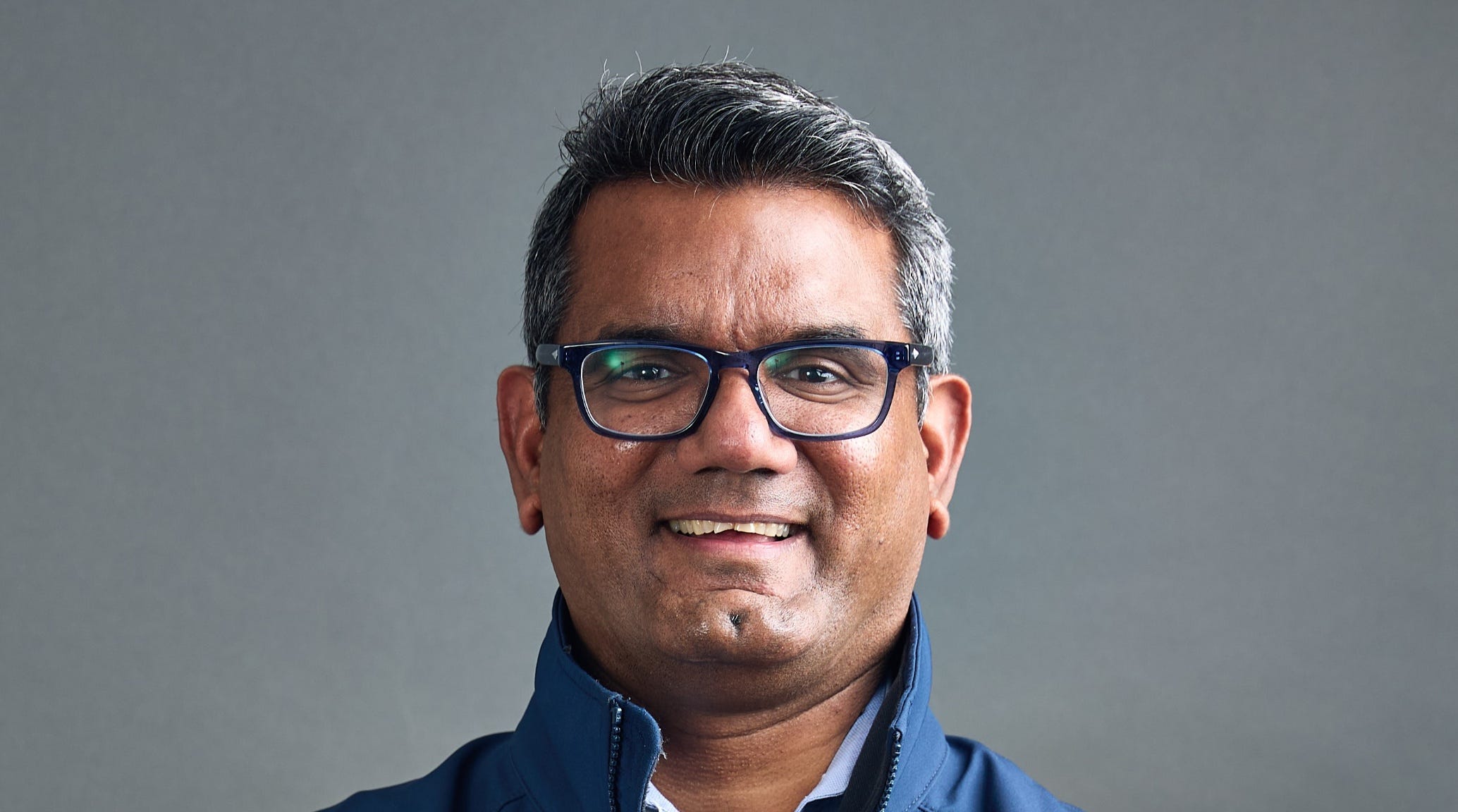
One of the most notable things about the six-year-old company is that it was founded and is run by Kunal Girotra. Girotra is well-known in Silicon Valley as a longtime hardware veteran. Among other notable chapters in his career, he helped start and run Tesla’s residential energy business, which he led until he left the company in 2020.
What did he learn at Tesla that he is taking into this new venture? What sets Lunar’s batteries and VPPs apart from so many others flooding the space? What is the future of the VPP business? I’m thrilled to have Girotra with me today so that we can dig into all of that and more.
With no further ado — Kunal Girotra, welcome to Volts. Thank you so much for coming.
Kunal Girotra
Thank you, David, for having me and thanks for the intro.
David Roberts
Ton to dig into here, but I would love to start at Tesla. I think these days listeners probably have a variety of associations in their head regarding Tesla, but this is about Tesla’s residential energy biz, which I think is viewed in the industry as pretty top notch. You stood that business up early. Those are early days for all this. I’m curious what you learned starting and running that business at Tesla that you are bringing to Lunar. What did you think you could do better on your own?
Kunal Girotra
As you said, Tesla, at least Tesla’s Powerwall product, set the foundation for a product that could be deployed in people’s homes. In some ways, you can credit them for starting that journey where putting batteries in homes became a possibility. That was a good thing, but I think the reason I left Tesla and started Lunar was there are 75 million homes in the US alone. While Tesla was on a path to build their products and deploy, there are a few differences that I saw that Lunar could tap into and create a much bigger impact than Tesla has.
A couple of them are — Lunar’s not a battery company only. We’re an electrification company. Every OEM or company trying to make hardware, Tesla included, was trying to focus on a widget — somebody else would make the battery, a third-party company would make the inverter, a fourth would have a smart panel, somebody else would have a heat pump.
What Lunar saw and what I saw was that the home was going to be electric. Yes, the start of that is generation, solar generation, storage, and control. Then you need a company to make a complete ecosystem of products so customers don’t have to piece together five different apps and installers don’t have to spend a lot of time installing these things in homes. This should become an appliance and something that is really plug and play.
Lunar’s approach was to make a differentiated hardware platform, and I can go into how our product is differentiated from, say, Tesla’s, and take an ecosystem approach. Our first product is the Lunar system, which takes care of generation. We have module-level power electronics that go behind the solar panels to generate more energy from the solar. Then we have storage, which is a modular battery system, not a monolith like Tesla has, which means it can scale in a person’s home.
David Roberts
One of the things that sets you apart here is that you are making your own batteries. You are designing and manufacturing your own batteries. These are not just commodity batteries, but you are also designing software integrated into the home and into VPPs. What’s interesting about Lunar is that you sell the battery and the software as a system, but you also will just sell the battery and also will just sell the software. These are separable products — they come as a package, but you can sell either one. You can just sell software to people who have other hardware installed. You are a both/and.
Kunal Girotra
I was going to get to that difference as well — the hardware is differentiated on the software side. I describe this analogy: think of us on the hardware side as the Apple of the home. We want to build neatly integrated products for the home that consumers can use and enjoy and get benefit from. On the software side, think of us as the Android, where we connect with any battery out there and then we provide this enterprise software platform to customers, who are not homeowners — those are third-party operators like Sunrun or utilities or retailers.
That is a big differentiator to your earlier question of how I do things differently than Tesla or others — very few or no other OEMs to my record do both. Most OEMs either make hardware and say, “You got to control my hardware with my software,” or, “I only do software,” and then they lose the granularity of how they control hardware. I can talk through the differentiator. You nailed it. Our enterprise software is agnostic to devices.
David Roberts
I wonder if you’ve ever had any pushback or questions from investors along the lines of, “It’s really hard to be a good hardware company and it’s really hard to be a good software company and you are trying to be a good one of both. Is that not somewhat crazy?” Have you not had some pushback? “Why not just hone in on the one thing you’re really super good at?”
Kunal Girotra
Yeah, someone told me, “If some investors tell you you’re crazy, that probably means you’re onto something.” That’s a fair point and I’ll tell you why we think we’re good at both and how as a company we approach that. When we started Lunar, it was clear that Lunar had to do both to be successful. Our thesis is working out — people are responding really well to our combined strategy.
The approach we took was hardware will build from the ground up, which is what we did. We hired a great team, a lot of ex-Tesla veterans. We have a full-on R&D lab in Mountain View, California. We design and build everything from the ground up. Every product that we deploy is Lunar IP and differentiated IP. On the hardware, we’re doing on our own.
On the software I had the same choice. But instead of that, instead of striving a team building it, I looked around and found the best company and team to acquire and made them a part of Lunar. That’s what accelerated our software journey. The company we acquired was a company called Moixa out of the UK. They had a platform called Gridshare and as you might know, the markets in the UK, Europe, and Japan are much more advanced and deregulated than the US.
These guys had done all the hard stuff that we could ever imagine with behind-the-meter batteries, controlling 50,000 devices in Japan alone — home batteries — and have 850 million runtime hours of doing this software. We acquired them, and that team sits in London. That software we brought into the US three years ago, and now it’s running across TPOs and energy retailers in California. We’re now going into Texas.
To your point, to build everything from scratch is hard and takes a lot of time. We took this approach of building hardware, because it’s hard to buy a company since nobody except Tesla was building good hardware.
Then on software, we acquired this company. I think now we have a great job managing those two efforts. I’ll pause here because I tend to go into long explanations. Before you let me run off — you want me to pause, I guess.
David Roberts
I think I have an audience uniquely welcome to long rambles, but I’ll cut in anyway. Let’s start with the hardware. You’re selling a system. The first question is this system — it’s a battery system with an inverter that is meant to be attached to a solar system. It’s not freestanding. You can’t just install one of these systems freestanding. You are installing it either with a solar PV array or attaching it to an existing solar PV array. Is that correct?
Kunal Girotra
That is not correct. The way I describe to people is it does what you said and more. It can do freestanding. We have deployed freestanding systems as well. The use cases I describe are: if you go to a home, you don’t have solar, you can use solar and batteries — solar and Lunar. This is how I call it, give people solar and Lunar. If a home has solar already, you can give them a Lunar system, which gets only storage. If you have a solar system in a home and you have an old solar, very small, 2, 3 kilowatts, you want to add more solar and Lunar, you can do that too. Lunar plays really well. Lastly, if you have a home where you have no solar and you don’t want solar, just batteries, you can do that too. It’s the most —
David Roberts
You can do that?
Kunal Girotra
You 100% can do that. We’ve deployed — there’s not a whole lot of demand for that in California, but as you go into —
David Roberts
Yeah, that’s more of a Texas thing.
Kunal Girotra
Yeah, and we are going into Texas now and we are working with energy retailers to deploy that model, to do energy arbitrage and day trading with the wholesale market. There is no limitation. That is the beauty about our hardware platform. It is the most flexible platform. Making the hardware for the first three years was the hard part, but now it is a software product because the hardware exists and I can deploy all sorts of firmware and software to make it do cool things.
The only thing it doesn’t do — that’s intentional — is it doesn’t provide solar only, even though we have an inverter. We have intentionally deprioritized use cases where a customer says, “I only want to do solar only.”
David Roberts
You don’t sell solar, you don’t sell the PV — you have a partner.
Kunal Girotra
I don’t sell the panels, but I make the module-level power electronics, I make the inverter. I could in theory sell solar and say, “Use my inverter for just solar as a grid-tied mechanism with the grid.” But that’s a use case I’ve intentionally deprioritized. The reason being, Lunar was started with the belief that batteries are the foundation for the electric home.
David Roberts
For sure.
Kunal Girotra
Some people think a smart panel is a foundation, some people think solar is a foundation. We believe that home batteries are the foundation for electrifying the home, and that’s why solar pairing was important. But we don’t do anything without batteries. That’s the main message. But we do all use cases.
David Roberts
Your battery, the battery itself is interesting in that, as you say, if you buy a Powerwall from Tesla, you just get the one big unit. You all have designed smaller modules that you can stack so you can create a battery of relatively precise size. How big are those modules?
Kunal Girotra
These modules are 5 kilowatt-hours each. You need two modules to make the system operate. You need a minimum of 10 kilowatt-hours on site, but it also expands to 30 kilowatt-hours, all behind one inverter, which is a 9.6 kilowatt inverter.
David Roberts
30 kilowatt — that’s the max you can get behind one inverter?
Kunal Girotra
Behind one inverter, but then you can stack multiple systems all the way up to 300 kilowatt-hours. We’re targeting small commercial very soon where we can go into offices and buildings and give that. For residences, 20 to 30 behind one is our most popular configuration. We started off with 20, meaning four blocks. Last year, we launched expansion to 30, and now we can do all the way to 300 as well.
Our vision is to continue to expand this into any use case. Homes are snowflakes — is what I call them. Every home has its own unique requirement — what wall do they have? Do they have space outside?
David Roberts
Where are your batteries? Are these meant to be outside, inside, on the wall, or on the ground?
Kunal Girotra
Again, I would use the word the most flexible, although flexibility is used in the VPP aspect. But this is the most flexible battery system you’ll find out there, meaning you can install it in the garage or outdoors. If you install it outdoors and you’re worried about cold temperature, don’t worry. We have heaters inside that can warm the battery up and make sure you can install it in the New England winter. It’s wall-mounted, but you can also floor-mount it. It’s the most flexible system. You can submerge it in a meter of water if it’s flooded, and it’ll still keep operating.
We call it the Beauty and the Beast. It looks pretty awesome because we believe, like Apple, you need to have products that homeowners are proud of. It doesn’t need to be expensive to make it look good. You just need to have a design philosophy. And then the beast, because performance is really high performing. You would never have to worry about this battery going bad or not surviving the extreme environments in various parts of the country.
David Roberts
I saw in an early piece that you were using NMC chemistry. But then when I looked at the spec sheet you all sent me, it says LFP. Did you make that switch? I’m curious when that switch happened and why.
Kunal Girotra
We started off with the NMC chemistry, and you are right. As of late last year, we have now officially switched to LFP chemistry.
David Roberts
For safety or performance?
Kunal Girotra
No, it’s all for cost. Safety is — and there’s a myth in my mind in the market that LFP is safer than NMC. For people like me who have worked on battery systems their entire life, they will all tell you it’s a myth. Safety is a function of chemistry plus system design. If you design your system well — you have millions of cars on the road, parked in garages, all using NMC chemistry, people have 200 kilowatt-hours of electric cars parked in homes. Very safe, and they drive all around — all NMC chemistry. The reason is the system design allows that.
For the ESS makers, nobody wants to prioritize the engineering work it needs to make NMC successful. Lunar did that. Ours is the safest battery with NMC. Unfortunately, the cost was just — LFP prices just went in a direction where, as someone who has asked to deploy a lot of systems and has to be practical about it, cost is where LFP wins hands down.
David Roberts
As I understand it, there is a slight performance hit, though, on energy intensity. Did you lose a little volumetric?
Kunal Girotra
Great question, you know the details of this . There’s a 30% energy density loss on a cell level. But remember that NMC requires a lot of safety design, which takes a lot of space. When you remove that for LFP, we ended up in the same exact 5 kilowatt-hour form factor. For an end customer, they don’t care because it’s literally the same product and the same output of energy. That’s why this nuance — whether it’s NMC, LFP — only certain installers care about. But for the end customer, it’s a 5 kilowatt-hour system. It did not change. Performance is the same, our cost just got better.
David Roberts
Another thing that you boast about your batteries is that the inverter is integrated. Can you explain what that means and why it is significant?
Kunal Girotra
The inverter is the brains of the system. It’s the thing that orchestrates the power control, converts power from DC to AC, has a lot of sophisticated controls in it. We believed making that in house was the first requirement. Most companies try to go to China or somewhere and white label stuff. We were like, “No, we’ve got to make that. That’s the core.” Any power electronics is made by Lunar.
The integrated inverter means that when you install a Lunar system, you go to a wall, you put these mounting brackets first, then you put the 5 kilowatt-hour blocks, like Lego blocks. You install them and then on the top is the inverter module, and then you have these covers that go on top of the system. To a customer it looks like a complete integrated system.
In the past, outside of Tesla, most people were selling these systems as, “Buy a dumb battery from someone else with some DC — DC or BMS. Buy an inverter from a third party,” and there would be two different things on the wall with lots of wire and conduit. What we have done is said, “This is for the end customer.”
If you think about a homeowner, most people don’t know what a kilowatt is, what an inverter or battery is. For them, this is a Lunar system. For the really detailed people — like you and the installers — if you look behind what the Lunar system is, it’s an inverter on the top, which is a DC-coupled system. It takes solar and battery both. Underneath the inverter are 5 kilowatt-hour battery blocks, which have their own integrated DC-DC.
David Roberts
When I saw the picture of the system on a wall, there are two boxes.
Kunal Girotra
Great point.
David Roberts
What is that second box? If the inverter is in the main box with the batteries, what is that second box — and what is it doing?
Kunal Girotra
The second box is the Lunar Bridge. We call it the bridge because it is the bridge between the utility and the home. That box — it is not an inverter. You can call it a circuit breaker panel. It is a circuit breaker panel that we provide.
David Roberts
Is it meant to replace your existing circuit breaker panel?
Kunal Girotra
It can. Going to the world of flexibility, you can choose to replace it as your main circuit breaker panel, or you could choose to keep it as your sub panel. It is your choice. Going back to the homes are snowflakes — some homes require you to relocate loads. When you relocate loads, when you install a battery system, they often install subpanels.
Our point was, when you’re relocating loads, just give them a circuit breaker panel and reduce the number of boxes. Let them install these in the Lunar Bridge itself. In those cases, when you relocate all your loads, yes, the Lunar Bridge becomes your main panel. In the use cases where the meter and the main in the home — like in the East Coast home — are separate, you install the Lunar Bridge in between, you don’t do any load relocation. That is also an option.
David Roberts
This is all stuff that installers will understand and appreciate — the homeowner does not have to.
Kunal Girotra
Homeowner benefits from fewer boxes. If you talk to a lot of homeowners who got battery systems from other competitors, the one thing they’ll complain about is the pictures look very beautiful with one box. But when I get these things installed, I get a wall full of shit on my wall — pardon my French. Lunar’s objective was you got to minimize the stuff on the wall, make it look elegant, vertically stack everything, have just two boxes. We’ve achieved that goal very well.
To finalize, the circuit breaker panel is not just a circuit breaker panel. It has a relay which disconnects the utility from the grid, which is necessary once the utility loses power. There’s an outage — islanding is what it does. The third thing it does is it has smart breakers where you can now install individual smart breakers. You can control certain loads in the home. Instead of a full smart panel, now you give them an ability to turn off the biggest loads that you really care to turn off if there’s an extended outage. That’s why I say generation, storage, control — everything provided by Lunar.
David Roberts
I did a whole episode a few years ago on digital circuit breakers. I don’t know if listeners will recall this, but existing circuit breakers — most circuit breakers out in the world — are physical. I don’t know if people appreciate this. They’re little spring-loaded physical devices. It is wild that our whole grid is depending on these little things. A digital circuit breaker replaces — there are no physical, no moving parts, which means it’s faster, more precise, and you can put programming in it, you can put a computer in it, instead of it being a physical device. Fascinating stuff. I recommend people go back and listen to that whole episode on digital circuit breakers. It opens up a whole world of interesting stuff.
When I buy the system, I get a big box on my wall full of battery modules and an inverter module on top. I get a circuit breaker on my wall. The other part is these little widgets that you are attaching to the solar panels. What are those?
Kunal Girotra
Those widgets are called maximizers, and they are essentially DC-DC converters that attach behind every solar panel. The purpose of those is you are entering an era where people are putting a lot of solar on their home. They’re maxing out because solar panels are becoming cheap. They’re putting a lot of panels in homes and they’re putting it in all sorts of roof planes that are cut up and not in one plane. If you have an alternative to our maximizers, the alternative to convert power from DC solar to AC is a string inverter where —
David Roberts
I’ve heard of those.
Kunal Girotra
— where you connect everything in a string of series and parallel, and the maximum power point tracking for that string happens at the inverter level. Meaning, if one panel is on a wrong plane, or if one panel has a bird dropping or a shade, then the entire string behaves as poorly as that one panel. That is how, 20 years ago, string inverters were. Most people had that.
Now module-level power electronics — and this is not — Lunar has made it better, but there are other companies who did this: Enphase, SolarEdge, they have a different version of that, but they do that too, where we take this maximizer which maximizes the output on a per-panel basis.
If one panel goes bad because of being put in a different plane or a shade or the sun, there’s an orientation difference, it doesn’t impact the other 20 or 15 panels on that. That becomes quite important as you install a lot more solar and a lot more tricky planes of the house. It gives anywhere from 2 to 10% more energy than a string inverter.
David Roberts
Interesting.
Kunal Girotra
I believe that every homeowner should be maximizing the energy and the electrons that come out of the solar. This is a good way to do that. Why did we make that? Because you want to give the customer an integrated experience. You can’t buy stuff from other people’s hardware and try to just do software integration. That becomes extremely hard. You’ve got to decide some pieces that you take ownership of and say, “To give this fantastic experience, I need to build the electronics on my own.” That was one of the things we chose to do on the maximizer as well.
David Roberts
Really interesting. You built your own batteries, you got your own inverter, you got your own circuit panel, and you got these little maximizers that attach to the panels themselves. Is that the system? Did I miss any pieces?
Kunal Girotra
You got it exactly right.
David Roberts
Here’s a question. Say I live in a place where there is no net metering, where I can’t get paid for my excess exports, and I live in a place where there are no VPPs. I can’t get paid for my contribution to whatever. It’s just me and my battery. Where does that pencil out? In other words, where do you need these extra revenue streams to make this pencil out — or does it pencil out without those revenue streams? I guess that will depend on the place.
Kunal Girotra
Ultimately, the good thing about these systems is these are energy generation and storage systems which harvest electrons, you can move things around. That’s how I say simply to people. The benefit of them is very locational dependent. In places where the sun shines a lot and electricity prices are high — like California — and the grid is unstable, it’s four benefits in one system. In California, it’s a no-brainer for any homeowner to get solar, storage, and smart software like Lunar AI to get the lowest cost of energy. There are so many outages, you get 24/7 power and you never lose power.
The grid is stressed at times, and it pays you for VPP events. The fourth benefit is you run off of clean energy. California happens to be a place where all benefits come together. That’s why you’re expanding now, though?
David Roberts
That’s what I’m wondering about. When you look at a new area, what’s the minimum viable policy environment?
Kunal Girotra
As we expand, we’re expanding into markets with at least three of the four. The energy prices need to be high —
David Roberts
And variable? Do they need to be varying throughout the day — time-dependent price?
Kunal Girotra
Customers buy these things for various reasons. If there are customers who say, “I need this to pencil from day one,” meaning if I lease it, my lease cost needs to be lower than the electricity bill, then if the state has net metering, the benefit is not as much. Because this product has multiple benefits, you would think that Texas would not be a place where — leaving Base Power aside just for solar storage — you would think Texas would not be a place for high deployments because the utility rates are not that high.
But it is one of the highest deployments of home batteries in that state because outages are quite high. The winter storms, the summer AC usage is quite high. People want outage protection. They say, “I’m getting this, why would I get a generator?” They know that VPP programs are growing — installers are installing a lot in Texas. In Florida, they install because of hurricanes. In some markets, resilience leads the adoption. Then you get VPPs. In some markets, energy savings leads the adoption. In some markets, VPPs will lead the adoption.
David Roberts
I would have thought in Texas that arbitrage would have been the lead thing because prices swing so dramatically and widely in Texas. That price swing is what you need to get that arbitrage value. I would have thought that would be the primary value stream in Texas.
Kunal Girotra
It depends on how the product reaches a customer. If you go through the installer route, they have no ability to influence arbitrage, so they just sell based on resilience. If you go the energy retailer route, which is what Base Power is doing, then the energy retailer is the one doing the arbitrage. They use it as a physical hedge. That is a growing model.
But there is a non-arbitrage big demand for Texas, which is just the installer route. People are saying, “My electricity bill is rising and the outages are increasing, so let me get solar storage instead of a generator.” The generator crowd is now realizing this is a much better 24/7 power system as compared to getting fuel-based systems.
David Roberts
I wish the data center generator crowd would come to the same realization. One of the subjects we return to a lot around DERs on this pod is the cost of customer acquisition. It’s always a huge — when you see the charts of the soft costs facing companies in this space in the US, customer acquisition is always a huge one. How do you think about that? Are you out knocking on doors? Are you trying to draft on Sunrun’s already high visibility? How do you think about customer acquisition? It’s tedious to round them up one at a time.
Kunal Girotra
I agree. Prior to starting Lunar, at my former employer, I also led — towards the end I ran their entire SolarCity sales and deployment platform, and we worked very hard to create a digital experience for customers to easily buy things online so that you don’t have to do door knocking, etc.
Having said that, the traditional route to sell these systems is through salespeople making it clear to customers how to buy it. I do agree that the soft costs are high in the US compared to Australia or other places and customer acquisition makes it a big part. Where does Lunar believe — how can Lunar contribute to get this to lower? We are a product and a technology company. We provide our products, both hardware and software — hardware, the boxes — to installers and we then do marketing and brand awareness to make people understand the value of these systems.
David Roberts
Are you doing that to the customers or to the installers? Because it almost seems like installers in some sense are your customers.
Kunal Girotra
Correct. We have two customers — the installers who end up reselling the system. But we believe that to customers over time we will do — we do some, but not a whole lot. We want to continue the brand marketing education as Lunar grows. We have a beautiful app that customers find, and the feedback is this is the best app that gives you full energy understanding of a home better than anybody else. We believe that will make people who have the Lunar system refer to their customers. How often do you refer an energy system? Very few. But you can now say, “This is a great system, you should go try it.”
We believe we’re going to be — if you look at Samsung, for example, you can’t buy Samsung products directly on their website. You have to go to Best Buy to buy them. But Samsung does a lot of marketing to tell people how good their products are and why you should buy them. We’re on that path where we don’t sell directly. We go through resellers, at least for now, and we believe that’s the right path. The cost of acquisition is high. The way we can reduce that is by making products really simple.
I cannot emphasize how important that is. One of the reasons the customer acquisition cost is high is because people believe these things are very complicated. How you make it simple is important. That will reduce the customer acquisition costs.
The second one is for the people who you do initially sell, you need to make it super simple on the customer app and show them why these systems are good for them. Show them the savings, accurate savings. Through our app, if you buy a Lunar system, you get VPP payments. If there is a VPP program in your area and we pay them through the app on a monthly basis, this is the only product that you buy and you get paid. When more and more people realize that this is how simple it is, that will drop the customer acquisition cost further.
David Roberts
Let’s talk software then, because that’s a huge piece of this. One of the things I’m a little hazy on — there’s the software that runs your individual system and you boast that this is AI. As I understand it, the system is controlling — it’s got connection and control of the panels and the battery and the EV charger and the heat pump, water heater, whatever. It is monitoring current grid prices, weather conditions, the weather forecast, maybe your past behavior to see when you might be around using lots of power. The AI is very smartly managing your power in a way that you claim saves money over and above even competing systems. That’s one software bit.
Then there’s Gridshare, which is the utility-level VPP software. Do I have that right?
Kunal Girotra
100%. You have done your research well.
David Roberts
Let’s start with the AI then, because this is — is this really — because you have these Span panels now, the whole game of managing and controlling residential energy through a single interface is a very big thing spreading around. How is it that you can say yours works better or makes homeowners more money? What’s the magic sauce? There is no one else trying to use AI. It seems like a pretty obvious place where machine learning’s ability to crunch a lot of numbers from a lot of different sources is very applicable.
Kunal Girotra
I can tell you what we do and how we stand by it. Then I can touch upon competitors a little bit as well. You described it well — this is all machine learning. There was a different name before, now it’s all called AI. That is a bit of branding. But essentially these are machine learning algorithms that we run. The first thing we do is — the key thing to understand is that you’re installing a power plant in a home. A solar storage system is essentially a power plant.
One of the key elements of that, which people don’t realize, is that you’re measuring the site meter of the home. You know exactly what in and out the energy is going in the home. The fact that you can measure that and compare that to someone who controls thermostats, for example — those thermostats are just, you’re controlling the device, but you have no idea what the rest of the house is doing. With a Lunar system you have all the information — you have generation information, meaning how the weather is going to affect and how much solar you can produce the entire year.
Then you have the site information. You know exactly how a home — is it Sunday, are they having a party, is it a weekday? You know the entire patterns of the home, which by and large are the same with occasional spikes. The third thing is in a place where the utilities are going insane with hourly or 15-minute different rates, which is where California has gone now, you have a very good understanding of the import prices that change every hour or every 15 minutes. In the NEM3 in California, even the export prices change every 15 minutes.
David Roberts
They have rendered a system where it has to be software 100% doing that for you — a homeowner with an Excel spreadsheet, there is no way to keep up anymore.
Kunal Girotra
Exactly. With these three variables, we have strong forecasting mechanisms for solar, for the load based on past behavior, and the utility rate is there. We feed these forecasts into machine learning algorithms. Every day we create a 48-hour plan. Our plans are always 48 hours. Out of the 300 or so plans we generate, the constraint is the lowest cost. The machine learning algorithms go to work. They have a constraint, and they give a 48-hour forward plan to the home.
After every 30 minutes we look past the 30 minutes — did it meet our plan or did it not? Did consumption go up? Did something happen to the weather? If things are on track, we keep the same plan. If things are not on track, then we change the plan.
David Roberts
A plan could just be, “I’ll charge the EV at this hour and I’ll heat up the water in the water heater at this hour. This hour I’ll store the solar energy that’s coming in and the batteries. This hour I’ll 100% grid,” all that stuff.
Kunal Girotra
All that stuff. That is the plan. How do you move the electrons, is what I call it, and where do you move them?
David Roberts
Because it’s machine learning, it gets better as it learns about the home’s behavior.
Kunal Girotra
Correct. The utility rate plan is what it is. There’s no learning there. It’s just published. The solar weather — there’s a forecast. There’s some learning there. The main thing is it learns about the home’s behavior and as time goes by it gets better at forecasting. Consumers can be a little fickle sometimes. The main thing is based on these machine learning algorithms.
Our deployment of Lunar systems in the last year of 2025 — we put it to test because our simulations were showing this should save a lot more money over self-consumption. Then our customers, rightfully so, are skeptical and say, “Show it to me.” When we started deploying our Lunar systems, we deployed Lunar AI and on average we saved about $450 more — $380 to $450 more for a 20 kilowatt-hour system in California.
David Roberts
Relative to a system that is just maximizing self-consumption?
Kunal Girotra
Self-consumption, yes. It doesn’t take into account the extra benefit you get from self-consumption, which is a big one already. Self-consumption does get you a lot of the benefit over just from the grid power. But to get an extra $350 to $450 just through software is pretty unique.
David Roberts
That’s going to be very market dependent. That delta is going to be specific to California. All these considerations, as we both understand, are different in every state. There’s going to be a different set of considerations.
Kunal Girotra
Full disclosure — you’re right. The reason it’s so good in California is because the utility rates are so dynamic. The reason it’s so good in Japan — we deploy the same algorithm in Japan where we acquired Moixa — is for the same reason: they have a tariff that changes half hour. The reason this will be great in the UK is because companies like Octopus have an agile tariff that changes every 15 minutes. We predict that this is the future. We predict this is where utilities are going as they’re seeing —
David Roberts
Dynamic pricing — wild to me that it’s not already everywhere —
Kunal Girotra
Yeah.
David Roberts
— universal. You can’t do anything else without that. On the VPP — you’ve got this software that’s in the consumer side house, this AI that’s learning, planning, maximizing value for the consumer. Then you’ve got this other software called Gridshare, which utilities run VPPs with. As I understand it, Gridshare — you can sell Gridshare to a utility without any hardware being involved at all. Utilities can come to you and say, “Hey, we want to start a VPP, we need some software to manage it. Can we have Gridshare?” Is that what Gridshare is?
Kunal Girotra
That’s correct. I call it — instead of a utility-facing software, I modify it and say it’s an enterprise software, meaning companies use it.
David Roberts
Aggregators.
Kunal Girotra
Aggregators, yeah. The customers could be utilities, but they need not be utilities. Of course, utilities are going to be one of the big customers. In different markets you have, even in California, even though it is not a deregulated market, the generation is provided by these community choice aggregators, which are the retailers of California. They procure power and they procure clean power.
We have a contract with three of the major community choice aggregators in California. They are called AVA in the Oakland area, SVCE and PCE, all in the Bay Area region, where they use Lunar Energy’s Gridshare software platform as a platform to manage all their distributed energy devices in people’s homes in their territory. Their grand plan is to control devices and use VPP — and reduce their resource adequacy purchases. Down the road, the holy grail is to use them and compare buying day ahead, real time in the Cal ISO market when the FERC rules get fully clarified. We are at the bleeding edge of now three retailers using us.
David Roberts
I did a pod with Seth of EnergyHub. I’m sure you know EnergyHub.
Kunal Girotra
Yeah, absolutely.
David Roberts
They came out with a white paper recently about VPP — it’s about levels of VPP readiness. I’m sure you read the paper. It’s fascinating. He introduces in that what’s called the Huels test, which is, “Is your VPP convincingly enough mimicking a power plant that a utility can’t tell the difference?”
There are lots of VPPs that are just, “I’m an aggregator aggregating water heaters.” “I have 50,000 water heaters,” or “I have 50,000 thermostats.” You have 50,000 home systems. You’re not dealing with individual devices, appliances, you’re dealing with home systems. That, it seems to me, would make your VPP comparatively more flexible than an appliance-specific VPP.
This brings me back to these levels of readiness and the Huels test. If you have 50,000 installed Lunar systems and you’re controlling those whole homes and all 50,000 of those whole homes are involved in your VPP, does that VPP pass the Huels test?
Kunal Girotra
Good of EnergyHub to clarify those levels, just as autonomy levels were clarified by the autonomy companies. Some clarifications and then an answer for the Lunar Gridshare reminder — those systems need not be Lunar systems. It could be any battery systems. We’re agnostic — we welcome more batteries to come join our platform.
David Roberts
But am I right that a VPP composed of whole home systems would have an advantage to a VPP —
Kunal Girotra
I was getting to that. I do believe — and this is what I tell people — that thermostats were the DERs of the last decade. The next decade is going to be all about whole home systems because that’s where the utilities can make sure that this is a true power plant ready to either shed load when I want to, export energy when I want to, and it co-optimizes based on the consumer — each home level’s performance. If I have 10,000 homes that I am optimizing, one way to do it is, “I want 2 kilowatt-hours from every home,” and be a dumb VPP provider that just provides raw capacity or frequency, or the other way is to do what Lunar does — we look at each home on a case-by-case basis and every home is a snowflake.
Here again, in some homes the consumption could be low, the batteries could be at 90% SOC. You could get 8 kilowatt-hours from the home without disturbing the home economics. That co-optimization is what is the level three or even level four, which is what the grid needs. I would describe that levels into two ways. One is what can your devices do? In that case, I think we’re as good as level four. Our devices with our software and even other devices can do a lot. We can co-optimize, our latency is pretty quick. We’ve shown last year with just the DSGS program —
David Roberts
Telemetry? Got to throw telemetry in there fast.
Kunal Girotra
Telemetry and the latency is pretty low. That part we’re pretty good at. The fact that we do whole home tells you that we are in that Level 3, Level 4. The next part is how well are you integrated with the grid side — on the grid terms or the grid control systems, the SCADA systems of the grid. Now that, I would say, Lunar hasn’t done that part well.
We excel on the device and the home battery side and we work with partners, but we need more willingness from utilities to go all the way and connect with their Schneider systems or their SCADA systems so that in the control room a grid operator can just give a signal and then these devices show up. But the devices will show up and we have a full platform that does that day in, day out.
David Roberts
That will be utilities gaining some experience with this, doing it a little bit more.
Kunal Girotra
They have a lot of experience because VPPs or DERs have been around for 10 plus years. There has been a lack of belief that these devices will be there.
David Roberts
The tech is there from just even a few years ago.
Kunal Girotra
I’ll give you two examples which I think will highlight why the game is changing and utilities are realizing how powerful this can be. One example is — Seth might have mentioned this — in California, last year the DSGS program, Sunrun alone dispatched about 500 megawatts of home batteries. This was the first time the number reached triple-digit megawatts and almost 500 megawatts. Lunar dispatched about 130 megawatts of those because all the non-Tesla batteries were dispatched by us. Tesla does their own dispatch. That number last year was 500. In 2024 it was less than 100.
In 2023 it was 5 megawatts. That realization — even the state, even the PUC and the California Energy Commission — is now “Wow, that’s real scale.”
David Roberts
When do you think California will hit a gig — next year? Two years?
Kunal Girotra
They could hit a gig next year easily. If the DSGS funding is now in question, they’re trying to figure that out. But I was speaking to somebody at the CEC and they’re big believers. They’re saying, “This has really proven that this can — you don’t have to build more peaker plants. This is a gig, 2 gigawatts of capacity.”
David Roberts
Here’s a couple of semi-skeptical questions about the VPP angle. I think they’re related. If you’re controlling, say, 10,000 Texas homes in a particular region, isn’t it going to be the case that the consumption profiles of those homes are going to be substantially correlated? In other words, they’re all going to have spare capacity at the same hour and they’re all going to be using their full capacity at the same hour. Is there enough differentiation to give you the variety you need to cover? Do you not end up with a bunch of highly correlated households which takes away a little bit of the value? Does that make sense?
Kunal Girotra
I see your point — if it’s a hot summer day, everybody’s going to turn on an AC, especially if you’re deploying systems in a location. That could be true. But the amplitude of consumption definitely could be different depending on the number of people in the home and how big the family is or how big the home is. We’ve seen that repeatedly. We have now thousands of systems deployed — last year was California, this year we’re expanding to Texas and other states — and we see so much variability even in the same region.
The load depends not just on the weather and the time of the year, it also depends on the people living in the house and how big the home is and how small the home is. It’s quite fascinating — there are homes which are such efficient homes, they consume very little energy. The next-door neighbor could be a very inefficient home and it consumes five times more, has two EVs, has different loads in the house. You’re partially correct, but the consumption patterns change quite a bit at a home level.
David Roberts
Got it. A related question. In Texas, the big value here is arbitrage. Texas has this energy-only market, which means that prices are close to real time and they fluctuate pretty wildly depending on when things happen. This is a perfect market for arbitrage. But then here comes Base, here comes Lunar, installing batteries at this crazy pace.
Is it not the case that with each battery you install, you incrementally reduce the amount of arbitrage available? Between you and Base, are you not going to arbitrage yourselves down to a flat demand line at which point your business will be gone? Are you not — I’m curious how your investors think about this too, because either your investors think that that’s not going to be a problem or they think you’re not going to solve it. What do they —
Kunal Girotra
Everybody thinks that the problem is so big it’s going to take many years before. That’s the answer. I agree with you. Fundamentally, if every home had a battery magically tomorrow, then your volatility is significantly reduced and then your business model is at risk. That’s why Lunar’s business model is — there are different business models that we continue to find, but it’s a far route away from volatility being reduced.
The other thing on the Texas thing that we should talk about is — maybe you already know this and I’m sure you do. When you deploy batteries without solar in Texas, you are importing energy to charge the batteries. You are paying the T&D charges to CenterPoint. Those are not forgiven and those still remain. Even though you export energy back, the T&D charges don’t get canceled out.
The ideal retailer model in Texas would be to have a solar storage offering combined — that then becomes a true distributed power plant, where then it is a physical hedge as a retailer. Conceptually what you described is correct. I believe it is going to take a long time before the volatility drops. The other factor is the weather is the wild card because it keeps continuing to surprise us. The last couple of years were quiet. This year has been a bit volatile already.
David Roberts
That’s not getting less volatile over time. That’s for sure.
Kunal Girotra
Totally.
David Roberts
Let me return to a couple of things you said before to tie them together. As I understand it, if I am in California and I want to buy from Sunrun a solar system with a Lunar battery system attached, all told, it’s in the order of $20,000 to $30,000. Is that roughly —
Kunal Girotra
Sunrun, 99% of their sales now are not upfront sales. They lease the system. In fact, not just Sunrun — now most installers have moved to a leasing model where the price that they charge for leasing a solar and a Lunar system is going to be lower than what they paid the utility before getting the lease system. If you paid $300 a month for your electricity bill, most likely your Lunar and solar system will be between $200 to $300. It will be lower. The customer feels, “I’m paying day zero lower costs.”
There’s no upfront cost. You’re saving money from the get-go.
David Roberts
Do you eventually own that? Is that how these leasing things work?
Kunal Girotra
This is a 25-year lease, so eventually, after a certain period, yes, you can buy them back. If you think about it from the perspective of a lease provider like Sunrun or others, because they get to control the system, they get to participate in these systems in different virtual power plants, so there is less incentive for them to give it back to the customer because they are now power plant assets that they can lend to the bigger power plant, the grid operator.
Base is doing a similar model in Texas. They’re like, “We’ll just put the devices and own them.” Sunrun does that. Lunar’s not gone on that model yet where we’re not taking the full risk of owning the assets. We’re still a technology provider. We believe this is the better model to partner with every lease provider, every energy retailer.
David Roberts
Wait, is Sunrun leasing to the customer the solar panels and your system?
Kunal Girotra
Correct.
David Roberts
Your system is included in the lease?
Kunal Girotra
Yes.
David Roberts
This gets back to customer acquisition a little bit. One of the things I’ve been obsessed with on this podcast now for a couple of years is — over and over again we have this distributed energy that has all these benefits. Installing batteries in homes has all these benefits. But there’s this missing money problem. The social and regulatory system we have set up does not value those things correctly. They don’t sell as fast as they might in a perfect market.
Where can we find that money? Every time you install a solar plus Lunar system on a home, you are creating a little increment of grid capacity, which you then manage as your VPP. Guess who desperately needs grid capacity? Maybe you have read the news, maybe you have picked up a newspaper recently. We have all these data centers, all these hyperscalers that desperately need grid capacity and have giant bags of money and are willing to pay virtually any price to get on the grid as fast as possible.
Here you have a machine for creating grid capacity. I’m no financial genius, but you need the money, they’ve got the money. Surely we can work something out. Surely there’s some way to set up a system where the hyperscalers who want grid capacity pay for the VPP capacity that you are creating. Then you can go to customers and just say, “We’ll just do this for free.” Furthermore, you could go to customers and say, “This data center that wants to hook up outside of town is paying for this system for you.” What a great bit of PR for the data center, for the hyperscaler, a free system for the customer, a better operating grid, more — win, win, win, win. Everybody wins. Have you discussed such a thing with any hyperscaler? Is this a gleam in your eye? Is this something that people are talking about?
Kunal Girotra
You’re spot on. We are having several such conversations with the hyperscalers exactly how you describe. You nailed it. It is a win-win for everybody. The fact that you can deploy this capacity much faster than interconnecting a gigawatt power plant — in two years you can deploy, or even less than that, deploy these systems and then the moment they get deployed, software can start controlling them. It is exactly the win-win benefit you describe. Obviously I can’t describe the detailed discussions we are having.
The challenge, and I think it’s a challenge we’ll overcome — it’s a little around — if it was a deregulated market like in Texas, it would be different. But then because you have a utility who has to benefit the customer, the rate billing for the customer happens with the utility, it becomes a tri-party negotiation, which is not a challenge, it just takes a bit longer. If PG&E is the utility provider for the data center and also the customers in that region, then you need a tri-party deal between the hyperscaler, utility, and someone like that.
Then what is the mechanism? Where does a credit go? Does it go on the bill or do you get paid? Is there an upfront system? Who owns the system? I agree and I hope Lunar is one of the companies — and I’m sure we will be one of the companies — who will announce something like this, hopefully soon. We are working behind the scenes, but I agree that this is a way to add grid capacity that people haven’t been focused on. It’s all the “Let’s put more nuclear, let’s put more gas upfront,” which is great, but it’s going to take 10 years.
David Roberts
But it turns out no matter how much money you have, you can’t magic up a gas plant before 2030. It seems to me the circumstances are inexorably pushing them in this direction.
Kunal Girotra
I fully agree with that. The last thing I would say as we end is that we have already shown a model. We did a program at PG&E called the Save program through Sunrun where Sunrun deployed a bunch of home batteries which Lunar Gridshare controlled, and they were deployed in areas where the distribution transformers were heavily congested.
PG&E gave us the data and there were a bunch of home batteries there and we would give them a forecasted capacity every day and say, “In this region there are so many batteries with capacity.” They would then return us with a load shape of the transformer saying, “This day this transformer is going to be loaded.” We would go and shave off that peak with home batteries with our software. We’ve done that and that same model needs to be applied in gigawatt scale to hyperscalers and then it is a win — win for everybody.
David Roberts
You’ve got this system, it’s whole and complete, ready to be installed in households. I’m wondering if there is an obvious next product for you or if you are focused on just selling at this point.
Kunal Girotra
It’s both. I’m always selling, always focused on expanding our systems all over the country. That’s number one priority. In addition, we continue to innovate. We’re innovating on two fronts. Reducing cost is also innovation. We’re focusing on getting our products at much lower cost. Second innovation is — I think of charging as a next frontier before we do heating and cooling. Generation, storage, control, and charging —
David Roberts
That gets you most of it, right?
Kunal Girotra
That gets you most of it.
David Roberts
EV charging is the big —
Kunal Girotra
But doing the AC charging, Level 2, is pretty boring. There are 100,000 chargers out there. We’re focused on how we do high power DC charging, supercharging for the home, and also combine vehicle-to-home and vehicle-to-grid. We can talk a little more about that as we release it. But it’s not going to be a run-of-the-mill charging solution. It’s going to be differentiated — so customers feel it adds a lot more value to their home and also if they have an EV next to it.
David Roberts
It seems in terms of the regulatory and legal environment, at the very least, you have a lot of runway, you’re out installing systems and things are a go. I wonder if there are obvious — when you think about policy, when you think about policymakers making things easier for VPPs, are there obvious asks of policymakers, is there a big thing that you would like policymakers to do or is it incremental things or are you worried about policy at all?
Kunal Girotra
Of course, I think policy is a big — this is a regulated industry by and large, so there is a huge impact on policy. On the VPP side or the energy market side, the thing that I would want as a magic wand solution is rapid implementation of FERC 2222. Different ISOs have implemented it at a different level.
David Roberts
Catch us up on which one that is.
Kunal Girotra
FERC 2222 is a ruling that lets behind-the-meter assets participate directly in the wholesale markets. Imagine if every home were able to bid directly in the wholesale market. You would be able to use software in a much freer manner compared to having these bespoke VPP programs which are bilateral and specialized funds coming from utilities and CEC, etc. FERC has passed that ruling. Different ISOs are taking their time to implement it. California ISO has done it. There are a few others that have done it, but not to the full extent.
I want the free markets to be allowed to really play in such that then you’ll see a lot more deployment of home batteries because now they can really trade directly with the wholesale market. That’s one.
David Roberts
Let me ask about this. Don’t you worry that a situation in which every household is a participant in a wholesale market gets you something like a computational overload? That seems very difficult to manage. I wonder how you think about the sentiment that I hear a lot — that we need to devolve some of this down to local markets, have DSOs, have local markets that then can just be treated as a unit by the wholesale market, rather than the wholesale market trying to reach down its tentacles into every individual household. Don’t you think we’re going to break wholesale markets if we try to move from a situation where they have, from a thousand participants to millions?
Kunal Girotra
To be clear, when I say each home should be participating, the homeowner itself is never going to be interested. It will be automatic, it will be an aggregator, and it will be an aggregator who aggregates. The margins are not going to be very high for an aggregator unless they have significant capacity. I would imagine the number of participants is not going to increase and the ISOs are going to see an aggregate capacity, not these individual homes doing it. I’m not worried about overloading the ISO. It is just going to end up having whoever has the best software and is able to aggregate a bunch of homes — maybe Sunrun does well there because they have leasing models and they own all these assets.
Although I do agree with you that DSOs or a local market would be a lot more efficient because you are now also dealing with distribution level impacts which are different from the overall ISO level. That part I do agree. But in terms of every home becoming a participant and negative impacts, I don’t see a whole lot. I think it is just going to be beneficial because then you truly use the existing capacity of the grid as opposed to always believing that you have to overbuild the grid three times by putting everything centralized.
That part is what I feel concerned about — we shouldn’t always build our way out of things by just building more, and this allows us to use the existing capacity in a much more efficient way.
David Roberts
Very live argument. Don’t you feel the logical endpoint of this is that the utilities will be the aggregators? I’m wondering how enduring the role of third-party aggregators is going to be. It seems to me the logic of this eventually is that the utility will just do that as part of its utility.
Kunal Girotra
I’m a big believer that I’m here to make this technology real and possible. How it happens can take various forms. I’m surprised why no utility until the last 20 years has not decided, “We will own and deploy systems because these are our customers, we have the most data about them and I can give the most efficient system and control them.” I do think that’s the logical endpoint. But the fact that they’re so hesitant to do anything behind the meter and they’re so used to doing things front of the meter, I wonder if that will change.
Now you must have seen that there was an RFI by PG&E talking about rate-basing 5,000 batteries for the first time. That’s a big step up exactly how you described.
David Roberts
This is a distributed — we did a pod on this too with Pier LaFarge . It is a distributed capacity procurement, DCP.
Kunal Girotra
Correct.
David Roberts
As you say, the utility knows where —
Kunal Girotra
— the constraints are —
David Roberts
— these DER systems will do the most good. There is a logic to them directing where they are constructed.
Kunal Girotra
I agree with you. That would be the — and look, my point was that Lunar is a technology provider. If we need to provide the technology to aggregators, we’ll do that. If we need to provide it to utilities, we’ll do that. Our job is to make it very easy to both deploy systems and control them. While we will play a role in shaping the business model, we’re also happy to go along with where the business model goes.
David Roberts
If listeners want one of these — right now you are selling in California. Next step is Texas and Delaware. How soon before we are nationwide?
Kunal Girotra
We’re expanding to eight more states this year: Texas, Utah, Nevada, New Jersey, and a few others. We’re making plans, and we will be nationwide by next year. Right now, we’re a bit capacity constrained. We are expanding our manufacturing. We’re fully assembling our products in North America. We’re domestic content qualified.
David Roberts
I was going to ask about that, about your batteries — you don’t have to — the foreign content rules, all that mess. Are you skating around that?
Kunal Girotra
I wouldn’t say skating around that. We’re good because we believed in making in the US from day one. Even our foundation before IRA —
David Roberts
Even the materials? That’s the challenge.
Kunal Girotra
Can you make 100% supply chain free of foreign content? That’s hard. But can you start with assembling your products in the US? Yes, and we did that from day one. We have two contract manufacturers in Georgia and Washington where we build our inverters, maximizers, the battery modules, all in the US. We are not a prohibited foreign entity like many of our competitors. We’re fully non-FEOC as well as domestic content. People using our products can get the full ITC up to even 50% — with 30% ITC base, 10% domestic content, and then 10% for energy communities.
David Roberts
That’s still in place through — when are they cutting that one?
Kunal Girotra
That one is in place till 2033. But it is for companies who lease systems. It is not for individual homeowners. If you buy the system, you don’t get those ITC rebates. If you lease a system, the leasing company gets that and they factor that in your reduced lease payment. That’s why the industry is shifting heavily from buying to leasing. As your customers want these systems, they would most probably be getting a pretty attractive lease price.
David Roberts
Kunal, this has been absolutely fascinating. As you can tell, I could probably go on another hour. Things are changing so quickly in this area. It’s really fascinating to watch. Thank you for coming on and walking us through it.
Kunal Girotra
Thank you, David. You’re very well researched. I’ve listened to your stuff before and this is fantastic because you go pretty deep and I like it that way. That’s awesome. Thank you.
David Roberts
Thank you for listening to Volts. It takes a village to make this podcast work. Shout out, especially, to my super producer, Kyle McDonald, who makes me and my guests sound smart every week. And it is all supported entirely by listeners like you. So, if you value conversations like this, please consider joining our community of paid subscribers at volts.wtf. Or, leaving a nice review, or telling a friend about Volts. Or all three. Thanks so much, and I’ll see you next time.


