

Following a stunning clean energy victory over right-wing donors on an obscure Arizona utility board, organizers are setting their sights on a much bigger prize: the state’s powerful utility commission. I chat with Charlie Fisher and Ning Mosberger-Tang about how they used disciplined messaging to overcome massive opposition spending and historically abysmal voter turnout. We discuss whether this localized ground game can scale to a massive statewide electorate and help build a durable, nationwide clean energy political machine.

📌 Instructions to add paid episodes to your preferred podcast app via mobile / desktop
(PDF transcript)
(Active transcript)
Text transcript:
David Roberts
All right. Hello, everyone. This is Volts for July 1, 2026: “A key Arizona race will test clean energy’s electoral power.” I’m your host, David Roberts.
This past spring, Turning Point USA — the right-wing group founded by the late Charlie Kirk — poured an extraordinary amount of money and effort into one of the sleepiest elections in the country: a race for the board of an Arizona public power utility called Salt River Project, which serves just over a million people in the Phoenix area. And … they lost. Clean-energy candidates gained a majority on the board for the first time ever.
If you’re wondering why anyone fights over a utility board, part of the answer is that SRP — which was planning new gas plants, a new gas pipeline, and new fees on rooftop solar — isn’t regulated by anybody but itself. It is unusual in that its elected board is the only check on what it charges and what it builds, and even more unusual in that only landowners can vote in board elections. Votes are weighted by the acre — the more land you have, the more votes you get, and renters don’t vote at all. It is exactly as feudal and anti-democratic as it sounds.
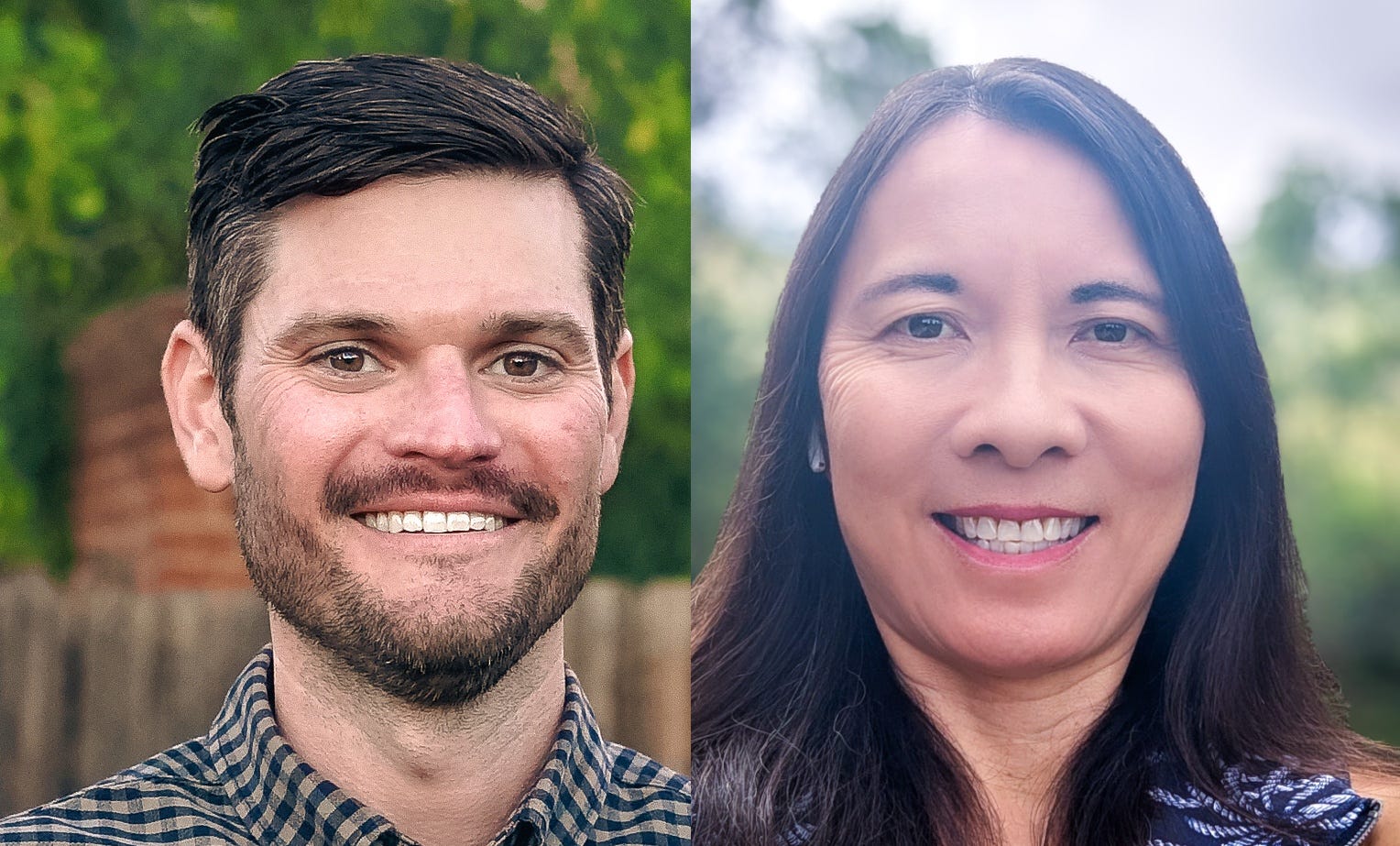
The people who pulled off that win are my guests today. Charlie Fisher ran the Arizona ground operation through his group Arizonans for a Clean Economy; Ning Mosberger-Tang is behind 1.5°Climate, a funder network targeting state-level, climate-significant elections.
Fresh off SRP, they are now going after a bigger prize: the Arizona Corporation Commission, the statewide body that regulates all the other state utilities. It’s a rematch against TPUSA.
And it’s a much tougher fight. Every one of the five seats is currently Republican, and a Democratic slate that tried to upend that situation (Volts listeners may recall that I interviewed one of those candidates) lost in 2024. Can the SRP playbook scale up to win a bigger fight with a real statewide electorate? Can the affordability and anti-corruption messages overcome partisan headwinds? And can they win races beyond Arizona? That’s what I’m going to get into with Fisher and Mosberger-Tang. Let’s do this.
With no further ado, Charlie Fisher, Ning Mosberger-Tang, welcome to Volts. Thank you so much for coming.
Charlie Fisher
Thank you so much for having us.
David Roberts
Charlie, let’s start with you. I’m curious how you got involved in the Salt River Project election at all. It seems small, obscure, and one of the things I’ve been wondering is, did you get into it and then Turning Point came in to fight you, or did Turning Point get into it and you came in to fight Turning Point? How did you end up getting involved and so involved in this election?
Charlie Fisher
Just to give a little bit of background. I started my career organizing with Arizona PIRG, the Public Interest Research Group in Environment Arizona, and a passion for climate and clean energy issues eventually led me to electoral politics. Prior to co-founding ACCE in early 2023, I was the executive director of the Arizona Democratic Party. I had fairly deep experience in campaigns and elections in Arizona. I had never even heard of SRP elections prior to starting ACCE in 2023, which was wild.
The obscurity is hard to overstate here, but the reality is that the 2024 election was the first time that Arizonans for a Clean Economy, or ACCE, got involved. Turning Point was not involved at all in 2024. We were very surprised to see their significant investment starting in early 2025.
David Roberts
Do you have any idea why they identified this? At least you’re in Arizona and in clean energy in Arizona, so it makes some sense for you. But they’re a national organization. How on earth did this come on their radar, do you know?
Charlie Fisher
It’s a good question and I don’t know for sure. I think one of the reasons given, or one of my theories at least, is that this was an early test of their ground game. Looking ahead to November of 2026, one of their top priorities, certainly in Arizona and nationally, is the governor’s race. They have come in heavily in support of Congressman Andy Biggs, who is in the Republican primary. They went so far as to send canvassers out to talk about SRP wearing shirts that said, “Thank you, Andy Biggs, for saving our utilities,” which is a bizarre strategy, to put it kindly.
I think it could have been some early flexing of the field-organizing muscles as we move towards November 26. The other information that has come to light is that a couple of SRP board members made sizable donations to Turning Point USA prior to their involvement. One $200,000 donation, and I think there was a $20,000 donation from SRP board members. Of course, they say it is unrelated, but I am not sure that passes the smell test for me.
David Roberts
What’s $200,000 among friends? Explain a little bit because I had trouble believing this when I was reading about it. It is flummoxing. I mentioned it in the intro, but explain a little bit about how the SRP election works. It sounds like it is transported from a different, earlier era of history. It’s wild to me that it still exists. Explain how these board members are elected and who gets to vote.
Charlie Fisher
Yes, you are right. It is from a different era. This system was initially established pre-statehood. SRP is unique because it was essentially created by a group of landowners, farmers, ranchers in the early 20th century. They came together, formed an association, and put their land up as collateral to convince the federal government to build Roosevelt Dam, which was our first big dam here in central Arizona. That was the beginning of the system. The fact that we still elect these folks on a system based on the early 1900s is clearly a problem.
The way that it works is there are 14 governing board members. Not to get too in the weeds, but there are two separate governing boards because SRP is technically two separate entities — water and power. For this discussion, we’ll just talk about the power side. The SRP district governing board is 14 members. On top of those 14 members, there’s an elected president and vice president. The president, vice president, and 10 of the 14 board members are elected on an acreage-based voting system, which, you mentioned at the top, means only eligible landowners have the opportunity to vote.
You have to own land in SRP service territory, and there are whole swaths of ineligible voting lands in SRP service territory. Just figuring out whether you are eligible is a challenge in and of itself. They are elected on four-year terms where half of the body is up every other year. The elections are held in April of even-numbered years when no one is thinking about elections.
David Roberts
The whole thing seems designed to absolutely minimize turnout. You don’t even know if you’re eligible to vote. You don’t know when the election is. These must have traditionally been tiny, tiny-turnout elections.
Charlie Fisher
Absolutely. Just to give you a sense, there are around 750,000 people who are eligible to vote in SRP elections. Looking back to 2022, when some grassroots climate and clean energy activists had started running and picking up seats, 6,972 people voted in 2022 out of 750,000 eligible for an entity that delivers water and power for over 2 million people in central Arizona. We knew that was the first problem we needed to solve — we needed to raise awareness and increase turnout.
David Roberts
Let’s talk then about how you do that. This is not a normal election. It’s not a normal voter base. A lot of the voter base doesn’t even know whether it’s the voter base or not. What was your strategy for targeting voters? You can’t just put ads on TV and stuff like that. This seems like a case where you really do have to go find people one by one. What was the strategy for increasing turnout?
Charlie Fisher
This was one of the most difficult questions for us, our team, our coalition to answer because it is so obscure. We did a huge amount of research into all of the eligible voters and did both qualitative and quantitative research to get as much data as we could on these folks: what is their voting history in other elections? We could really get a sense of who these folks are, what makes them tick, and what motivates them.
The other challenge was at what acreage, at what amount of land does your property not just become your home and the place that you live and your single largest asset, but become more of a business and a financial relationship. That very much changes the incentives of how you want to vote for SRP board members.
David Roberts
This is a big question I have. My gut says the more acreage you have, the more likely you are to vote for conservative candidates. But is that true? Does that hold?
Charlie Fisher
I can’t say for sure, but that was our theory as well: if you have 10 or more acres, and we set our threshold at one acre or less for a number of reasons. If you have more than 10 acres, you view your property as an investment, a financial, wealth-building tool rather than a place that you live. That was our first, and there was no hard science behind it, but we ended up deciding that if you have an acre or less than an acre, there’s a high probability that your home is where you live and that you will be persuaded and deeply affected by rising utility prices.
We looked at the districts that were going to be voting, the district board seats that were going to be voting in April, honed in on those ones, set our acreage cap at one, and then we talked to folks that we knew were good voters in other elections and were completely unaware that they even had the opportunity to vote in SRP.
David Roberts
That’s door knocking. That’s going out to their houses and knocking on their doors.
Charlie Fisher
Oh, yeah. We ran a comprehensive campaign. We had five direct mail pieces to this universe. It ended up being about 60,000 people. We did five mail pieces. We ran a whole series of digital ads. We did both paid and volunteer canvassing — door knocking, phone banking, texting. We threw the kitchen sink at this thing to make sure every single one of these folks knew that they get to vote for these people that set their rates. You can request your ballot in the mail, which has been made more difficult in Arizona in all other elections.
But for SRP, to their credit, they do a good job of maintaining a permanent early voter list. That was the goal: make sure people are frustrated with their bills, know that this board is elected and the election is coming up, and all you have to do is request this ballot in the mail and then you have a say in these people who are setting your monthly bills.
David Roberts
Ning, I have the same question for you. First, maybe just tell us briefly a little about what your group is, and then how did this weird, obscure little election come up on your radar? How did you get involved?
Ning Mosberger-Tang
David, first, I want to mention that I’m very excited to be on this call because I am a big fan of your podcast.
David Roberts
Thank you.
Ning Mosberger-Tang
It covers a lot of topics that we are very interested in. My background: I used to work in the tech industry. Back in 2006, because I was so concerned about the climate crisis, I left tech to focus on climate change mitigation work. I have been doing that ever since. The first 10 years, between 2006 and 2016, I focused on conservation work, including some global work and energy efficiency campaigns, education for climate change, environmental issues, and a whole bunch of things on the ground. But the 2016 election changed my strategy.
Maybe I’m late, but I realized that in order to make a real dent, really change something in the climate space, I have to get engaged with policies and politics. I started in Colorado state politics and state policies in 2018, and then in 2020 moved onto the national level, doing more policy and political work at the federal level and in other states. In 2022, I started a 1.5°Climate donor collaborative because I realized that there is only so much one group can do. We have to get more donors on board and through our collective effort we can make a difference.
1.5°Climate was started in March 2022 and since then we have grown our membership from one, which is me, to more than 700. In the past four years we have moved more than $36 million through our collective effort to more than 100 organizations including Charlie’s.
We are very excited about ACCE’s strategy, the way they engage with the voters and get turnout in these low-hanging fruit type of campaigns. Because you just turn out a small number of voters and they will be able to change the majority of that SRP board and make a big difference there in Arizona. These are ideal applications for us at 1.5°Climate Network. We are trying to identify low-hanging fruit, high-impact but under-the-radar strategies and get our donors to pay attention to that and move funds to them.
David Roberts
You were involved in the Georgia PUC elections last year, were you not? Volts listeners will be very familiar with that. I had one of those candidates on. It was a very exciting election that the good clean energy candidate won. You were engaged in that?
Ning Mosberger-Tang
Yes, we were very involved. We brought in Briante McCorkle. She is amazing. She leads the Georgia Conservation Voters. We helped them raise funds to fill their C4 gap. We also had some conversations with Peter Hubbard and Alicia Johnson. They were great candidates.
To win elections you have to have the finance. You also have to have great candidates and I think we had that in that election. I’m very excited that both of them were able to win. We are going to continue to be engaged this November because they are going to have two more races there. Peter needs to get reelected and then Sheila Edwards is running for the open seat. We are hoping that we can help them again through Georgia Conservation Voters. If they win, they will be able to get three-to-two.
David Roberts
Yeah, they’ll have a majority.
Ning Mosberger-Tang
Majority. That’s right. That’ll be so exciting for a red state like Georgia.
David Roberts
I’m curious about the messaging that you used in SRP in this election. If you’re identifying donors who are already inclined toward clean energy, inclined toward Democratic candidates, maybe all you needed to do was just let them know that this was happening and that they could vote in it. Was that the majority of it or was there a specific set of messages that you focused on in this particular race?
Charlie Fisher
It was a combination, to be honest. I will make a quick distinction. AZCE, Arizonans for a Clean Economy, did purely educational work and that was about 80 percent of the total campaign, in coalition with other organizations as well. We did not do this alone. The vast majority of the work, to your point, Dave, was just letting people know that this is an election that happens, that impacts your monthly bills, and you have the opportunity to vote. That did a huge amount of the lifting for us.
We were also incredibly disciplined in our messaging in that we were just letting folks know SRP just voted to raise your rates again. In February of 2025, they voted to raise prices on residential customers for the fifth time in five years. We wanted to make sure that every single eligible voter, particularly the ones in the districts that were going to have seats up for election, knew that fact.
The reality is that SRP has higher favorability than all of the other investor-owned utilities in Arizona, and historically they have had lower rates. We needed to make sure that people knew that the SRP board just voted to raise rates again for the fifth time in five years.
David Roberts
Rates were the central message. That’s the central message.
Charlie Fisher
100%.
David Roberts
Not so much on all the gas incoming, the gas pipeline, all this stuff. Not a dirty versus clean energy thing, more just affordability.
Charlie Fisher
100%. The candidates on the other side, because we were on the independent side and couldn’t coordinate with candidates, were talking about clean energy, they were talking about data centers. That became a big topic towards the closing stage of the campaign. We were really focused on “these folks are raising your rates. Request your ballot today.”
The huge value that Ning and the 1.5 team brought in is we did, because so many of the questions that we got were, “Who should we vote for?” We aren’t able to answer those questions as AZCE, but with Ning’s support —
David Roberts
You’re a C3, so you can’t say, you can’t weigh in on that.
Charlie Fisher
Exactly. We said, “Here are the two websites of the different competing slates of candidates. Check them out.” We wanted to make sure that you vote. With Ning and her team’s support, we were able to raise PAC dollars into Arizona Power PAC, which is our sister PAC organization. In coalition with CHISPA Arizona PAC, we were able in the closing month or so to follow up with all of those same folks and say, “These are the good guys.”
David Roberts
That’s a C4. They’re allowed to do electoral work, the PACs. This is an election analysis question. I’m curious what both of you think about it. Some of the conventional wisdom after the dust settled was that Turning Point’s heavy, high-profile engagement in this kind of ended up backfiring. Even some GOP consultants felt it ended up backfiring. It just drew attention to the race, raised the salience of the race, raised the number of people who voted, and it backfired on them. Do you agree with that assessment?
Charlie Fisher
I agree partially. There is absolutely no doubt that Turning Point’s investment and involvement and the media coverage of their involvement raised the salience and awareness far beyond what we were doing. I do think it backfired. The strategy — like we talked about earlier — whether it was the “Thank you, Andy Biggs, for saving our utilities” T-shirts, the fact that they were supporting the entire status quo slate of candidates that had just voted to raise rates for the fifth time in five years, or the fact that they blanketed the entire county in street signs. Those really large political signs for an election that not even a third of Maricopa County residents are eligible to vote in and no one knows about.
Putting up street signs for an election that no one knows about and very few people are eligible for, and randomly out of nowhere saying, “Keep the Green New Deal out of Arizona” in really liberal neighborhoods. I live in midtown Phoenix, one of the liberal cores here, and on the end of my street was an anti-Green New Deal sign. I think people were just, “What are they talking about? What is going on?” On the other side, we continued to be incredibly disciplined, talking to just those 60,000 people, educating them on this opportunity. It was a combo.
Ning Mosberger-Tang
That’s a really unusual time. In Wisconsin, Elon Musk tried to engage in the Supreme Court race there, and it really backfired. The bottom line is still the affordability message, because the same thing happened in Georgia. When the GCV ran a campaign in Georgia, they focused a lot on the utility rates and affordability and how the current commission was raising the rate many times in a row. That’s the message that resonates with voters.
David Roberts
Arizona has Prop 211 that now forces C4s to disclose their donors. This has been a long time liberal campaign worry about dark money coming in, etc. Do you think that kind of disclosure helps or constrains your group, your C4?
Ning Mosberger-Tang
It does make people more cautious when they want to invest in Arizona because a lot of donors do not necessarily want to be disclosed. On the other hand, we are doing what we believe is the right thing. The candidates we support or the initiatives we support, we are proud to be one of the supporters. It has an impact, but it is not a huge impact. For example, this election with SRP, our donors invested directly in the PAC, so we donate to the PAC, and it is all disclosed.
David Roberts
Let’s pivot. The main thing I wanted to focus on today, the main thing of interest now, is this upcoming election for the Arizona Corporation Commission. This is the Public Utility Commission that regulates all the other utilities in the state in the more normal way. The machine you built up, or this campaign you built up, this group and network you built up, is trying to roll into this next election and win it, too.
The striking thing, the most immediately striking thing, is that this is just a very different kind of election. It’s not this weird feudal landowner thing. It’s a statewide election with a statewide electorate. Charlie, I’m curious what parts of the playbook you think transfer here in terms of turnout, messaging, etc.
Charlie Fisher
You are 1000% right. That is a completely different dynamic. It is a different thing in November.
David Roberts
Not as obscure, but PUC elections are not high on people’s priority list either. It’s still semi-obscure, but not nearly as obscure.
Charlie Fisher
Absolutely. Of course, we have all of our statewides, we have competitive congressional races. There will be tens of millions of dollars spent communicating to voters in the lead-up to November. That was just not the case.
David Roberts
You don’t have a quiet room in which to target these messages. You’re going to be competing with a lot of other messages. They’re going to be getting a lot of direct mail and messages from all over the place. How does the strategy translate?
Charlie Fisher
The first piece is being incredibly disciplined and targeting, really trying to identify who are both our base voters who are likely going to vote or maybe skip midterm elections, but really are unclear about what the Arizona Corporation Commission is, because we have a situation in Arizona where almost every cycle there are over 100,000 people who cast ballots who will vote for the Senate race or the presidential or the governor, and will just skip over the Corporation Commission.
The first job that we need to do is educate those folks specifically that you cannot skip this election and you have two votes. Use both of them and understand this is the only line on your ballot that directly impacts your monthly budget. The targeting and being really disciplined about who we talk to is one thing that absolutely carries over. The education piece is similar. It will be more expensive and certainly a much larger universe of folks we need to talk to, but we need to simply educate them that the Arizona Corporation Commission regulates monopoly utilities in Arizona.
Oftentimes people think that it’s just for business owners. They do paperwork and administrative stuff, which they do as well. But the primary function is utility regulation. The affordability message, to Ning’s point, has to carry through. I would guess that both sides are going to be making that claim that they are the affordability team.
David Roberts
Voters of all kinds across the country are going to be hearing that word out of everyone’s mouth these coming elections. That does muddy the waters a little bit.
Charlie Fisher
I just think it is a much more difficult case to make as an incumbent commissioner who has raised rates consistently over the four years of your service that you are the affordability team.
Really educating folks early on those points, on those facts, is critical. We’re excited. We just launched an education campaign called Follow the Power to help people connect those dots and understand how they can get involved at the ACC, how they can scrutinize their decisions, provide testimony, and then register to vote and commit to vote for ACC in November.
David Roberts
To the extent you’re willing to tell us, I’m curious what the scale of investment required here is for a true statewide race versus the much smaller, much more targeted SRP race. Is it a lot more money?
Ning Mosberger-Tang
Oh yes, I think it is going to cost millions of dollars potentially, but it is going to be a team effort. There are many other races up and down the ticket in Arizona, including the governor’s race and also the state legislature and congressional races as well. I hope the GOTV efforts done by other groups, other funder-pilot donors will be helpful for this ACC election as well.
What Charlie is doing is really important to reduce the down-ballot drop-off for this commissioner vote. All these together, potentially we can make it a really good year in Arizona and finally get the state trifecta in Arizona. That is going to have a pretty big impact down the road for policymaking, not just for clean energy, but for other things as well.
David Roberts
One difference here is that the SRP elections were facially nonpartisan. They are not Democrat versus Republican. There is no D or R next to the candidates’ names on the ballot. In some sense that is helpful because then the only distinguishing feature is affordability. The message is the main thing. The message is up front, the affordability thing. But Charlie, in this election the ACC candidates are partisan. They are Republican or Democrat. They are going to have an R or D next to their name. The basic fact of Arizona is that there are more registered Republicans than there are registered Democrats.
Do you think that hurts or helps here? In a race that they don’t necessarily understand, they don’t necessarily understand the dynamics or who the candidates are, are people just going to revert to partisanship? Is that something that’s on your mind?
Charlie Fisher
Absolutely. It definitely makes it more challenging to make the message be the leading point that sticks with folks. The race is partisan and there are going to be two Democrats versus two Republicans and potentially some third-party candidates as well.
The messaging shouldn’t be, though, because these issues aren’t. It’s why ACCE, I have a background in Democratic politics. ACCE’s mission is to build durable bipartisan support for clean energy leadership in Arizona because clean energy is popular across party issues and rising utility bills are incredibly unpopular regardless of whether you’re a super conservative Republican or a super liberal Democrat.
No pro-high-bills constituency.
Exactly. Very limited constituency for “Yeah, let’s keep raising bills.” I think continuing to focus on that message and just name plainly who the folks are that have been raising bills and who are the folks who are committing to changing that status quo. The registration advantage is real. The reality is that we need to focus on those folks in the middle. The nonpartisan voters in Arizona make up the second largest, and it’s very close with the Republican Party. Those are the critical voters that determine outcomes in generals in Arizona.
David Roberts
It does seem like anti-incumbent — everybody’s pissed off these days about something or other. There’s a lot of anti-incumbent energy.
Charlie Fisher
Backlash election after backlash election these days, it seems.
David Roberts
Which is useful to you if you’re out of power. But the minute you get in, it works against you. It’s troublesome. Turning Point is back. They’re engaged in this election too and they’re backing an insurgent MAGA challenger against the Republican incumbents in the primary of this ACC election. Do you think that is going to split the right or create fissures and conflicts on the right that are going to hurt them in the general election? Or do you think they’re all just going to unite around whoever ends up on the ballot? How much of a threat is that MAGA challenger to the right — unity in this election?
Charlie Fisher
Initially, and Ralph Heap is the gentleman that you’re speaking of. He’s a legislator down in Tucson. Initially when he filed to run for corporation, he was running as a team with another legislator from Northern Arizona named David Marshall. They were very much the Turning Point slate and were working hard to out-MAGA the two Republican incumbents who are in my view pretty staunch conservatives themselves. Every single bill that both Heap and Marshall ran during the legislative session was essentially a clean energy ban.
They did a lot of messaging during the legislative session. About a month ago, David Marshall dropped out of the ACC race because he was appointed, potentially illegally, to be the Navajo County Recorder, the top elections official in Navajo County in northeastern Arizona.
Now that there is not a slate, I am curious to see whether Turning Point really does invest deeply in Ralph Heap’s primary campaign or if the opportunity to wholesale swap out the nominees with two more Turning Point-aligned folks was more motivating to them. We have not seen too much spending from them.
That was definitely the thinking initially with that slate, that it was going to be a nasty, negative primary and that the candidates on the Democratic side who don’t have a competitive primary would be able to start talking to the general election, staying positive, sharing their vision while the others were fighting each other. We will see whether there is a significant investment from Turning Point, given that new dynamic.
David Roberts
Data centers came into the SRP election. They are obviously out of nowhere a huge issue for everybody. Are you messaging around those at all? Do the Democratic candidates versus the Republican candidates have different messages on them? What role are data centers playing in all this?
Charlie Fisher
Certainly a big issue with a huge amount of grassroots opposition, as you have seen across Arizona and across the country. It has not been a top issue that I have seen from any of the candidates yet. The legislature just finally wrapped up last week or the week before. One of the big takeaways was that they removed the tax break, tax credit that has been available to data centers in Arizona for many years. You very quickly saw both sides take victory laps on that win.
I anticipate that trying to talk tough and be seen as tough on data centers is going to be, similarly to affordability, an issue that both sides try to claim high ground on. It is going to be really difficult for the Republicans given the fact that one of the incumbents, Kevin Thompson, is a lobbyist for data centers. He works for EdgeCore and he just announced that publicly at a conference or a panel that he was speaking on a couple of weeks ago. It is going to be real difficult to be the anti-data center guy, given that is how you pay your bills outside of your commission work.
David Roberts
It’s funny that the same messages, the same push, the same messages, everybody wants to grab them. There are no high-profile issues on which the R and D are disagreeing. Everybody’s trying to claim the same ground. It’s an odd dynamic.
Ning Mosberger-Tang
Data centers will be an important issue this year in the election, I believe, because it is so connected with affordability. If you look at the polling, affordability of energy is one of the top priority issues for voters in many states. For example, states like Michigan, this is one of the top issues that voters are concerned about this year. Because of that, our group, 1.5°Climate, has been very interested in state-level policies for data centers. Our donor network hosted an educational call for our members about data center policies just a couple of months ago and then we followed that up with data center policies that will go into the state legislature in three states: Illinois, Colorado, and Virginia.
Our members were very interested in getting engaged, trying to make sure that data center policies ensure that data centers will be clean, bring their own energy, and make sure that the data center customers, meaning the hyperscalers, will be covering the cost for transmission, for adding the load for consumers.
David Roberts
It must be tricky because I think all the populist energy here is just “no data centers.” Data centers are bad. I’m sure you would prefer more nuanced policy than that.
Ning Mosberger-Tang
We have a different view. I don’t think I can represent our entire network of donors because we have 700 members and everybody has a different experience and opinion on that. Mostly our group takes the view that data center buildout may not be preventable. There are a lot of questions about AI, whether it’s going to be good or bad for humanity and what can we do about it, but it’s probably going to happen. If that’s going to happen anyway, let’s make sure that we are directing the development, making sure that it’s going to go in the right direction for consumers, for all of us, and not just for the hyperscalers or for the utilities. That’s our take on that.
We support efforts in state legislatures where they would like to regulate the data center buildout to make sure that it will be beneficial for climate and also for consumers. We look at it as a potential opportunity to increase the availability of clean energy. If the data center buildout gets overbuilt, which is possible, because there are a lot more requests for data centers than what they actually can use right now, potentially it could create energy sources for the future, which will be helpful for electrification of everything.
We look at it as an opportunity, but that needs to be guided and supported in a way that will be beneficial for us.
David Roberts
Charlie, I’ll just ask point blank: affordability has been a worry for a while. Democrats went after the ACC in 2022 when they had a really good year, when they won Governor and Secretary of State and Attorney General. They won a bunch of other really competitive races and they lost all the ACC races in 2022. Then they went after them again in 2024 and lost them all again. There does seem something slightly cursed about this. Why do you think this time will be different? More money, more organization, more concern about affordability? Why do you think this is going to be different than the past two races, which people had high hopes about as well?
Charlie Fisher
The answer is all of the above. We are more organized and have a larger coalition of nonprofits, C3s, C4s, an IE coalition that is very large and robust. We’re working in complete lockstep. Historically, what happens is groups will try to coordinate when they’re working on the same race and at least try to share messaging and talk about who they’re targeting. We are building our entire plan as one coalition. We got in the room in May and wrote one plan. We are using one shared universe —
David Roberts
For all these state races?
Charlie Fisher
No, just for Corporation Commission. This is a coalition that only is focused on Corporation Commission. These different organizations that are a part of it will obviously work on Governor, AG, SOS, Legislature, all the different races. But all these groups have come together and said we are committing all of our resources for ACC. We are working in this shared coalition, using this shared universe, sharing all of the data, shared research and polling to make sure that it is really a comprehensive campaign and not just folks talking to different groups, potentially stepping on each other’s toes. It will be really coordinated from beginning to end.
That’s a coalition that we hope is going to stay together for the long haul — so that we can continue to learn lessons and grow and do that early education work, which was so critical to SRP, that has to be done for ACC too. Our plan is to start ASAP with that education effort and be able to really follow it up with the candidate-specific work later.
Ning Mosberger-Tang
I also believe that this year’s election environment will be different from 2022 or 2024. In 2022, we did not get a red wave that was predicted. In 2024, we did not have a very good election environment. I’m hoping that this year will be different. The ACC election is partisan. That is really important — that we have the right kind of election environment overall for Arizona this year. On top of that, with coalitions that Charlie and others have built and with a collective effort and investments from networks like ours, I hope we can finally get that breakthrough and at least win two seats there.
David Roberts
One notable difference is in 2024 all the ACC candidates did this pledge where they refused to take PAC money. They only took public money, which was noble, but resulted in them getting outspent a gazillion to one. Now it is more of a gloves-off — there are PACs, there is money getting involved, and I think at least it is going to be a lot better funded this year. Possibly a fairer fight, money-wise.
Charlie Fisher
That’s the absolute importance of the work that we and CHISPA and EDF and others are doing in this coalition. The same situation in 2026: it is extremely difficult for Corporation Commission candidates to raise private dollars. Both the Democratic candidates and I believe all three of the Republican candidates are running with our public funding system, clean election system this year too. The bulk of the messaging, organizing, and education really does need to come from outside groups.
David Roberts
They’re privately still committing to that. They’re not personally taking the money. It’s outside groups where the money is being spent.
Charlie Fisher
That’s right. They can raise about $29,000 in $200 increments as seed funding to get their campaign started. After that, it is about $100,000 for the primary and $240,000 for the general, and that is all they can spend.
David Roberts
A lot more money than that will be involved ultimately, outside. One question here is it’s a five-seat commission on the ACC. They’re currently all Republicans. In this election cycle, two of the seats are up. Even if clean energy candidates win both those seats, they’ll still be in the minority. What is the prize here? What does this all get you?
Charlie Fisher
Even one pro-clean, pro-climate commissioner has an enormous impact. We saw that in 2020. Every commissioner has individual subpoena power. The ability to open up the books, to really get access to data from the utilities that they are not always eager to share, is a huge benefit. I don’t believe that all of the Republican commissioners are dyed-in-the-wool anti-clean energy folks. Some of them are. There are coalitions to be made, especially if there are two Democratic commissioners and three Republicans. They are going to have to work together. There are policy priorities that they could come together on and make some positive movement even when pro-clean folks are not in the majority.
The importance of electing two this November is to have a real opportunity going into 2028 with all of this infrastructure built, with all of this knowledge and this list building and these supporters, carry all that education work into 2027. Don’t stop in November. Continue to educate, continue to engage and organize. Rolling into 2028, we have an opportunity to elect a pro-clean majority for the first time in decades.
David Roberts
Conventionally, presidential years are more difficult for you because there is going to be enormous turnout on both sides. But if you have two commissioners in place and there are three races up, you only have to win one more to get a majority.
Charlie Fisher
That’s right.
Ning Mosberger-Tang
It’s similar to the Georgia Public Service Commission race.
Last November we got two, and then this November hold one and then win one more and it’s a two and then we get three-to-two majority. It’s a two-election process.
Charlie Fisher
I don’t want to be Pollyannish here, but I think there’s a real chance that 2028 generates, with two genuinely new presidential nominees from both parties, fingers crossed that’s what happens, that there could really be a significant political realignment and we could potentially move beyond this constant backlash after backlash election roller coaster that we seem to be in. I’m cautiously hopeful that we can get there.
David Roberts
Who knows?
Charlie Fisher
Got to stay positive sometimes.
Ning Mosberger-Tang
We’ve got to take advantage of the environment this year and get us to win as many state-level trifectas as we can. That’s one of our focuses for 1.5°Climate this year: to help win the trifectas in states like Wisconsin, Michigan, Nevada, Arizona. We have this opportunity, could be a historic opportunity to win a trifecta. If we have a state trifecta, it will really be helpful in terms of redistricting, in terms of governing, in terms of protecting free and fair elections because a lot of these states are battleground states for 2028.
David Roberts
Looking beyond Arizona, this is a big fight and I think it is representative of a lot of other fights in that affordability is huge. The race was previously obscure but all of a sudden is very important, and there are big climate and energy stakes involved, and affordability is at the center of all this. I think that is going to be true in a lot of other places too.
Ning, by way of wrapping up, what other races do you have your eye on? Are there any other under-the-radar, high-impact climate-related elections? Are there others that are on your radar that you’d like to share with us either this cycle or in 2028?
Ning Mosberger-Tang
You’re probably familiar with rural co-op board elections. Those are also very much under the radar and the turnout rate is below 10% for sure.
David Roberts
Rural co-ops are notoriously dirty, typically pretty conservative, correct?
Ning Mosberger-Tang
Correct. We just hosted a call with CVIQ to support their rural co-op operations. They are doing some test pilots in Midwestern states to use digital ads, communicate with those voters that they want to educate about the importance of these rural co-op elections. That is one of the many under-the-radar opportunities that we have supported and continue to support.
The other thing will be, as I said, state trifectas are really important this year. They are not necessarily under the radar, but usually state legislature elections get a lot less attention than congressional races. That is one of the things we pay a lot of attention to. I know you also work with groups like Climate Cabinet because they pay a lot of attention to state and local races. Also Jane Fonda, the Jane Climate PAC, and those are the groups that we work closely with as well and supported in the past.
David Roberts
A lot of these under-the-radar races have always had climate implications, but they have been underfunded and slightly scattered and not super organized. From your perspective inside this donor network and doing this work, do you think there is something like a coordinated and powerful clean energy money and electoral machine getting built here? How optimistic should we be about that?
Ning Mosberger-Tang
That’s one of the things that we try to do. The whole purpose that we started this network is we recognize that there are so many opportunities out there, but the donors only have so much time to figure out where to invest to make a difference. We are trying to make it easy for them and we do the vetting and we talk to organizations like Charlie’s and talk about the strategy and make sure that it’s something that we should share with our network and get them supported.
I’m more optimistic this year than in 2024 because I think that eventually we have a lot of issues with the federal government and overreach, but because of that it created a backlash. People are motivated, mobilized. For people who care about climate, we all know that clean energy is also cheap energy.
We also know that voters are very concerned about the affordability of electricity, of energy. It’s almost like things are coming together in a way that will hopefully be beneficial for us to win back the pro-clean energy power this November. I’m feeling pretty hopeful. But hope alone is not enough. We have to fund this work. In 1.5°Climate we are trying to expand our network because even with 700 donors we cannot fund all the projects we have identified which are catalytic, impactful, and under-resourced like Charlie’s. If people are interested, check us out or join us. They can go to our website, 1.5climate.org/join. We will be happy to get some collaboration going and help us win back power and protect climate.
David Roberts
This will be such an interesting test case of so many things. I’ve never been in a more uncertain, chaotic, unprecedented set of circumstances electorally and in terms of not just all the chaos at the national level, but ferment around clean energy and data centers and a lot of unknown and crazy things going on. It will be really interesting to see how this plays out. I think the ACC race will be a bellwether of a lot of other things.
Thank you both for coming on and walking us through the thinking here. I appreciate it.
Ning Mosberger-Tang
Thank you so much, David.
Charlie Fisher
Thank you so much for the opportunity, Dave.
David Roberts
Thank you for listening to Volts. It takes a village to make this podcast work. Shout out especially to my super producer Kyle McDonald, who makes me and my guests sound smart every week. It is all supported entirely by listeners like you. If you value conversations like this, please consider joining our community of paid subscribers at volts.wtf, leaving a nice review, telling a friend about Volts, or all three.
Thanks so much and I’ll see you next time.


