


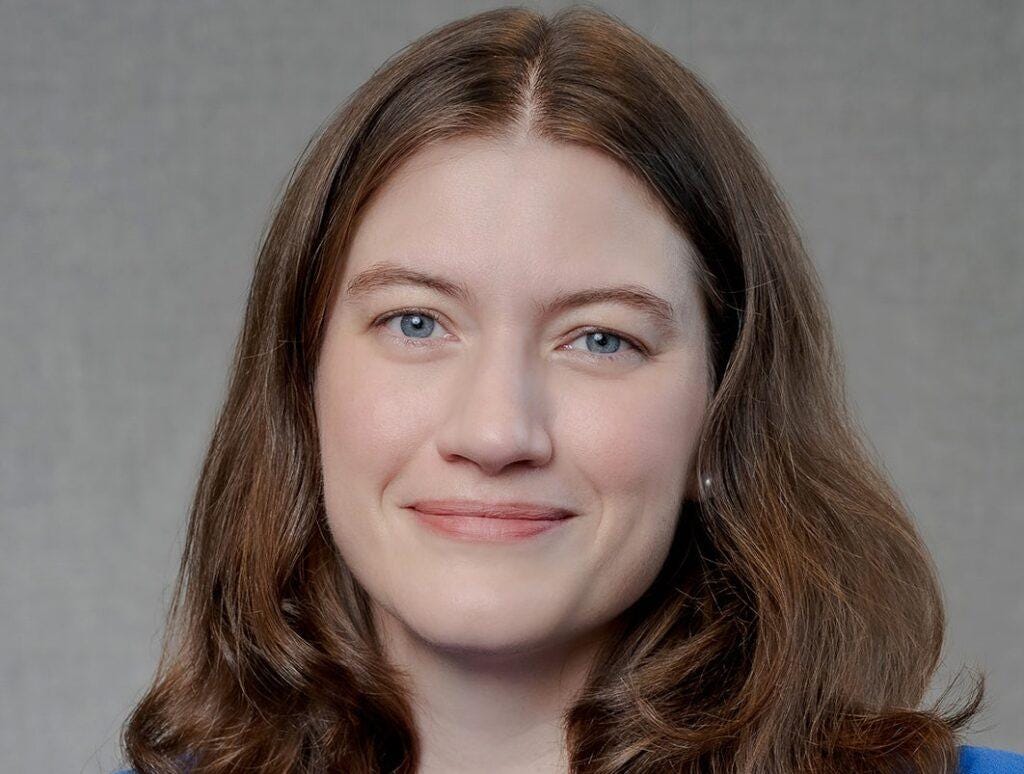
In this episode, I chat with Dr. Sarah Kapnick about the core of climate science and the wild variables that have emerged in the last decade. We discuss the “accidental geoengineering” experiment of reducing shipping aerosols, the newfound ability to pinpoint methane leaks from space, and the legal implications of being able to attribute financial losses to climate change.

(PDF transcript)
(Active transcript)
Text transcript:
David Roberts
Hello, everyone. Greetings, salutations. This is Volts for February 6, 2026: “How’s the climate doing?” I am your host, David Roberts.
I began my career as a journalist in the early 2000s and the online climate wars of that era were formative for me. My first brush with fame was when Rush Limbaugh mentioned me by name on the radio, over something climate-related, which brought me a torrent of angry emails (mercifully, this was before social media).
By the mid-2010s, I felt I knew what I needed to know about climate change (looks bad!) and turned my professional attention toward clean energy, which was beginning to get cheap and viable. I haven’t followed climate science closely since.
In the wake of the MAGA backlash and Trump’s victory in 2024, climate has precipitously fallen off the political agenda. Trump has pulled out of the Paris Agreement, withdrawn from the UNFCCC, dismantled climate science research programs, banned the use of the words “climate change” in government documents, and so on. Meanwhile, Democrats seem to have vowed to say nothing but the word “affordability.”
Has anything happened in the world of climate science that should make me less concerned than I was back then? Or more concerned? What is the science saying these days? What has happened in the last 10 to 15 years?
I thought it would be a good time to touch base with a scientist — I have with me today Dr. Sarah Kapnick, previously chief scientist at NOAA, and now the global head of climate advisory at JPMorganChase, working at the intersection of climate, risk, and finance.
We’re going to do a check-in, or a level set, or whatever you call it: what’s happened in climate science lately and just how freaked out we should be about it.
With no further ado, Dr. Sarah Kapnick, welcome to Volts. Thank you so much for coming.
Dr. Sarah Kapnick
Thank you so much for having me for this discussion.
David Roberts
Dr. Kapnick, I’m particularly excited to get you for this discussion because I note you are not only a scientist, but your career has been spent translating science for people in institutions outside of science, which means you have long professional experience answering impossibly broad dumb questions from people like me. It makes you perfectly suited to the job we have ahead of us today.
Dr. Sarah Kapnick
I would like to say none of them are dumb.
David Roberts
There are no dumb questions.
Dr. Sarah Kapnick
It’s very important to have curiosity in the space and to talk it through as we are going to do today.
David Roberts
Here’s what prompted me to do this pod. Among people like me, in my basic core, you’re educated, dim, politically aware, whatever general demographic, people seem to have settled into this attitude towards climate change, that it is grim but manageable. The idea here is, over time, through concerted action, we have taken the truly apocalyptic possibilities — your 4 to 8 degrees of warming type of possibilities — off the table. We’re headed for somewhere between 2 and 3 degrees of warming, which is, as I said, grim but manageable. It’ll be bad, but it won’t be as bad as it could have been.
I also see sometimes out of the corner of my eye headlines to the effect that the impacts of climate change are hitting faster, sooner, worse, or harder than we thought or expected, causing more damage than we expected. I read about tipping points looming or already underway. Some of them are already tipping, which brings me back to freaking out. Part of what I want to do here is just, pardon the pun, take the temperature of where we are.
I think the place I want to start is to talk about what climate science has learned over the last 10 to 15 years, etc. But maybe the place to start is what hasn’t changed in climate science in the last 15 years. In other words, what is the steady core? Are we as confident as we were then about it?
Dr. Sarah Kapnick
I would say the steady core is that we have observations of what’s happening in climate. We have temperatures and stations around the world and satellite data in the ocean that are showing a steady rise in temperatures over time, and that is linked to the rise of greenhouse gas buildup in the atmosphere. Additionally, we don’t just have the measures of that — we’re monitoring what’s happening on the climate through observations.
We also have physical-based models — models of the climate system that allow us to see that change over time and be able to see it in the models, why it is happening, and how it varies in time. And then also project into the future that if you continue to have greenhouse gases accumulate in the atmosphere, you will continue to have temperatures rise. A host of things come from that in terms of changes in extreme precipitation, changes in glacier size, changes in temperatures in the ocean, and further impacts on ecosystems. There is a growing body of research around how that affects society.
But the basics of it — temperatures are rising, they’re linked to greenhouse gases — that is fundamental to it. The expectations of that into the future, the response of temperature, are pretty steady in terms of our expectations of how it’s going to continue to warm.
David Roberts
One of the things I was thinking about, all these old fights, takes me back to a previous time in my life. There used to be a lot of fights online about the models, the climate models. This was a big thing. Various people accused the models of weighing things or putting their thumb on the scale. There was a whole fight over the hockey stick thing. I barely even remember the details of that one. What I want to know is, the basic models that were developed in the 90s and 2000s, have they held up pretty well? Are we now observing what the models said would happen, roughly?
Dr. Sarah Kapnick
We are, to put it very bluntly. Those models have continued to evolve since the 90s, since they were developed, and they have become more complex and allow us to ask more questions about how climate impacts weather and ecosystems and more local scale issues. But zooming out — large scale perspective — those models have been very steady in the amount of temperature that will rise with the amount of greenhouse gases that have now accumulated in the atmosphere.
David Roberts
We had it pretty right.
Dr. Sarah Kapnick
We did. A few years ago, when Suki Manabe, the Japanese American scientist who helped build the first climate models in the US, won the Nobel Prize in physics —
David Roberts
I remember.
Dr. Sarah Kapnick
At the dinner for him held in Princeton that I went back for, he said, “We learned this and we are now seeing it.” They were right. They were right in the way that those were constructed. They’re fundamental physics that have led us to today. There’s new science and new information that is coming in that we will talk about, but the base understanding of what was predicted with the amount of emissions that we’ve seen and the accumulation in the atmosphere is what was expected within the bounds of expectations.
David Roberts
It’s funny. Those early scientists were so right about the science and so wrong about what they expected to happen socially. When they produced a bunch of good science, they were saying, “Isn’t this the part where you take the science and do something about it?” Their predictions on that front were very wrong.
Dr. Sarah Kapnick
We all have our skill sets and unfortunately, I think there was an underestimation of the difficulty of understanding what all the impacts in society would be and the behavioral science of how people might react and all the myriad ways that we are now living through and learning and seeing at this point in time.
David Roberts
I’m not sure anyone’s really mastered that skill set completely.
Dr. Sarah Kapnick
When I first learned about it, and I was working on Wall Street over 20 years ago, and I wanted to have this career at this intersection of climate, risk, and finance, I thought surely that we would be where we are today in better understanding of climate and its intersections, on insurance and on other things. I didn’t think it would take 20 years, the level of evolution that I’m seeing now. I have the job that I thought should exist back then, now. But that’s because with the science and with clarity of what you think the world can look like, you can start thinking about what that means. Not everyone is going through that thought process. Not everyone has the same views of how society will react or how markets will react. There’s a lot of uncertainty in the translation of that science and the use of the science and when do markets react.
David Roberts
Indeed. When people talk about the scientific developments of the last 10 to 15 years, one thing that comes up a lot is what’s called attribution science. For listeners who don’t know what that is, it’s what it sounds like. It’s the science of trying to attribute specific weather events to climate change. If a giant hurricane comes along, it used to be, I remember in the early 2010s, a big hurricane would come along, a bunch of people would come out saying, “Hey, look, there’s climate change.”
Then a bunch of people would come after them saying, “Now, now, we’re not allowed to attribute any specific weather event to climate change. It’s too fuzzy for that. It’s all probabilistic,” etc. I used to get scolded about that all the time.
Sometime around 2020, I started reading these headlines saying, “Hey, guess what? We can do this now.” I’d like to hear from you a little bit more about what attribution science is and why it has had this seeming breakthrough now, where it has such confidence tying specific events to climate change.
Dr. Sarah Kapnick
As a journalist, you really lived through the evolution of the science and then being able to talk about that science and what it means as you look at weather events. Climate attribution science has developed over the last 10 years. The first paper on it was after the heat wave that happened in 2003 that went across Europe, that led to thousands of deaths, and the analysis there was showing what was the likelihood of that event when it happened, what was the likelihood of that event happening in the past, based on observations, and then also using models to try and understand how that risk is evolving in time.
The reason the science has now evolved and people are making claims about how those risks are changing in time and how much climate change has changed the risk of individual events is because, number one, we’ve now had enough climate change occur that you are able to start parsing, in a technical term, the statistics out where you can say, “This event has a much higher likelihood of happening now than in the past because of all the climate change that has happened to date.”
David Roberts
Your sample set has grown.
Dr. Sarah Kapnick
It’s the sample set, but it’s also the signal is now separated from the noise.
You have variability in these extreme events. The extreme events happen by definition very infrequently. It’s also hard to quantify what that likelihood is in time. But now you’ve had so much climate change occur, and when you have these events occur, the buildup in multiple of these events in short periods of time and change in that over time is now — you’re able to say, “No, this event is now happening with greater frequency. This is how the frequency has changed over time.” It’s not just in the observational record.
Now, in the physical-based models, there is the ability to generate hundreds, if not thousands, of years of data to be able to say what a year like this should look like and what the extreme weather should look like in a world with X amount of greenhouse gases in the atmosphere.
Now you can also, using that technique, create thousands of years of data, which then allow you to quantify what the risk is today, what it was in the past, what it is in the future, and be able to make those statements of “climate change has altered the risk of this event by this much.” You can also explain why. It’s the fact that you’ve had enough climate change to be able to see it in the observational record, but then also these modeling techniques and the availability of supercomputing systems that allow you to do this.
David Roberts
That was going to be my question. I know there is more data to work with, but I was wondering how big a role the advances in raw computing power have here. I assume you can run more models more often these days just because of computers.
Dr. Sarah Kapnick
Exactly. It’s more models, more data. I’ll add to that that over the last 10, 20 years, there’s also been a shift that the physical-based models used to be very coarse in resolution. You would look at climate over a box that was 300 km by 300 km, 20 years ago.
David Roberts
Spatially coarse, you mean?
Dr. Sarah Kapnick
Yeah, spatially coarse, but now you can look at it at blocks of 25, 50 on each side. That also lets you look at these extreme events, which may be very local. Adding on to that, the revolution that’s happening right now in weather and climate modeling, with AI techniques, allows you to take all those data sets and create new synthetic data sets with the spatial scales of the extreme events to further explore them. All of these scientific advancements over the last 10, 20 years, plus all the climate change that has happened, allow us to ask these questions about risk and how that risk is changing in time.
David Roberts
It seems to me that no matter how good this gets, we’re probably never going to develop the ability to predict events that are by definition extreme outliers.
Dr. Sarah Kapnick
There are prediction capabilities in weather.
David Roberts
Weather-wise, climate-wise, years.
Dr. Sarah Kapnick
There are certain things that you can predict on a seasonal basis, which is a couple of months out to two years — heat waves have some predictability, large-scale droughts. I did a bunch of research years ago on snowpack and on hurricane numbers, and the barrier to that is roughly two years. There is science that is decadal prediction, looking out five years and longer and at a really large scale. That type of information really is ocean temperatures and heat waves. With AI and machine learning, there is more analysis trying to show predictability at those longer timescales and understand them. I think it is a really exciting area of science development.
David Roberts
Slightly a diversion, but I have always been curious about this and you raised it, so I thought I would throw it out to you. Among scientists, is there the thought that with sufficient data and computing capabilities, we can capture the climate and predict it completely at some point, if we have complete data? Or is there an element of unpredictability and uncertainty that is irreducible? Practically speaking, this does not really matter. But I wonder, at the limit, is this an understandable system with sufficient computing power, or is there an element of chaos to it that will never be reduced or eliminated?
Dr. Sarah Kapnick
There are certain things that we think we will be able to predict and certain things that we won’t because ultimately it’s chaotic. But also the very definition of did you predict something or not, particularly for those systems that are chaotic, you would give a forecast of the future that’s broad. If you fall within that broad analysis, was it correct?
David Roberts
It’s all about granularity, I guess.
Dr. Sarah Kapnick
This is where there is difficulty in explaining predictions and how to use them and whether something fails or not. In the communication of all of it, it is why it has been so difficult for people to understand how to use the information in their daily lives, their businesses, and others. The communication of all of this — particular predictions that are good or not, and what we know, what we do not know, and how that changes in time — is very difficult to discern, not just for the average person, but even for very sophisticated, educated people.
In my day job, that’s what I spend a lot of time doing — explaining the probabilities and statistics and trying to translate what it means and where those sources of uncertainty come from, and then what that means as you chart a path to plan for the future.
David Roberts
As you and I discussed previously, decision making under extreme uncertainty is not something I think that humans are naturally very good at. They need lots of help. One of the things I wanted to ask about this attribution thing before we move off it is, has it reached a level of confidence that its results could theoretically be used in, say, court cases or insurance proceedings? In other words, could we go to court — if a giant hurricane happened and science says, “This happened because of climate change” — is that information solid enough to be used in legal, financial, and economic settings?
Dr. Sarah Kapnick
It is starting to be tried in courts, and people are using the attribution science to argue that physical impacts are changing. Those physical impacts that have financial impacts lead to loss, which then are put into court. These are happening around the world. The science of attribution will continue to get stronger as long as climate change happens and more climate change affects these events and as those events are realized. Some of the court cases that have come through have tried to say, “An event will happen to me in the future that will lead to a loss, so you should pay me today to avoid that loss.”
David Roberts
Oh, interesting.
Dr. Sarah Kapnick
In some of those cases, what’s come to pass is, you have to experience the loss before you bring the case. They were thrown out not because of the science, but because the loss hadn’t happened yet. We should revisit this question 10 years from now when we have more climate change, when you see more financial losses due to events — we’ll see what happens in litigation. This litigation is happening all around the world and there are various trackers that are tracking where that litigation is happening, what the nature of it is, and what types of events are following.
Fundamental to all of it is the science of knowing how risk is changing over time. That science is going to continue to improve. Part of the reason it is going to continue to improve is because with each additional ton of CO2 in the atmosphere, it is going to lead to more climate change.
David Roberts
Have we had a clear-cut example yet of a particular party being held legally liable for a particular climate damage based on this attribution science, or is that still to come?
Dr. Sarah Kapnick
I am not aware of all the court cases, but the ones that I have been following so far have not seen that.
David Roberts
It’s definitely something to watch. That’s one of the things that’s come along in the last 15 years. The other thing that seems to have developed or come along quite a bit, or at least I see a lot more headlines about it, a lot more discussion about it, is this notion of tipping points. In the beginning, tipping points were these big scary giants in the distance. They are what put the existential in the phrase “existential risk.” They are the ones that could truly be catastrophic and were part of what got everybody so scared about climate change.
Then there was a little pushback from the scientific community, saying, “Everybody calm down a little bit, dial your rhetoric back a little bit. These are big scary things, but they’re very low probability. There’s no reason to think they’re imminent. Everybody chill out a little bit.” Now I feel we’re coming back into a cycle where they’re back — the big scary giants are back. Furthermore, we understand them better. Furthermore, it looks like some of them are happening right in front of our very eyes.
Help me wrap my head around how I should feel about tipping points. What is the state of the science there?
Dr. Sarah Kapnick
You’ve gone through all the emotions of many of the scientists and the communicators in the space as well, through your arc. I should start with the definition. The definition I wanted to give — a simple definition of climate tipping points — you should think of them as these critical thresholds in time in a part of the Earth system where just an additional amount of warming from climate change can trigger a really large, abrupt, and potentially irreversible change to a totally new state.
David Roberts
When I think about tipping points, the key feature for me is that once that starts, once you put that last additional ton on and you flip the system, once that change starts, it’s unstoppable. That’s what is scary to me — once that’s underway, no matter what you do about emissions, you’re out of control of it. Is that accurate or is that too theatrical?
Dr. Sarah Kapnick
Each tipping point can be different in its behavior. As a scientist curious about studying them — from glaciers in the past, we have seen these abrupt changes where glaciers grow or they are stable, and then suddenly they decline rapidly, or then they grow rapidly. You can see it in the records that we have in the past, but also in the models and the modeling capabilities. If you run many years of looking into the future, you might have something like this — changes in ocean circulation and how quickly it happens or how sticky it is. Does it ever reverse and why does it reverse? You can find sometimes these things happen abruptly or they happen in many of the simulations, but there also may be times when they do not happen when you are running it the same way. That is part of the messiness of the communication of these things.
David Roberts
That just makes it scarier to me. It’s these big, looming, scary giants that sometimes disappear in your peripheral vision but then sometimes reappear. The fact that we can’t pin them down or predict them precisely makes them scarier to me.
Dr. Sarah Kapnick
What you also said — you heard about it, then it went away. Some scientists seemed to be fighting, and then it’s back again. There are deep debates about some of these — about what will trigger them, when they’ll be triggered, how fast they will happen, will we know when they’re happening, will they be irreversible? There are unknowns of these things.
Now certain science programs, either done by philanthropy or by governments or within universities, are starting to ask those questions. The ARIA program in the UK has been funding sensor technology and creating observation systems, saying, “We need to know if these things start to happen,” and also funding — if they start happening, how might you reverse them?
As information about that has gone out, that also adds to the uncertainty of the general public, saying, “What do these things mean? I thought you said it’s definitely happening and it’s irreversible. Now you’re also saying that we might be able to prevent it and you’re looking into the technologies to avoid it.” There is a lot of research around these things to better understand and pinpoint and, to get back to your original question, predict when they happen, understand why they’re happening, and figure out all the ways to avoid them.
David Roberts
Is this an area where the science itself has improved? In a sense, it’s hard to study. You’re defining the thing that you’re studying while you’re studying it. It’s difficult to do in real time.
Dr. Sarah Kapnick
That’s also science. Yes, it’s constantly evolving and constantly asking new questions and trying to push all of the information forward. The scientist who’s really led and is very publicly one of the science leaders on different aspects of understanding, identifying, and reporting out on advancements on this is Tim Lenton, who’s in the UK at the University of Exeter. They put out a regular report on the status of tipping points — what is known, what isn’t known, when they expect them to occur, and describing advancements in the science on them. We should also expect there’s going to be a number of other large international bodies of scientists starting to write about this in group reports, trying to understand what is the state of this. That’s coming out of all the uncertainty and all of the questions that are arising as the science has developed.
David Roberts
Do we know enough to say with any confidence that any of these are underway? The coral reef thing — everybody keeps talking about coral reef tipping point. I keep reading that they’re unhealthy. Is that a thing that’s underway and unstoppable at this point? Are there others that we believe have been triggered and are underway as we speak?
Dr. Sarah Kapnick
The coral reef die-off and how coral reefs are responding to heating and when they’re going to have large die-off, that one is in the more near term. We’re observing it with every single large El Niño that occurs. 1997-98 was the first one that showed a large die-off, more around 25%. When we had the most recent El Niño, you had over 80% of bleaching event that occurred. With each El Niño, you have a background of a warmer climate. During the El Niño, you have a spike in ocean temperatures that lead to these bleaching events and it stresses the coral reefs.
You can look out into the future about the amount of warming and the warming that will be in the El Niños to understand how much more stress they are going to be under. With each bleaching event, you hope that they come back, but they do not always come back. That is the one that we know the most about — being able to predict that going forward because of the really tight thresholds of temperature under which the coral reefs bleach.
David Roberts
I’ve also been reading a ton about the circulation ones, but I will never remember that phrase as long as I live. But you know what I’m talking about.
Dr. Sarah Kapnick
The Atlantic Meridional Overturning Circulation, or for short, AMOC.
David Roberts
AMOC, maybe I can remember that. That’s the one where I feel I’m reading in headlines now, “Oh yeah, that’s happening by the way.” That’s the one I’m seeing people talking about maybe being in our lifetimes. Am I correct? What’s the state of that particular one?
Dr. Sarah Kapnick
That is also correct. The time horizons that people say that it will slow down or shut down are over — it is 2030s and starting to happen now all the way into past 2100. There is this wide range of dates. However, we already can observe changes in the ocean circulation of AMOC and what the effects of that are. What the AMOC is — the ocean actually moves on a large scale. It has a highway of water. In some parts it is sinking, in some parts it is moving to the surface, some it is moving west, east, east to west, north, south.
The AMOC is how it’s moving in the North Atlantic because it sinks really in the farther north where it gets really cold, it sinks down at the bottom. That’s what gives us the jet stream and has the pull of the water that is coming — warm water from the Caribbean up north. That is what might shut down.
David Roberts
This is the one that’s going to plunge Europe into an ice age, correct?
Dr. Sarah Kapnick
Yeah, because you’re no longer moving heat from the Caribbean equator up north if this shuts down. That heat that is moved by the ocean highway is what makes it warmer at the same latitude in parts of Europe than it is in parts of the US or Canada.
David Roberts
When we say we see it starting to change, that causes me to feel a great deal of terror. Does that mean that it’s underway and it’s happening? Can we stop it? How well do we understand what’s —
Dr. Sarah Kapnick
Right now we are seeing it slow down. One of the ways that we can measure this is because that highway of water also changes sea levels locally. As the slowdown is happening, it’s increasing sea levels a little bit more on the east coast. There have been studies tying this to more high tide flooding days that are starting to occur. People get fearful of these things because it’s either something that’s unknown and that unknown creates fear, or it’s starting to affect their daily life, finance, or the operability of infrastructure.
Those flooding days — high tide flooding days that you’re starting to see along parts of the East Coast — affect operability of ports, being able to use those ports because you have flooding and you have to deal with the water. It affects the use of roads, it affects people being able to get to their jobs, it affects the infrastructure because saltwater is corrosive. Now it’s corroding infrastructure along the coastline. If you get more and more of these high tide flood days impacting a little bit from AMOC, but also impacting from general sea level rise from climate change, that’s when you can start quantifying what some of the impacts are of starting to see this.
David Roberts
This gets to the main question. We mentioned decision making under uncertainty, which is the core state that we find ourselves in climate. But here particularly, if I’m a bank in Europe and I hear from climate scientists, “Europe might be plunged into a multi-century ice age and that might happen in your lifetime,” I would feel that that should affect my decision making somehow. If Europe is going to be in an ice age in my lifetime, that’s financially relevant to me.
On the other hand, the uncertainty bars are huge, it is difficult to know what to do with it. It seems we ought to be acting differently based on this knowledge, but it is not clear to me what exactly we should do. How do you, when risks are this big and vague and far off and fuzzy and difficult to pin down, make decisions around them?
Dr. Sarah Kapnick
There are two different ways that I see this starting to be implemented. There are the groups that have assets or investments or have long-term decision horizons on multiple decades. They’re the ones that are talking about this and asking me questions about it the most. They are matching their decision timeline to the timeline of when these events can occur.
People with shorter time horizons of weeks, months, years, are having a hard time grappling with these issues. The questions that come out of this are, when is it going to affect me? How do I prepare for it? Will I be rewarded if I prepare for it? Maybe will there be new information that will come to pass that then I won’t be as worried about this in the future, and I don’t need to deal with it now?
The shorter time horizon people are really debating what to do. The way that I talk about this in a financial sense is the big question for companies or investors is, when does the market start repricing these things? When does this information, as more information is known, change?
David Roberts
I was going to ask about insurance. This is incredibly relevant to insurance, but also fuzzy, you have to translate it into a number in the end. How on earth do you do that?
Dr. Sarah Kapnick
It goes to the time horizons of how people are thinking about these things. Insurers, some of them also because of how they operate, life insurers, have assets under management that they are trying to make sure have certain returns over certain periods. Some of those, in terms of life insurance, may be decades. They are thinking about how this might affect assets and asset valuation.
Maybe it’s not assets over 30 years, but maybe when more information on these things comes in the next five, 10, 20 years, certain assets will reprice and have less returns as a result. They’re thinking, “How do I think the science is going to evolve? How do I think the market is going to evolve in response to that? How do I plan for these things as a result? How do I diversify away if I think a tipping point is in just one region? Maybe do I have to diversify across multiple regions and think this through?”
David Roberts
You’re taking this fuzzy, high-uncertainty science and now you’re laying on top of that equally high-uncertainty questions about sociology, about behavior. How are people going to think about it, how are people going to react? Part of what you’re doing in a market is not just reacting to the science, you’re reacting to how other people are reacting to the science. It seems like a hopeless fog.
Dr. Sarah Kapnick
As someone who gets to have these conversations regularly, I would not say it’s a hopeless fog. A term I sometimes use is we have a fuzzy crystal ball of what the future looks like in terms of climate. It’s not perfect, but we have a range and we know generally what’s going to happen. Decision makers, businessmen, politicians, national security experts — they’re used to making the best decision they can under certainty at the time, and you make that decision. Part of the conversation, particularly around this, with much uncertainty and the large potential financial risks or large potential national security risks that come from it, they also think through, “What are the decisions I need to be making today to position myself as new information is known or as the world changes?”
Based on how I think the world operates now, based on how I might think it operates in the future, they either do, “What do I think are the potential scenarios, what do I think the general direction is, what do I think the worst case scenario is that I want to avoid?” Then they create their framework for making a decision around that. Depending on the time horizons, depending on the cost of responding, depending on what their views are of their ability to change course as more information comes in, they make different decisions based on this. It all comes down to the framework of how do you take the science, translate it, and then how do you put it in your framework of decision-making that you need to have.
David Roberts
Speaking of that, one of the things you sometimes hear that has improved in climate science is an understanding of more short-term variabilities or the short-term weather extremes. When I think back to early days, climate science had a very chunky understanding. One of the perpetual discussions was, wouldn’t it be nicer if we had more granular information that could translate into decision making more easily? Is it true that we are getting better on a temporal scale — getting more granular in our ability to predict and understand short-term variability — or is that just more computing or am I making that up entirely?
Dr. Sarah Kapnick
Yes, hands down, we are getting better at the temporal scales and knowing what is happening more locally. That has been part of the weather revolution in the last few decades — improvements in the modeling, compute power, improvements of satellite and observations that go into that, to know what the current state is, to be able to predict it forward, and then the tools of models to predict it forward.
Now, very excitingly, a reason why we’re seeing a lot of advancements in AI weather modeling is that it also takes all that data, all that model output, all that information that exists today and builds the AI models, which then can even do it with — once you do the really expensive compute to build the AI model, you can then run those for weather forecasts in a really short period of time.
We’re also starting to see the use of those AI weather models in decision making. There’s a program around monsoon data and prediction in India for agriculture that someone was telling me about the other day. There are more of these case studies coming up now, because those AI models are now in existence and are building better for being able to look really locally at what the impacts are and predict them in advance, and in advance for very specific types of decisions, not just the physical output, but also the decision output that needs to happen on the impacts. Those are starting to be taken up and used in ways that we couldn’t have dreamed about, even five years ago.
David Roberts
Interesting. Improved science is leading to improved resilience. We’re seeing it happen, we’re seeing it translate into real resilience benefits.
Dr. Sarah Kapnick
Yes. I think we will continue to see it translate as, unfortunately, events keep continuing to happen and new types of events that we have never seen. People are going to use innovation to figure out how to have advanced warning, early warning systems around these things so they can pre-position assets, do evacuations, prepare to minimize damages, and then bounce back as fast as they can.
David Roberts
I was going to ask about AI. I’ve seen lots of headlines about AI in weather forecasting, because weather forecasting is a classic AI application.
Dr. Sarah Kapnick
I agree.
David Roberts
There’s all this data, it’s fuzzy, it’s nonlinear, but are there other areas — it strikes me that climate science is full of areas that are tons of data. You have to run analysis over tons of data, find patterns in tons of data, and that is exactly what AI is for.
Are there other areas of climate science where AI is making a big difference? What is the current relationship of AI and climate science now?
Dr. Sarah Kapnick
We’re seeing it in the development of AI models that can be used and run faster than existing physical models. It’s also being used to create more local-scale information. I’ve also been seeing advancements in groups that are taking all that observation data, taking all the model data, and they’re creating — this is very technical — new parameterization. It’s the code that represents a part of the climate system, the Earth system, and it goes into the physical-based models. The AI is also being used now to improve some of the model code itself and to find places where if you make changes, you improve model prediction or skill. It’s also being used to advance the predictive models.
David Roberts
One of the things you do when you change one of your parameters is you go back and — I forget the word for it — but you predict the past.
Dr. Sarah Kapnick
Yeah, called hindcasting.
David Roberts
Hindcasting, thank you. You got all the vocabulary — hindcasting. You do a new parameter and you say, “Does that predict previous events better than current parameters?” I imagine that whole process is much faster these days with all the computing power.
Dr. Sarah Kapnick
Yeah, that entire process is faster. It allows you to do it with the physical models, it allows you the AI models, it allows you to run them both in tandem and put them together and inform one another. The other areas that are exciting are when you create these predictions of the future, be them short term or long term. There’s also a process called post-processing — you get the data and you get it out. But there are also ways to look at the statistics of that data and the knowledge of that based on previous predictions or projections, to look at that data slightly differently to improve skill on things. That’s another area that I see AI being used.
I also see it being used on creation of new products or to create new insights from vastly different data sources. That also really lends itself to AI — how do you recombine various pieces of information to be able to create insights. That’s the exciting part of the innovation that is coming out of it. You can see it in the headlines and how they’re talking about it. At the different AI companies, a lot of them have weather groups or weather models. It’s through that reconnection of information that they’re creating new types of products to create insight about what the future looks like and how to respond.
David Roberts
If you let your sci-fi brain run for a little bit, your utopian brain, say that the predictions about the exploding power of AI in the coming years come true and we have this unthinkable computing power available to us, pattern finding that we never had before — where could climate science get? Do you anticipate climate science being substantially revolutionized by this rising power of AI? What would that look like? Is it just going to be more and more granularity?
Dr. Sarah Kapnick
I think that it is going to be more granularity. I think it will speed the ability to bring a lot of information together in a short period of time to make decisions. I think it will also have the potential to create new types of innovation and new insights. But I don’t know yet what that speed of innovation is and how much that will change from the past. The slope of that curve — how fast does it accelerate or not — is still a question to me. It’s very timely.
It’s very timely that you’re asking this question because I was just reading the Nature paper that came out on this this morning that showed that researchers using AI were having more output. The punchline is it’s more output, but it’s in a more narrow space. If that continues, we could see more output, we could see more things that come from it, but it will be along similar research lines. It won’t be on more diverse research lines. Some of the ways that has been described is we may not make the big leaps forward. We may make small incremental change off of what we already knew.
That would suggest that the slope in that curve is not going to increase if AI is used in that way. We are still in such early innings of understanding that and having the data to understand how people are using it and how they are changing. Even now, knowing that, I think the scientists that are using that are going to think differently about how they are interacting with AI because they do not want to be super narrow, necessarily.
David Roberts
A couple more straight questions before we run out of time. There’s been a lot of talk — when I think about climate science the last 10 to 15 years — a lot of talk about methane, about a better understanding of methane and its effects and its lasting effects. Through all these cool new satellites, now we can see methane emissions, “see” them on the ground. We now have a much better empirical understanding of where methane is coming from. What’s your take on the role of methane in climate science? What’s the short story there?
Dr. Sarah Kapnick
Short story: Now satellites and laser technologies are allowing us to know where the leaks are happening and where they’re coming from, the sources, in a way that we didn’t have previously. That’s giving the ability to record how much is going into the atmosphere, where it’s coming from, understand the sources, and then be able to plug those leaks. The reason people care about methane is the additional expectations of how much methane goes into the atmosphere of warming is that it’s roughly 0.3 degrees of warming. If you stop those leaks from happening, you will cool the planet by 0.3 degrees.
David Roberts
You will not have that warming more quickly, too. That effect will be felt more quickly than cutting CO2.
Dr. Sarah Kapnick
Yes, because of how methane cycles through the atmosphere in the Earth system.
David Roberts
But we knew that. We have a better empirical understanding of where it is and what’s leaking it. Has there been any real change in our understanding of its role in the atmosphere?
Dr. Sarah Kapnick
What has really changed is thinking about methane reduction as an important strategy for managing global temperatures and that potentially some of those strategies might be lower cost or could have a near-term impact on warming that is significant. Because we now have the satellite data, because there are now boxes of instrumentation that you can put in a location and, radar, it sends a beam around it and then it can identify where all the leaks are in regions, because you now have those technologies, you now have the ability to pinpoint where it is happening and be able to then hypothetically stop those leaks. That is what has changed now — identifying, “We can identify it.” Hypothetically, you can stop it.
Also, the realization that if you stop it and you put dollars towards stopping it, it will have a climate impact. There’s a bunch of analysis arguing some of the methane reductions may be lower cost than carbon reductions for other technologies. If you’re trying to do a cost-benefit analysis of different activities to reduce greenhouse gas emissions at large into the atmosphere, pinpointing methane reductions becomes an important part of the strategy.
David Roberts
It turns out that burning fossil fuels and throwing particulates up in the atmosphere shelters us from some of the warming that we would otherwise be experiencing — a perverse benefit of pollution that is otherwise a health nightmare. As we have been reducing that particulate pollution, especially on the oceans, all that heating that was held back is coming in. What is our current understanding of that dynamic? How worried should I be about that? The way I read these headlines, if we solve pollution, we are condemning ourselves to a rapid degree of heating in a relatively short time period. That seems worth freaking out about. What is the state of play there?
Dr. Sarah Kapnick
You’ll find in talking to me that I don’t freak out about things.
David Roberts
I would say I freak out about everything, so we’re a nice balance here.
Dr. Sarah Kapnick
We’re seeing this real time now. Particularly what you’re referring to is that there have been standards around cleaning up exhaust on ships traversing the oceans. As a result, they’re not putting those particulate matter out, they’re not leading to clouds over the ocean. The ocean is very dark, so it absorbs a lot of heat. If you have the clouds and you have those particles, instead of the ocean absorbing the heat, it gets bounced back out into space. In the last decade, we are now unknowingly having an experiment on what that cleanup does when you actually do it. That is one of the reasons that’s been put forward.
There’s a bunch of modeling and observations now that are starting to support this — that’s why when we saw the warming in 2023, 2024, and when it breached in some of the data sets of 1.5 degrees of warming in 2023, it was because of this loss of those aerosol particles. As a result, discussion now of what does that mean going forward if you reduce further pollution. The modeling and the analysis of the observations right now are pointing to the cleanup of those particles will lead to further warming. It’s on tenths of a degree, not on multiple degrees. But it’s an important aspect of the modeling that occurs of understanding what the future looks like on a variety of scenarios of greenhouse gas emissions, of aerosol emissions, and how the climate responds.
David Roberts
This gets into a slightly broader thing — you repeatedly see headlines saying that warming is happening faster than we thought, the effects are spiraling faster than we thought. As I understand it, there’s been some argument about does that mean the models were wrong, that the models have systematically underemphasized things, or is it just that there are these peripheral one-off things like the particulate thing happening that are accelerating things in the short term, but the models are still sturdy? Is it true that we’re seeing effects unspool faster than expected?
Dr. Sarah Kapnick
I would say yes, broadly, in terms of some events. If you try and reproduce them and look at them in the climate projections, you don’t see them for decades out. We weren’t talking about them as an issue. The 2021 heat wave that led to the wildfires — it was called the heat dome that happened over the Pacific Northwest — when people went back and looked at some of the predictions, it wasn’t expected for a couple more decades to see that type of thing.
There were two problems of the science in the past. One was we weren’t able to use those models for the tools to look at extreme events locally the way that we can now. In some ways, you couldn’t ask those questions. In looking at what the future looked like, if you looked at it directly, you weren’t saying that was a problem. We weren’t necessarily asking those questions in the decades before. There’s a perception of this extreme surprise. We didn’t know at all. But we did know there was uncertainty on these things.
Now what’s happening is we are observing the climate system in real time. We’re observing this one model realization, one realization of our life in the observation record, the ultimate one that now we’re comparing against what was predicted from the past and what we have in our models. It’s revealing either gaps in our understanding, gaps in the data, or unexpected things that are happening that weren’t something we were really watching closely. If you started to have the ships clean up and the cleanup happens at an accelerated pace than what was expected, what does that mean, real time?
David Roberts
Is there any reason in any of this to revise our basic understanding of the science? Even though it’s unexpected, does it still fit within our basic framework? Or should we think that we’ve gotten something substantially wrong because all this is happening before we thought it would?
Dr. Sarah Kapnick
It still fits within our basic framework. In the conversations I have with my clients, people need to be asking questions about how their business, their life, their livelihood, how it interacts with climate and the climate we have had in the past, and how changes in that may affect them in the future.
You can either look at certain scenarios about what the future looks like, or another methodology is you think about where are your pressure points and what might break you or what might affect you. Then try and understand what are the different types of scenarios. Some of them may be climate or extreme weather, some of them may be other types of events that may affect you. Then try and understand what is the probability of that. How do you build resilience around those myriad things?
David Roberts
Much more of an insurance mindset. Back in the beginning, we used to have these models that would crank out these very precise numbers, and we would talk about optimizing toward those numbers. I feel like we’ve all gotten the memo now that we’re not going to have that kind of precision. We need to be doing this rather than optimizing — this hedging strategy that you’re talking about. How do we hedge our bets? What are the things that we want to absolutely not lose? More of an insurance mindset.
One other stray thing — geoengineering. What’s going on there? I wonder, what is the attitude of the credentialed climate scientific community toward that stuff? Are all those just wild and crazy cowboys out there doing crazy stuff, or is this something that climate scientists are really seriously engaging with? What’s the state of that discussion?
Dr. Sarah Kapnick
We talked at length about the ships and how ships led to change in aerosols.
That’s a real world example of —
David Roberts
Accidental geoengineering —
Dr. Sarah Kapnick
Accidentally leading to warming and affecting local and potentially global climate as well. With climate models, there is the ability to look at many different types of worlds and to be able to model those out and look at what those effects might be. There are these examples that we are starting to see of the ships. You see it whenever there is a volcano eruption, you see it after a wildfire, these local and global events.
This field of science — the term I usually use is climate intervention, of how do you affect the climate knowingly? There’s a wide range of this. It’s how do you modify the sunlight and the solar heat, which affects temperature. There’s how do you affect carbon removal from the atmosphere to lower temperatures. There are a myriad of these things. Over the last 10 years, the science around that has evolved rapidly and there’s been more focus on it, more programs on it, more science happening in academia and governments, and this is happening in the US as well as around the world. What is also starting to happen is as that science matures, we’re also starting to now see startup companies, and you’re starting to see companies acquired in the space, and IPOs.
David Roberts
Yes.
Dr. Sarah Kapnick
Science has rapidly evolved over the last 10 years and the technologies are rapidly evolving. You’re starting to see the companies that are looking at this as something that might happen in the future and providing services as people are starting to seek those out. The carbon dioxide removal is in a more mature state across all of these. There’s even a market around carbon removal that prices how much carbon you remove. There is a lot of science around this and there’s a lot of discussion of where the science goes on these different things. I see the science evolving, I also see companies evolving around this as well.
David Roberts
Real final question. I often joke — one of the things that I got really sick of when I used to talk and write and study climate change a lot is a distressing amount of the public conversation about it devolves to “How should we feel about it?” or “How do you feel about it?” or “How do I feel about it?” or “What’s our level of optimism?” or “1 to 10,” just this constant psychoanalyzing of it, which I am sick of. Nonetheless, I’m about to do it myself.
We’re told that we’re heading somewhere between 2 and 3 degrees. That’s the conventional wisdom now. 2.4, 2.6, something like that. I would like to hear from you. You said you don’t freak out. How bad is that going to be? 2.5 — how should we think about 2.5? We’ve been told for a long time that 1.5 is the threshold. We saw this report from the UNFCCC that said going up to 2 would be all these catastrophes, all these long-term effects. Then you go from that up to 2.5. Seems like it will be really bad, but people are acting weirdly sanguine about it. I would like to take your temperature. How do you feel about coming in at, say, 2.5 degrees?
Dr. Sarah Kapnick
Society of today was built for a climate that no longer exists and is going to continue to change. On the path to 2 to 3 degrees, the world is going to look different — very different on the climate space. The way I feel about it is we know what the climate is going to look like into that horizon. Therefore, we need to take the information that is available to us and think through and plan what adaptation, resilience is needed to deal with that. I’ll also add, I work often in the space of decarbonization and how does one decarbonize and thinking about that. There is a need to think through how does one decarbonize, because there will be pressures to do so as the climate continues to warm and we see the physical and then financial and societal effects of that.
David Roberts
Always a cheery topic to visit. Thank you for coming on and doing such a great job walking us through this. I feel really good. Not good, but I feel better educated.
Dr. Sarah Kapnick
I think people get nervous and they freak out because it is something that they do not know a lot about and they do not have a framework for thinking about how to navigate through that uncertainty. I hope I have given you some peace with a little more information and thinking through how to navigate through the future.
David Roberts
Thank you for listening to Volts. It takes a village to make this podcast work. Shout out, especially, to my super producer, Kyle McDonald, who makes me and my guests sound smart every week. And it is all supported entirely by listeners like you. So, if you value conversations like this, please consider joining our community of paid subscribers at volts.wtf. Or, leaving a nice review, or telling a friend about Volts. Or all three. Thanks so much, and I’ll see you next time.


